
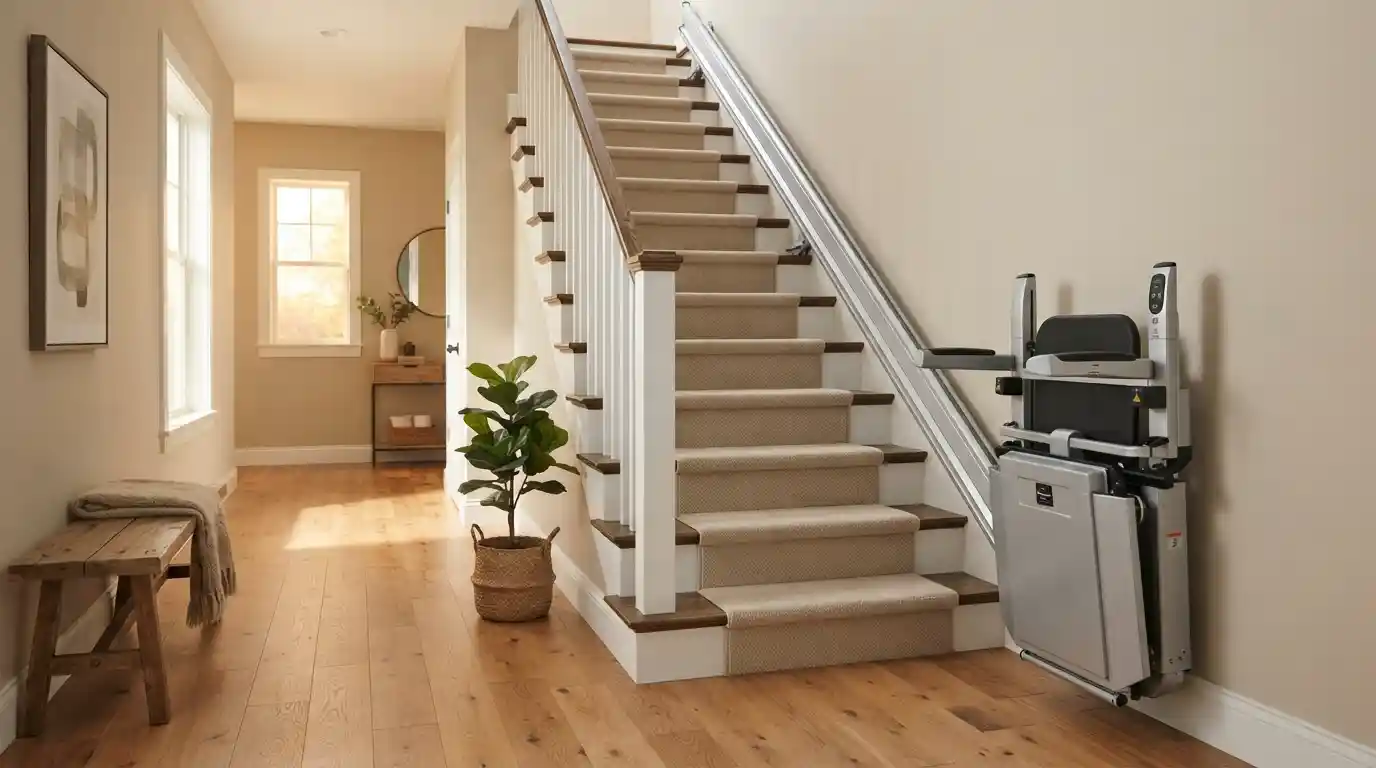
Most people searching for a platform stair lift for home installation expect a single number to fall out of a Google search. It doesn’t work that way, and I learned that the hard way while helping a family member sort through quotes. We got two bids for the exact same basic straight-rail unit same city, same staircase. Same everything on paper and one installer came back at $4,200 while the other wanted $9,800. Nobody warns you that the spread can be that wide before you’ve even picked a brand. This guide breaks down what actually drives the price of a platform stair lift for home use. So you know which questions to ask before you sign anything and roughly where your own project should land.
What Is a Platform Stair Lift for Home Use?
So what actually is this thing? A platform stair lift is a powered device that carries someone in a wheelchair or powerchair up and down a staircase on a flat, open platform instead of a seat. It rides along a track mounted either to the stair treads themselves or to an adjacent wall. Driven by a cable traction or rack-and-pinion mechanism that keeps the speed steady and predictable. What sets it apart from a standard stairlift chair is that the platform never tilts.
It stays level the whole ride, which means the person doesn’t have to transfer out of their wheelchair or rollator at all. I’ve talked to a couple of occupational therapists about this over the years. And that one detail is basically why they steer families toward platform units. Instead of seated lifts whenever full-time wheelchair use is part of the picture. It sounds like a small thing until you picture doing that transfer twice a day, every day.
There are really two flavors of this equipment. Inclined platform lifts, or IPLs, follow the shape of your existing staircase the same way a traditional stairlift would. Vertical platform lifts, or VPLs, skip the staircase entirely and just travel straight up through open air. More like a compact outdoor elevator bolted onto a porch or deck. Both get lumped under the “platform stair lift for home” search term. But they’re solving two pretty different access problems. And mixing them up is probably the single most common mistake I see people make when they start shopping.
Is a platform lift the same as a wheelchair lift?
On terminology “wheelchair lift” and “platform lift” get used interchangeably in most manufacturer catalogs. So don’t overthink it if you see both on the same website. Where it actually matters is that some installers reserve “wheelchair lift” specifically for the vertical style and use “platform stairlift” only for the inclined version. Worth a quick clarifying question before you assume a quote covers the configuration you actually need.
How Much Does a Platform Stair Lift for Home Cost?
Price swings mostly on two things whether your staircase is straight or curved. And whether the install needs real structural work like a pit or a shaft cut into the floor. German installers tend to publish fixed pricing more openly than US dealers do. Which makes them a useful reference point a straight-stair platform lift there runs around €10,300. A curved one climbs to roughly €16,500, and a vertical lift needing an on-site shaft can land anywhere from €26,000 to €32,000 once you add in VAT at 19%. Stateside, the numbers track a similar shape even if the currency’s different. Figure $3,000 on the low end for a basic straight indoor unit, and $15,000 to $20,000 or more once you’re talking a custom outdoor vertical lift with a full weatherproof enclosure.
Weight capacity and platform footprint push the number around too, and this part gets overlooked a lot. Standard units are rated around 225 kg, call it 500 pounds. But heavier-duty models go up to 300 kg or 750 pounds for the bigger powerchairs. A typical platform runs 1000 x 800 mm out of the box. Though I’d say custom fabrication comes up more often than not once you’re dealing with a tight entryway or an oddly shaped landing.
What’s the average cost of a home wheelchair lift installation?
Zooming into installation specifically straight-rail indoor jobs generally land between $4,000 and $9,000 fully installed. While outdoor vertical lifts for porches and decks run $8,000 to $18,000. Depending on how tall the lift needs to travel and how much weatherproofing it needs. If you see a unit rated IP65, built with stainless steel and fitted with a platform heater for freeze protection. Expect it to sit near the top of that range — you’re paying for it to survive winters, not just look nice.
Platform Stair Lift vs Vertical Platform Lift vs Home Elevator
Gradeability is the number I tell people to ask about first, honestly, more than price. Most inclined platform lifts handle a stair pitch between 20 and 50 degrees, which covers nearly every residential staircase out there, curves and intermediate landings included. But if what you’re actually dealing with is a raised porch or a deck rather than a full run of stairs, a vertical unit with around a meter of travel height solves that far more cheaply than trying to retrofit an inclined lift onto steps that barely exist in the first place. A genuine home elevator sits in a different category entirely — it needs an actual shaft or hoistway and real construction work, which is exactly why it costs multiples more and takes weeks instead of days.
Can a platform stair lift handle a curved staircase?
Curved staircases are absolutely still on the table — Bruno, Savaria, and Harmar all build curved platform lifts as standard catalog items, not special-order oddities. The cost bump comes from the custom rail bending, since the track has to be measured and fabricated to match your exact stairs rather than cut from stock lengths. Budget for 40 to 60% more than an equivalent straight-rail system, and don’t be surprised when a curved quote comes in noticeably higher than the flat number you had in your head.
Choosing an Installer and Getting a Real Quote
This is the part I’d tell a friend to slow down on. During the site visit, a certified installer should be walking you through platform size, finish options, and whether the job needs support posts or can just mount to an existing wall — if they’re quoting you sight unseen over the phone, that’s a red flag worth paying attention to. Push them specifically on whether the number includes delivery, installation, and a warranty period, because plenty of listed prices only cover the equipment itself. And check that whoever you’re working with carries TÜV inspection or an equivalent independent safety certification, plus a service schedule — once a year for indoor units, twice a year if it’s outdoor-rated and taking weather.
How many quotes should I get before choosing a platform stair lift for home?
Get at least two, ideally three, and make sure each one covers the same scope: same platform size, same weight rating, same warranty terms. A $6,000 quote missing a warranty isn’t actually cheaper than an $8,000 quote that includes two years of servicing — it’s a different offer wearing a smaller number.
Funding and Long-Term Costs
Don’t assume the sticker price is the final number, and don’t assume you’re paying it alone. In markets with long-term care insurance programs, subsidies of up to €4,000 have been available for qualifying home modifications, and equivalent grant programs exist through state and local accessibility funds in the US — availability varies by state, so this is worth confirming directly with your local aging-and-disability resource center rather than taking any single dealer’s word for it. Running costs stay low regardless: a 0.56 kW motor on 220V power draws roughly what a small space heater does, and most owners report running costs are a minor line item compared to the upfront installation.
Conclusion
A platform stair lift for home use isn’t a single product with a single price — it’s a category that spans a $4,000 straight-rail unit and a $30,000 shaft-mounted vertical lift, and the gap between them comes down to staircase shape, travel distance, and how much structural work the install actually requires. Get your scope defined before you compare quotes, confirm what’s included, and don’t skip the site visit. The equipment lasts for years; the decision is worth getting right the first time.
FAQs
How long does a platform stair lift last?
Most residential units last 10 to 15 years with regular servicing, similar to other mechanical home equipment like a garage door opener. Manufacturers with decades of track record, some citing 80+ years in the mobility equipment business, generally back their platform lifts with multi-year warranties on the drive unit specifically.
Can I install a platform stair lift myself?
No, professional installation is standard and often required to keep the manufacturer warranty valid. The rail mounting, electrical connection, and safety calibration need certified technicians, not a DIY weekend project.
Will a platform stair lift fit a narrow staircase?
In most cases, yes, since the platform folds flush against the wall when not in use and takes up minimal space during a ride. Very narrow staircases may need a smaller custom platform, which an installer can only confirm after an on-site measurement.
Does Medicare or insurance cover a platform stair lift?
Traditional Medicare typically doesn’t cover home stair lifts, though some Medicare Advantage plans and long-term care insurance policies offer partial reimbursement. Check your specific policy and ask your installer whether they provide documentation for insurance claims or state accessibility grant applications.