
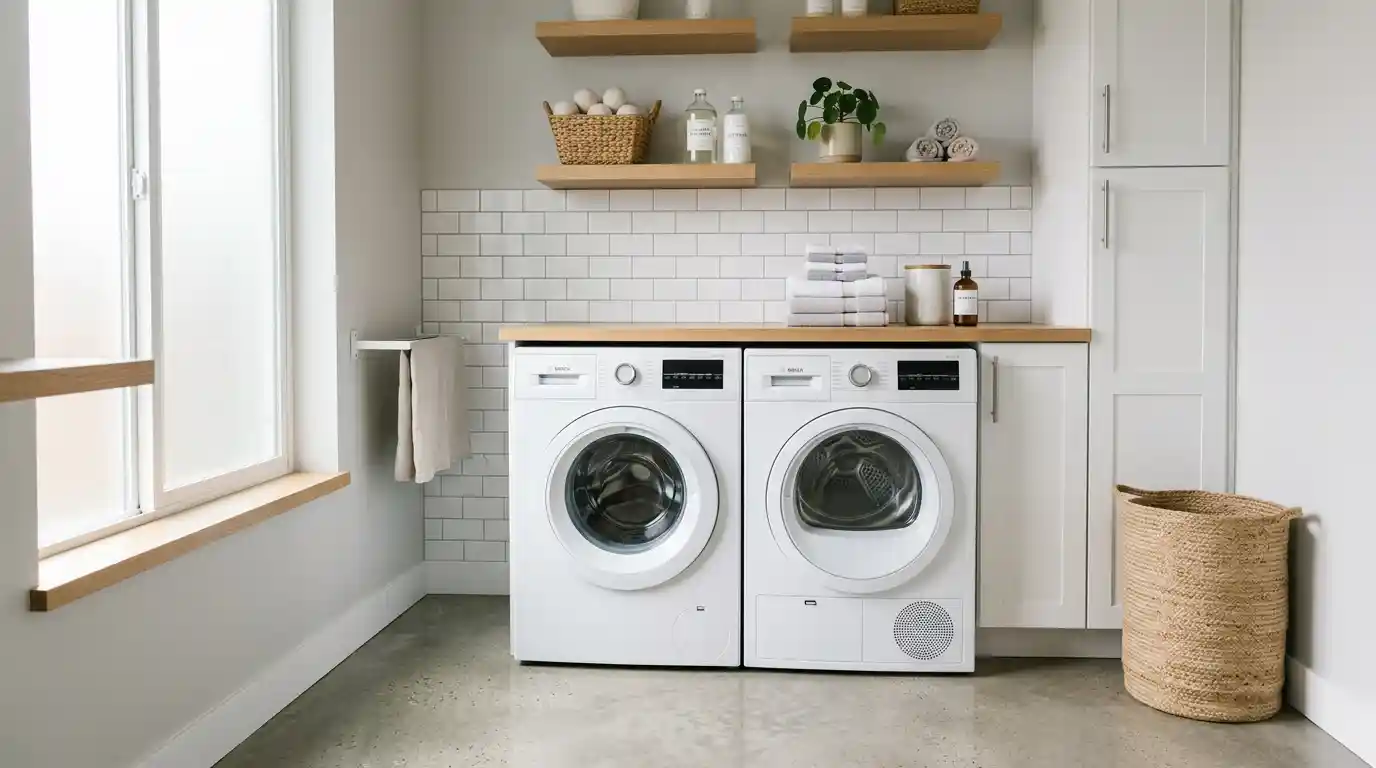
Here’s what actually happens. You spend forty minutes on a review site, pick a set that looks good, check the price, and order it. Then the delivery crew shows up, carries both machines into the laundry room, and one of three things goes wrong the door swing clears about two inches of space to load anything, the closet ceiling is 74 inches and the WashTower needs 76, or there’s no 240-volt outlet anywhere near where the dryer needs to sit. I watched this exact scenario play out for a couple in a Toronto condo last year. Beautiful LG set. Sat in their hallway for six days while an electrician sorted the outlet situation.
None of that is the appliance’s fault. It’s a planning failure, and it happens constantly because most buying guides skip straight to brand comparisons without covering the decisions that happen before you pick a brand.
So that’s where this starts.
A washer and dryer set is not just two matching home appliances. The moment you decide on a configuration stackable, side-by-side, all-in-one laundry center you’ve also decided on a floor footprint, an electrical requirement, a venting arrangement, and in some cases whether a plumber or gas technician needs to be involved. Figure that stuff out first. Everything else is easier once you know what kind of setup you’re actually working with.
The Configuration Decision Nobody Frames Correctly
Most laundry buying guides treat this as an aesthetic choice. It isn’t. Whether you go stackable washer and dryer, side-by-side, a modular laundry tower, or a compact washer and dryer set determines what installation looks like, what breaks first, and whether you can replace one unit without replacing both.
Side-by-side washer and dryer is the standard for a reason. Both machines sit at waist height, you load and unload without bending, and if the washer dies in year nine you replace the washer and keep the dryer. Simple. Standard full-size models run 27 to 28 inches wide and 30 to 35 inches deep and before you buy anything, measure the stairwells and doorways the machines have to clear on delivery day, not just the laundry room itself.
Stackable washer and dryer is what makes sense when you’re working with a laundry closet, a compact apartment, or any setup where floor space is genuinely scarce. The dryer sits on top via a stacking kit and I want to be clear that the stacking kit is not optional, it’s a structural requirement, not an accessory. What you also need to know: only front load washers can go vertical. Top load machines cannot be stacked, the drum orientation physically doesn’t allow it. If stackable is where you’re headed, you are buying a front-loader, no exceptions.
The LG WashTower and GE stacked laundry center take the stackable concept and build it into a single unit with one shared control panel at a sensible height. The WashTower is 76 inches tall check your ceiling clearance before ordering, not after. The real tradeoff with any single unit design is that when one component has a problem, both machines are down. For an apartment laundry closet that’s usually a reasonable compromise. For a household that does laundry every two days, it’s worth thinking about.
Compact washer and dryer sets at 24 inches wide are a different category entirely. Bosch, Miele, LG all three make compact laundry sets that fit in bathroom laundry nooks, hallway utility closets, Boston condo utility rooms, the kind of spaces where a full-size machine simply isn’t going. Drum capacity on compact models runs 2.3 to 2.8 cubic feet, which is fine for one or two people, less comfortable for a household doing daily loads of bulky items.
Front Load vs Top Load — and the Data People Ignore
This debate gets more airtime than almost any other appliance question, and most of the conversation is opinion dressed up as advice. The actual numbers are less complicated.
Front load washers use 40 to 60 percent less water per cycle. Spin speeds hit 1,200 to 1,600 RPM compared to the 850 RPM ceiling on many top load machines which means clothes going into the dryer are meaningfully drier before the drying cycle even starts. That gap in moisture content is not small. It shortens drying time, cuts energy consumption during the most power-hungry part of the whole laundry routine, and reduces wear on fabric over time. The horizontal drum rotation and tumbling action is also gentler on clothing than the agitator washing method that most top load machines use. Independent testing consistently shows front load washers running 25 to 50 percent more energy efficient overall.
Top load washers are faster on cycle times, cheaper upfront entry-level top load laundry pairs start around $800 to $950, front load sets generally open at $1,200 and climb from there and you can throw in that shirt you left on the bedroom floor mid-cycle by just lifting the lid. For people with mobility or back limitations, loading from the top without bending into a front drum is a real practical advantage. A pedestal drawer on a front-loader addresses some of that, but it adds cost and height.
High-efficiency top load washers without agitators close the performance gap considerably. If the budget ceiling is under $1,200 for the set and you don’t need 24-inch compact width, a solid HE top load pair from Whirlpool, Maytag, or GE is a perfectly legitimate choice. What it genuinely cannot do is stack. If there’s any realistic chance your next home has a laundry closet rather than a laundry room, a front-loader is the only configuration that stays flexible.
The Dryer Fuel Decision, and Why Heat Pump Changed It
This used to be a straightforward call. Gas dryer if you have a gas line faster drying times, lower long-term operating costs. Electric dryer if you don’t simpler installation, 240-volt outlet, done.
Heat pump dryer technology made this more interesting. Miele, Bosch, and LG all produce heat pump dryers now, running on a closed-loop refrigeration system with evaporator, condenser, and compressor that recycles hot air through the drum rather than exhausting it outside. What that produces in practice: the most energy-efficient dryer option currently available, a fully ventless design with no external duct requirement, and lower operating temperatures that are genuinely gentler on fabric longevity over years of use. A ventless washer dryer set with heat pump drying has become the standard for compact laundry installations across the US, UK, and most of Europe.
The tradeoffs are real though. Cycle times run longer than vented dryers. Purchase price is higher. And repairs when they happen require a technician who understands both appliance repair and refrigeration systems, which is a narrower field than general appliance service. Before buying a heat pump dryer, spend five minutes confirming there’s actually someone in your area who services them. In New York, Boston, Seattle, that’s no longer a question. In more rural areas it sometimes still is.
For homes with existing gas hookups and full-size laundry rooms, a gas dryer is still a solid option. Faster than standard electric, lower long-term energy costs compared to conventional electric models. New gas line installation runs $15 to $50 per linear foot, licensed professional work only, permit required.
Drum Capacity: What the Cubic Feet Number Actually Means
The spec that determines whether your weekly laundry routine stays manageable or becomes a grinding series of extra loads is drum capacity, measured in cubic feet.
Compact models at 2.3 to 2.8 cubic feet work for a single person or a couple without heavy weekly volume. Standard models in the 4.0 to 5.0 cubic feet range handle most two-to-four person households without running multiple small loads. Once you’re regularly washing king-size comforters, bulk bedding, or the kind of laundry load a large family generates that’s where high-capacity models at 5.5 cubic feet and above earn their cost. Washers above 4.5 cubic feet can fit a king-size comforter in independent lab testing without splitting it into two runs.
The thing most people miss: matching dryer drum capacity to washer capacity matters. A 5.0 cubic foot washer paired with a 7.4 cubic foot electric dryer gives clothes room to actually tumble in the drum, which is exactly how sensor dry technology works. The moisture sensor in the dryer drum needs air circulation around the load to accurately read dryness levels and stop the cycle before overdrying happens. A dryer drum the same size as the washer drum — or smaller extends drying times and puts unnecessary heat stress on fabric. Check both numbers, not just the washer’s.
Wash Cycles and Smart Features: What’s Worth the Price Difference
Modern laundry appliances have a lot of cycles. Most of them get used occasionally at best. The ones that consistently earn their keep in real households are narrower than the spec sheet suggests.
Steam wash is genuinely useful not a premium gimmick. Steam penetrates fabric in a way that water alone doesn’t, and for stain removal on items you can’t run through a full heavy duty cycle, it makes a real difference. The sanitize with OXI cycle handles the hygiene end higher wash temperatures for loads where bacteria or allergen removal matters. LG’s Allergiene cycle, independently AAFA-certified, removes pet dander and dust mite allergens using steam. That certification matters because it’s independently verified, not a brand claim.
TurboSteam on the dryer side can de-wrinkle a shirt in roughly ten minutes without rewashing it I use this more than I expected to, honestly. For households that regularly pull wrinkled clothes out of a dryer that sat overnight, it’s the feature that quietly saves time every week.
Sensor dry is non-negotiable in any dryer purchase in 2026. The moisture sensor stops the drying cycle when clothes reach adequate dryness rather than running a fixed time. It protects fabric, saves energy, and prevents the specific kind of wear that comes from overdrying synthetic fabrics at high heat cycles over years.
Quick wash cycle, delay start, heavy duty cycle for tough stains and bulky loads, gentle cycle for delicates these are the everyday workhorses and any mid-range laundry pair should have them. An automatic detergent dispensing system that doses based on load size is worth specifically looking for if you run HE washers overdosing HE detergent creates residue buildup in the drum and dispenser housing that causes more maintenance problems than most people attribute to the right source.
WiFi connectivity, remote start, and the LG ThinQ app are genuinely useful if you’re regularly running laundry while away from home and want end-of-cycle alerts so clothes don’t sit wet. For most households it’s a convenience feature, not a deciding factor.
Noise, Vibration, and the Floor Your Machine Sits On
Front-loaders vibrate. How much that matters depends almost entirely on what surface they’re sitting on a concrete slab absorbs vibration well, a wood floor amplifies it noticeably. If your laundry room is on the second floor, adjacent to a bedroom, or in a hallway closet near living spaces, the noise level during spin cycles becomes a real daily quality-of-life issue.
Bosch compact washers consistently test as the quietest in their class. Miele and LG sit close behind. For any laundry setup near sleeping or living areas, anti-vibration systems and direct drive or inverter motors should be specifically on the checklist. Direct drive motors connect to the drum without a belt or pulley, which reduces operating noise and eliminates one of the mechanical failure points that shortens appliance lifespan on belt-driven machines.
Second-floor installation compatibility is a separate question from noise not all full-size machines are manufacturer-rated for second-floor use. Confirm it in the product specs before delivery day, not on the morning a technician has to haul it back downstairs.
What a Washer and Dryer Set Actually Costs Right Now
Budget pairs Frigidaire, Amana, entry-level Whirlpool run $800 to $950 and deliver reliable performance without the features that make daily laundry noticeably easier. They work. They just work plainly.
Mid-range sets in the $1,200 to $2,000 range are where most buyers land, and honestly it’s where the value is. Samsung and LG dominate this tier — front-load efficiency, steam cycles, sensor dry, smart connectivity, real drum capacity. A well-chosen mid-range matching washer and dryer set will run a typical household for ten-plus years without drama.
Premium sets from $2,000 to $3,000 and above cover two different categories: compact luxury Miele and Bosch heat pump sets where you’re paying for quiet operation, heat pump energy efficiency, and long-term build quality — and high-capacity flagship models for large households. Both categories have buyers for whom the premium is justified.
Installation costs are a separate budget line. Gas line work runs $15 to $50 per linear foot if needed. Stacking kit is $20 to $75. Pedestal drawers run $150 to $300 each. Delivery and haul-away of the existing set — some retailers include this, many charge separately. Add it to the total before comparing prices across stores.
Maintenance: the Unglamorous Part That Determines Whether You Hit 12 Years or 7
Front-load washers average 10 to 13 years lifespan. Dryers typically reach 10 to 15 years with reasonable care. The distance between reaching those numbers and falling short comes down to a handful of maintenance habits most people don’t start until something smells or stops working.
The door gasket on a front-load washer traps moisture after every cycle. That trapped moisture is where mold and odor buildup originate the most common complaint about front-load machines, and the one most frequently blamed on the machine rather than the habit that causes it. Wipe the gasket after use. Leave the door cracked between cycles. Run the tub clean cycle monthly. Clean the detergent drawer before residue hardens in the dispenser housing.
Use HE detergent. Specifically formulated for low-water high-efficiency machines, producing low suds and avoiding the residue buildup that standard detergent causes in a drum that uses a fraction of the water a conventional washer does. This one matters more than most owners realise until the wash cycle starts leaving white film on dark clothing.
Clean the lint trap after every single dryer load this is not periodic maintenance, it’s every load. Lint buildup in the vent duct on a vented dryer is a genuine fire hazard. Heat pump dryers need periodic condenser cleaning; Bosch’s self-rinsing condenser system that uses evaporator moisture to clean itself during the cycle is a genuine long-term ownership advantage over manual condenser cleaning on competing models.
Warranty coverage on the motor, drum, and heating elements specifically not just the general warranty period is worth reading before purchase. Extended warranties from brands with strong local service networks are worth it on premium machines. Confirm the service locator for your area before buying, because the most common maintenance regret isn’t skipping the warranty, it’s discovering there’s no local service option after the fact.
Conclusion
Buying a washer and dryer set is one of those purchases that quietly shapes how your household runs every single week for the next decade or more. Get the configuration wrong and you’re working around it forever wrong fuel type, undersized drum, a stackable setup on a floor that vibrates, a heat pump dryer in a town with one appliance technician who’s never opened one. None of that is dramatic. It’s just low-grade friction that compounds over years.
The people who end up genuinely satisfied with their matching washer and dryer aren’t the ones who found the best deal or picked the highest-rated model on a review site. They’re the ones who measured the space first, confirmed the electrical setup, matched drum capacity to their actual laundry volume, and picked a fuel type that made sense for their home not the one that looked best in a spec comparison. That’s the whole game, really.
A quality washer and dryer set should disappear into your routine. You shouldn’t be thinking about it. It runs, it cleans, it dries, the lint trap gets cleaned, and ten years pass without incident. That’s what you’re actually buying — not features, not a brand, not a colour that matches the laundry room wall. A decade of laundry days that don’t require your attention.
FAQs
Before buying a washer and dryer set, check your available space, electrical requirements, ventilation setup, and the type of laundry configuration that fits your home. Measuring doorways, closets, and installation areas before ordering can prevent delivery and setup problems.
Front load washers are generally more energy-efficient, use less water, and provide stronger spin performance, which helps clothes dry faster. Top load models are usually more affordable and offer shorter wash cycles, making them a practical choice for buyers with tighter budgets.
A stackable washer and dryer is ideal for smaller spaces such as apartments or laundry closets because it saves floor space. Side-by-side machines provide easier loading access and allow you to replace one appliance without replacing the entire set.