
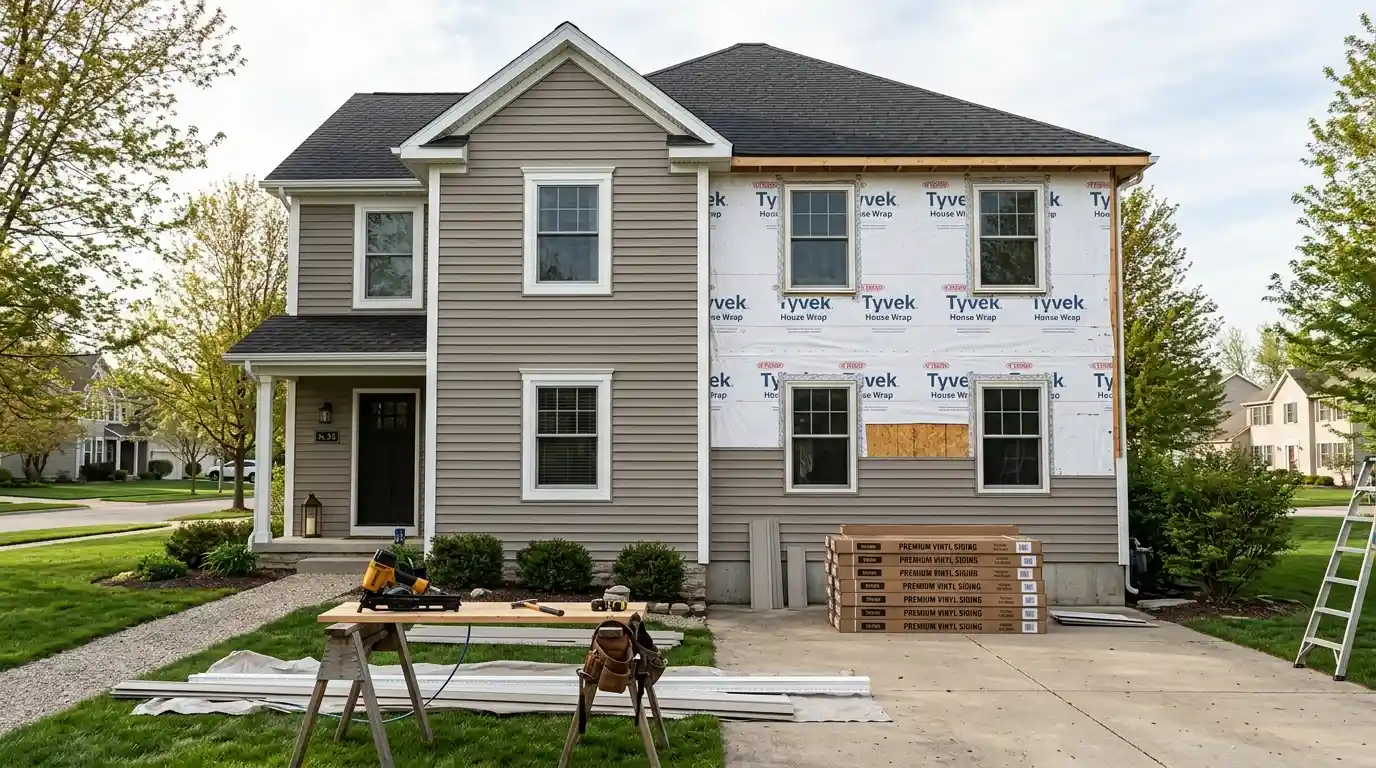
The number that comes back on a vinyl siding estimate rarely surprises anyone in the right direction. Most homeowners go into the quote process expecting to pay somewhere in the middle of what they’ve read online, and most come out of it having learned that the middle was a fiction built from national averages that don’t account for their specific house, their specific location, or the specific grade of material the contractor defaulted to without discussing it first.
I’ve seen this play out from both sides of the estimate as someone who has walked properties with contractors and as someone who has helped homeowners decode quotes that arrived with line items missing or material specifications buried in language that assumed nobody would ask. The vinyl siding cost conversation is not complicated once you understand what’s actually driving the number.
The grade of vinyl. The style profile. The square footage of the exterior, not the living space. The labour share of the total. The old siding removal that sometimes appears and sometimes doesn’t. And the installation timing that most guides mention in passing and most homeowners ignore until the contractor tells them the next available slot is four months away.
The Grade Decision That Changes Everything Before a Single Panel Goes Up
Vinyl siding cost begins with grade selection, and most homeowners make this decision without fully understanding what they’re choosing between. Builder’s grade vinyl siding sits at 0.040 inches — the thinnest option, the most affordable, and the least durable across freeze-thaw cycles, wind exposure, and UV degradation over time. It costs between $2 and $6 per square foot depending on style, and in sheltered suburban settings with moderate weather exposure it performs adequately.
The problem is that builder’s grade vinyl is also the option contractors default to when grade isn’t specified in the scope of work, which means the homeowner who asked for “vinyl siding” without specifying grade may be getting the cheapest available product at a price that didn’t signal that.
Standard residential vinyl siding at 0.042 inches adds meaningful durability without a dramatic cost premium the price range runs $4 to $7 per square foot, and for most mid-range residential exterior renovation projects it represents the right balance between vinyl siding budget and vinyl siding lifespan. Premium grade vinyl siding at 0.046 inches costs $6 to $10 per square foot, delivers superior impact resistance, better noise reduction, and significantly better warping prevention and sagging vinyl siding resistance over a 20 to 40 year service life. Superthick grade vinyl sits above that, with some premium profile products reaching $12 per square foot or beyond.
Insulated vinyl siding sits in its own category. The foam-backed panels at 0.05 inches or thicker paired with rigid foam insulation for genuine thermal performance improvement cost $7 to $12 per square foot installed, making insulated siding the most expensive vinyl option by a meaningful margin. The insulated siding payback calculation matters here: in cold climate zones, heating bill reduction across five to ten years can offset the cost premium meaningfully. In temperate climates or well-insulated homes, the R-value improvement delivers less practical return per dollar spent. Match insulated vinyl siding cost to climate and existing insulation levels rather than selecting it because it sounds like the premium choice.
Style Profiles and What They Add to the Material Line Item
The vinyl siding style profile shapes both the material cost and the labour cost simultaneously a fact that gets underweighted in most vinyl siding cost guides that list profiles with price ranges but don’t explain why those ranges exist.
Horizontal lap siding at the basic end clapboard style, standard horizontal profile runs $2 to $7 per square foot in material cost. It’s the simplest installation pattern, the most forgiving for less experienced crews, and the most widely available from manufacturers including CertainTeed vinyl siding, Ply-Gem vinyl siding, Alside vinyl siding, Georgia Pacific vinyl siding, and Crane vinyl siding. Dutch lap siding adds a decorative shadow line and sits slightly above standard lap in both material cost and cutting precision requirement. Beaded siding adds a bottom-edge bead detail that reads as more refined at street level modest material premium, minimal labour impact.
Board and batten siding costs $3 to $8 per square foot and has grown significantly in popularity on farmhouse style and transitional exterior homes over the past three years. The vertical orientation requires different fastening sequences and more precise alignment than horizontal profiles, which adds labour time on complex facades. Scallop siding and shingle siding profiles the decorative vinyl siding options most often used as accent sections on gables or upper storeys rather than full-facade coverage run $5 to $10 per square foot, with the labour cost climbing on multi-story homes where scaffolding and safety harness requirements apply.
The wood grain vinyl siding and textured vinyl siding profiles that dominate the premium end of the specialty profile vinyl market cost more because the surface treatment requires thicker gauge material to hold the embossed detail across temperature cycling. These profiles also generate more installation waste because cutting to pattern alignment adds material loss beyond what standard lap installation produces. The waste factor in the material quantity calculation typically 10% to 15% on standard profiles, up to 20% on complex patterns or homes with many penetrations is worth confirming in any written estimate before the material order goes in.
The Labor Share Nobody Explains Until the Estimate Arrives
Labor accounts for 60% to 70% of total vinyl siding cost on most residential projects a figure that surprises homeowners who expected materials to dominate the budget. The $3.70 per square foot average labor cost sits within a range of $2.15 to $5.25 per square foot depending on location, architectural complexity, and site conditions.
Geographic labor variation is real and significant. Vinyl siding labor cost in New York reaches $14,400 in total project terms for a mid-size home. The same project in Houston comes in at $7,100. Boston runs higher still at $16,500. Rural and lower cost-of-living markets cut those labour figures substantially sometimes half the urban rate for comparable work and comparable material. The material transport cost and shipping cost from manufacturer to site also varies by location, adding overhead costs for contractors in markets distant from major distribution warehouses.
Multi-story home siding cost carries a labour premium that compounds the base rate. A second storey means ladders, scaffolding, and safety harnesses where a single-storey ranch home needs none. Dormers, bay windows, eaves, and gables require additional measuring, cutting, and fitting that adds labour hours without adding linear footage of siding in any simple way. Each architectural feature is a slow-down point in the installation timeline that the contractor prices per hour, not per panel. A simple box-shaped single-storey home and a two-storey home with dormers and an irregular roofline can carry dramatically different labour costs for identical square footages of installed vinyl a fact that the per-square-foot national average obscures entirely.
Installation timeline typically runs one week for the siding installation itself, with the full removal and replacement process running up to two weeks including old siding removal, surface preparation, moisture barrier installation, and cleanup. The cleanup cost and waste disposal cost dumpster rental or contractor-managed disposal should appear as a line item in any detailed estimate. When it doesn’t, it typically gets added as a project extra siding charge after the work is underway.
Old Siding Removal, Permit Costs, and the Line Items That Grow the Budget
Old siding removal is the budget variable that produces the largest gap between the headline vinyl siding estimate and the actual total project cost. Removal costs run $0.70 to $2.00 per square foot for the labour alone, with total old siding removal cost landing between $1,000 and $3,000 depending on the property size and the condition of what’s being removed. Tear down of old materials plus disposal fees sits at $2,050 to $3,750 on average for a standard residential project.
The alternative installing vinyl over old siding saves the removal cost but adds weight to the wall assembly, may void the new material’s manufacturer warranty, and can conceal underlying moisture damage, wood rot, or sheathing failure that would have been visible and correctable during proper removal. The install over old siding decision is one where short-term budget saving has documented long-term costs that most homeowners discover only after the new vinyl is already on and the practical home tips that prevent the expensive siding mistakes consistently flag substrate inspection as the step that separates a siding project that compounds in value from one that compounds in future repair cost.
Structural repair cost, sheathing repair, house wrap replacement, and Tyvek replacement are the sub-surface costs that surface during proper removal projects and that experienced contractors include as contingency allowances in written estimates. Any vinyl siding estimate that arrives as a single total figure with no contingency language deserves a direct question about how unforeseen substrate damage will be priced. The answer distinguishes contractors who have done this enough to know what they’ll find from those pricing optimistically to win the job.
Building permit siding requirements vary by municipality some jurisdictions require permits for full siding replacement, some don’t. The permit cost where required runs $150 to $500 depending on the locality. Window trim cost, soffit cost, fascia board cost, corner trim cost, J-channel cost, and starter strip cost round out the additional cost factors that sit below the main siding line in most estimates. These trim and accessory costs add $1,500 to $4,000 on a typical project and should be itemised rather than bundled.
When to Buy, Who to Hire, and What 82% ROI Actually Means
The 82% return on investment figure from the NAR Remodeling Impact Report for vinyl siding is the number the industry cites most frequently. What it means practically is that $12,000 in vinyl siding cost produces approximately $9,840 in home value increase at resale a genuine return on a home exterior upgrade, better than most interior renovation categories, and consistently supported by the curb appeal vinyl siding delivers at the listing stage.
The timing of the project affects the vinyl siding budget directly. Summer is peak season for siding contractors demand is highest, contractor availability is tightest, and pricing reflects both. Fall and winter installations are when siding contractors have better availability and more competitive pricing, with spring installations offering a middle position between peak and off-season rates. The 5% to 10% material price increase noted across the industry in 2026 from supply chain and manufacturing cost pressures means that delaying a project expecting prices to drop is a questionable strategy material prices for vinyl siding have not moved back toward 2023 levels and the trajectory has not indicated they will.
Paying to paint vinyl siding $1 to $3 per square foot is the lower-cost alternative to full replacement when the panels are structurally sound but faded or dated in colour. The consideration is that painting vinyl siding may void the manufacturer warranty, and faded vinyl siding that has lost surface integrity doesn’t hold paint the way sound panels do. The paint vs replace vinyl siding decision is worth a direct inspection conversation with a contractor before committing to either budget.
Conclusion
Vinyl siding cost is not a single number. It is the sum of a grade decision, a style profile choice, a labour market reality, a substrate condition that nobody knows until the old siding comes off, and a timing call that affects both contractor availability and material pricing. The homeowner who understands those five variables before the first contractor arrives on site is the one whose final invoice lands closest to the original estimate and whose finished project performs the way the warranty says it should.
The 82% ROI figure from the NAR report is real, but it assumes correct grade selection for the climate, proper installation by a qualified contractor, and a finished product that genuinely improves curb appeal rather than simply replacing one tired exterior with another. Builder’s grade vinyl on a premium home in a hail-prone climate is not an 82% ROI project. Premium grade insulated vinyl correctly installed on a cold-climate property that was losing heat through a failing exterior wall absolutely can be.
Get three written estimates with matching scopes. Confirm the grade specification in each one. Ask what the old siding removal and substrate repair contingency looks like in writing. Check the manufacturer warranty terms before signing anything. Schedule in fall or winter if the project timeline allows. None of those steps are complicated. All of them are skipped more often than they should be and the vinyl siding cost surprises that homeowners write about online almost always trace back to one of them.
FAQs
Vinyl siding cost depends mainly on the siding grade, profile style, exterior square footage, labour rates, removal requirements, and installation conditions. The final price can vary significantly because every home has different materials, layouts, and location-based costs.
Vinyl siding prices vary by grade and type. Builder-grade vinyl may cost around $2–$6 per square foot, standard residential options often range from $4–$7, while premium and insulated vinyl siding can reach $10–$12 or more per square foot depending on the product and installation needs.
Removing old siding is usually the better long-term approach because it allows contractors to inspect the wall structure, repair moisture damage, and install the new siding correctly. Installing over existing siding may reduce upfront costs but can hide problems and affect warranty coverage.