If you have ever stood inside a half-finished house on a windy day and felt a draft cut through the framing, you already understand why house wrap matters. After all, this is not just a layer of plastic sheeting. It is, in fact, the difference between a home that holds up for decades and one that quietly rots from the inside out. Moreover, after years of working on building projects, I can tell you that DuPont Tyvek House Wrap is the product contractors and builders trust most consistently.
What Is DuPont Tyvek HomeWrap?
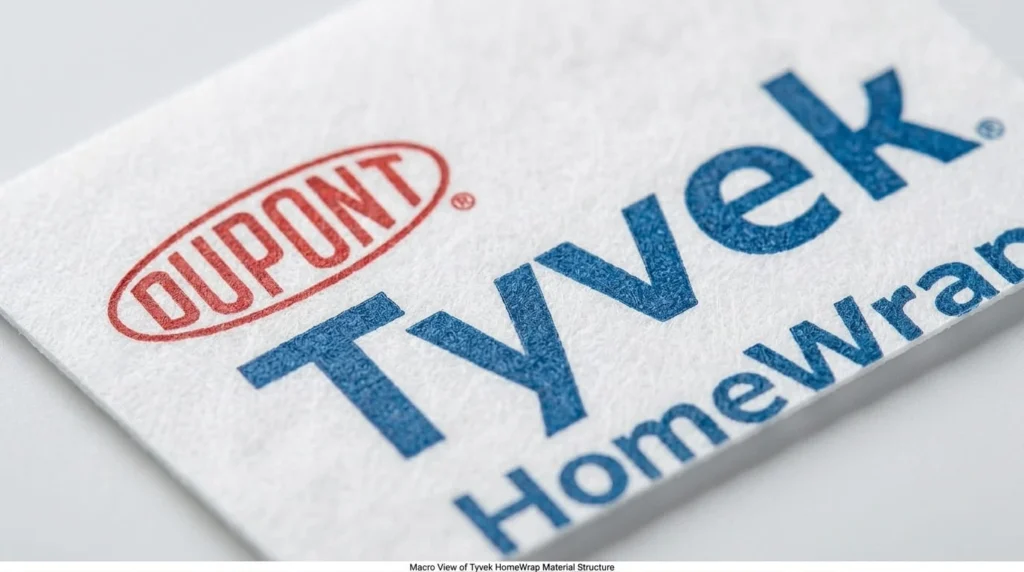
DuPont Tyvek HomeWrap is the original house wrap. Over the decades, furthermore, it has earned that title through real-world performance. Specifically, it starts as a nonwoven, nonperforated sheet made from spun high-density polyethylene (HDPE) fibers. Those fibers fuse into a tight, uniform web. That web, consequently, creates millions of tiny pores. These pores let moisture vapor pass through freely. At the same time, they block bulk water and air penetration from ever getting in.
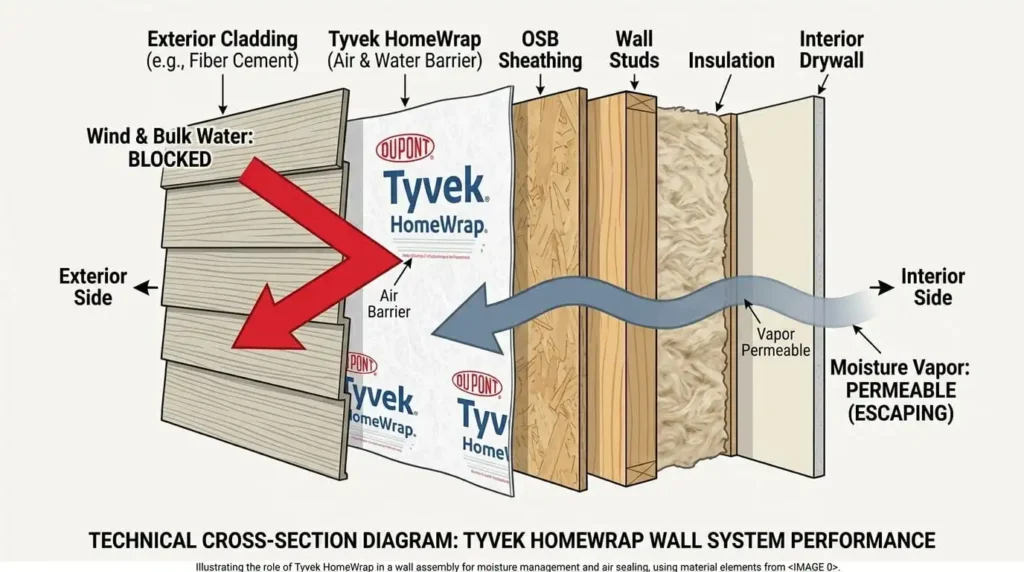
As a result, you get a breathable yet highly protective building envelope layer. This layer sits between your exterior cladding and your wall systems. Additionally, it keeps wind and rain out while letting trapped moisture vapor escape a balance that is genuinely difficult to engineer at scale.
How Tyvek HomeWrap Protects Your Home:
Air and Water Barrier Performance:
At its core, Tyvek House Wrap works as both an air barrier and a water barrier. Specifically, the air penetration resistance sits at less than .004 cfm/ft² at 1.57 psf. This meets ASTM E1677 Type I air barrier standards. On the water side, moreover, it achieves water penetration resistance of 250 cm per ASTM E96. Additionally, drainage efficiency exceeds 90% under ASTM E2273 testing.
In plain terms, wind-driven rain will not push through this WRB. Furthermore, any moisture that gets trapped inside your wall systems has a clear escape path. The vapor permeability rating of 5 perm minimum ensures that. As a result, mold and water damage struggle to take hold. Consequently, your wall systems stay healthier for much longer.
Energy Efficiency and Insulation Performance:
One of the most underappreciated benefits of quality house wrap is what it does for energy efficiency. By stopping air movement through walls, Tyvek House Wrap helps your insulation reach closer to its full R-value. Without a proper air barrier, even the best insulation underperforms. Outside air leaks in. Conditioned air leaks out. Therefore, your system works harder than it should.
Over time, this directly affects your HVAC efficiency and monthly energy bills. Moreover, homes wrapped with Tyvek House Wrap stay cooler in summer and warmer in winter. They also stay drier all year round. For anyone building a new home or tackling a serious renovation, that ongoing saving is real money. Ultimately, the long-term return on this single building envelope layer is hard to ignore.
Key Features Worth Knowing:
Ease of Installation:
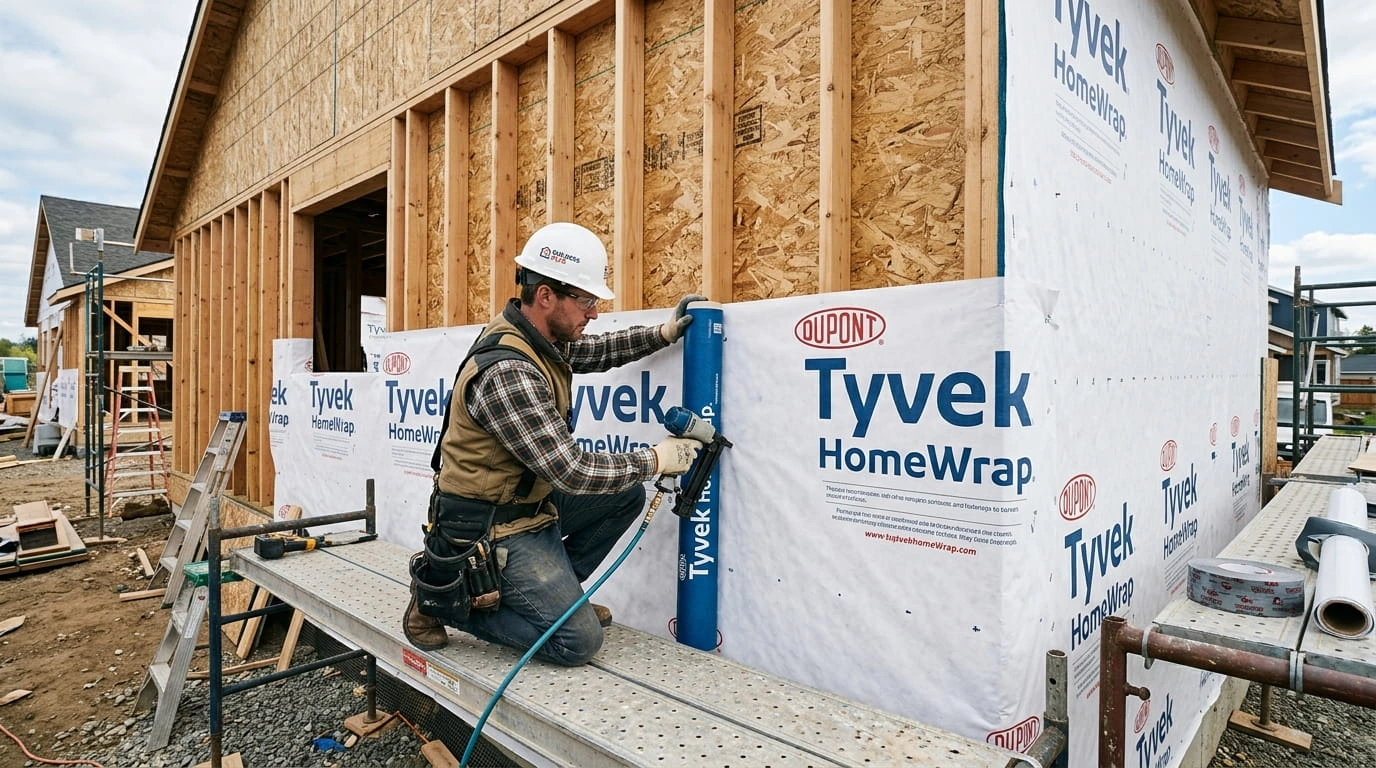
Builders consistently appreciate how straightforward Tyvek House Wrap is on site. First, the material is translucent. This gives installers a clear view of studs and the sheathing surface right away. Additionally, it clings naturally to the house during installation. That clinginess keeps things manageable even on windy days.
Furthermore, it works with standard adhesives and sealants without any complications. It also installs quietly, which helps on busy job sites. In terms of strength, the tear resistance rating of 8/6 lbs per ASTM D1117 holds up well under construction site demands. As a result, installers spend less time managing the material and more time moving the job forward.
Durability and UV Resistance:
Tyvek House Wrap handles the full construction window without breaking down. For instance, it withstands up to 120 days of UV exposure before cladding needs to go up. In addition, the maximum in-service temperature reaches 180°F. The polymer construction resists rust, rot, and degradation unlike paper-based alternatives. Moreover, the basis weight of 1.8 oz/yd² keeps the material light enough for a two-person crew.
A standard 9-foot roll weighs just 16.875 lbs. Finally, it meets ASTM E84 standards with a flame spread index of zero — a critical detail for residential and commercial code compliance.
Fire Performance:
It meets ASTM E84 standards for surface burning characteristics, with a flame spread index of zero a detail that matters for residential and commercial building code compliance across most markets.
Available Sizes:
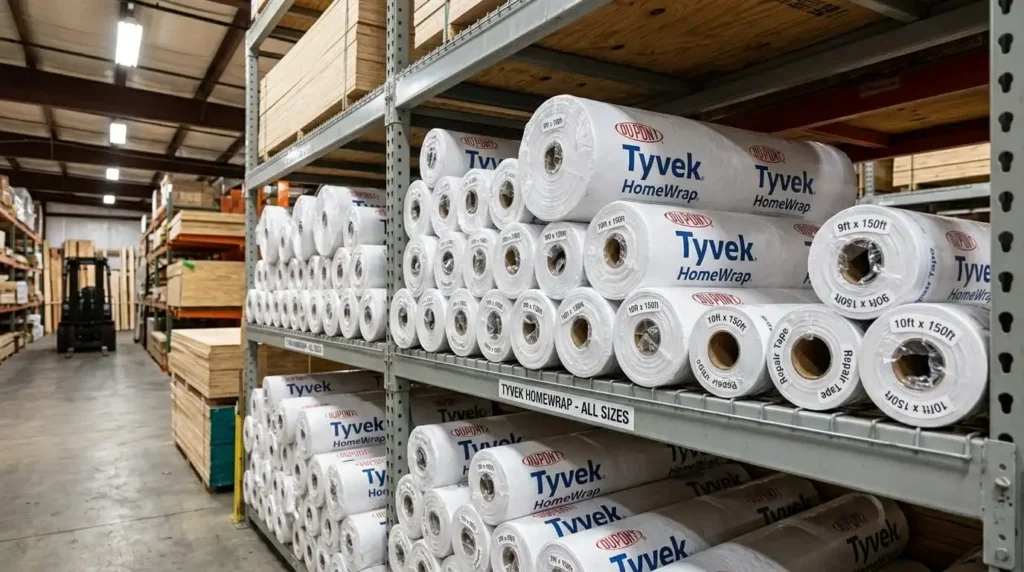
Tyvek HomeWrap comes in a range of standard roll sizes to fit different project scales:
- 3 ft x 100 ft
- 3 ft x 165 ft
- 5 ft x 200 ft
- 9 ft x 100 ft
- 9 ft x 150 ft
- 10 ft x 100 ft
- 10 ft x 150 ft
The 3 ft x 100 ft roll — SKU 3THW, Model TY3100 is the most commonly used size for smaller residential jobs and renovation projects, and it is available at suppliers like Hamshaw Lumber for around $79.99.
Where Tyvek HomeWrap Fits Best:
Tyvek House Wrap performs well across many different applications. First and foremost, builders choose it for new construction where the building envelope starts from scratch. However, it works just as well in renovation projects. In those cases, contractors replace old cladding and need a reliable water resistive barrier before new materials go up.
Beyond that, it suits both residential and commercial work equally. Whether you run a large contractor operation or tackle a serious DIY renovation, the installation process stays manageable. That said, always follow DuPont’s installation guidelines carefully. Pay particular attention to window and door flashing details. Doing so ensures the drainage plane stays continuous across the entire building envelope.
One Important Thing to Watch:
If your project runs long and the 120-day UV limit passes, two options exist. On one hand, you can install a fresh Tyvek WRB layer directly over the existing one. On the other hand, you can remove the old layer and replace it entirely. Either way, the new layer must integrate properly with your window and door flashing. This step protects drainage plane continuity throughout the whole system.
It is also worth noting that a two-layer system reduces overall permeability. Therefore, contact a DuPont Building Envelope Specialist before making that call. In short, planning your timeline around the 120-day limit from day one saves considerable hassle later.
The Bottom Line:
There is a clear reason DuPont Tyvek House Wrap holds its position as the leading house wrap. The HDPE fiber technology delivers. The breathable yet water-resistant structure performs consistently. Furthermore, the proven ASTM test results back up every claim on the label. Whether you build from scratch or wrap an existing structure during renovation, this house wrap pays off quietly. Lower energy bills, fewer moisture problems, and lasting structural integrity follow naturally. Ultimately, Tyvek House Wrap remains one of the most reliable choices in the building envelope category full stop.
Conclusion:
Choosing the right house wrap is never a small decision. After all, it sits behind every wall and silently protects everything you build. DuPont Tyvek House Wrap has earned its reputation through real job sites and real weather conditions. Furthermore, its ASTM-tested performance holds up under genuine scrutiny. From HDPE fiber construction and breathable vapor permeability to 120-day UV resistance and proven drainage efficiency, every detail points toward long-term building envelope protection. Moreover, whether you are a seasoned contractor on a large commercial job or a homeowner managing a serious renovation, Tyvek House Wrap removes one major worry from your list. In the end, that kind of peace of mind is worth every penny.
FAQs
DuPont Tyvek House Wrap is a breathable building envelope material made from high-density polyethylene (HDPE) fibers that protects walls from air and water intrusion while allowing moisture vapor to escape. It is installed behind exterior cladding to help maintain healthier and more durable wall systems.
Tyvek House Wrap works as both an air barrier and water-resistant barrier by blocking wind-driven rain and reducing unwanted air movement through walls. Its vapor permeability allows trapped moisture to leave the wall assembly, helping reduce the risk of mold and water damage.
Tyvek House Wrap is valued for its breathable design, durability, UV resistance, and consistent performance compared with paper-based alternatives. Its HDPE fiber construction helps it resist rot and degradation while providing reliable building envelope protection.
1 thought on “DuPont Tyvek House Wrap: The House Wrap That Actually Does What It Promises”