
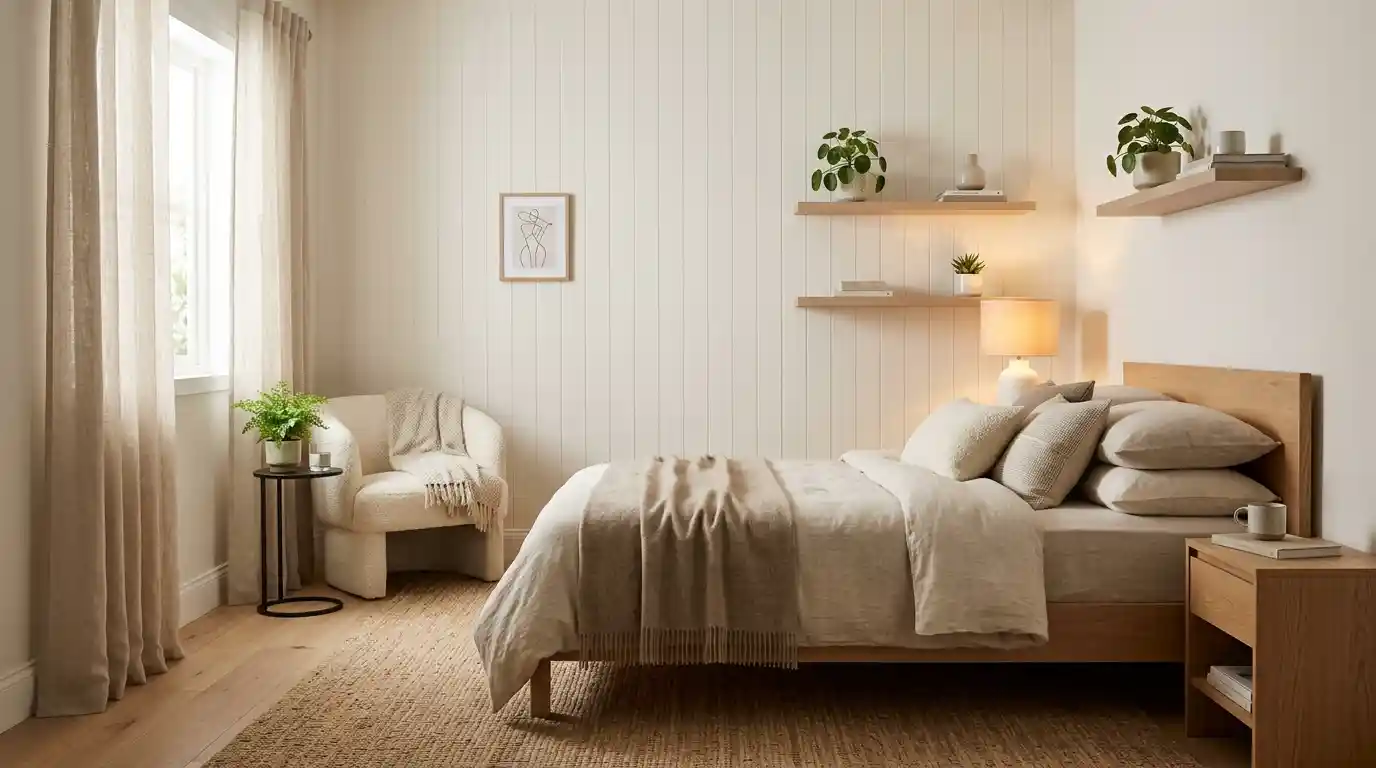
The smallest bedroom I ever styled properly was about 9 by 10 feet barely bigger than a generous walk-in wardrobe in a Victorian terrace that had been converted into flats. The owner wanted it to feel like a sanctuary rather than a storage cupboard. What made it work wasn’t a clever trick or a single piece of furniture. It was a decision made early on to stop trying to fight the room’s size and start working with what the constraints actually forced: intentional design, every piece earning its place, nothing decorative that didn’t also do something functional. By the time we were done, the room felt settled and personal in a way that larger, loosely furnished bedrooms often don’t.
Small bedroom style ideas that hold up aren’t about making a room look bigger by fooling the eye, though some visual techniques genuinely help. They’re about understanding what makes a compact space feel good to actually be in the lighting, the materiality, the restraint in how much gets brought into the room and then building out from that foundation rather than trying to squeeze a large-room aesthetic into a small footprint.
The Style Decisions That Work Hardest in a Small Bedroom
The first question worth settling before anything else: what’s the room’s primary job? A guest bedroom has different needs than a primary bedroom shared by two people, which has different needs than a teenage girl’s room doubling as a study space. Small bedroom style ideas that work well treat the room’s function as the design brief, not an afterthought.
Warm minimalism is the aesthetic that consistently performs best in compact bedrooms, not because it’s currently trending though it is but because it’s structurally suited to small spaces. A muted green bedroom with pale wood furniture and layered neutral bedding doesn’t feel sparse because the texture does the visual work that color and volume would do in a larger room. Tonal layering boucle chair, linen bedding, woven bench, chunky knit throw all sitting within the same warm neutral palette creates depth without visual competition. Nothing competes, nothing overwhelms, and the room feels settled rather than squeezed.
The Nancy Meyers bedroom aesthetic soft lighting, creamy tones, flowing curtains, the impression that the room has been lived in gently and well translates remarkably well into small spaces because it’s built on comfort and restraint rather than scale. Similarly, the Scandinavian bedroom style works in a 10×10 room because low-profile furniture, open sightlines, and pale woods keep visual weight low while natural materials and textile depth prevent it from feeling clinical. Japanese minimalism applied to bedroom design goes further still fewer pieces, more breathing room between them, an understanding that empty space is as intentional as filled space.
Organic modern bedroom style is the 2026 iteration of all of this: curved silhouettes on furniture to soften the straight lines of walls and built-ins, warm wood tones that feel grounded without going rustic, layered neutrals punctuated by one material that carries real texture a sculptural rug, a macramé throw draped over the bed rather than hung on the wall, a bouclé chair tucked into the corner with a slim side table beside it. It’s polished without being precious, and it scales down better than most styles because its character comes from texture and form rather than from room-filling statements.
For a cozy cabin bedroom or rustic modern bedroom, deep olive walls and cinnamon-toned linen create a cocoon-like feel that works specifically well in rooms with sloped ceilings the enclosure that would feel oppressive in a standard palette feels intentional and warm when the colors lean into it. A dark wall color in a small bedroom sounds counterintuitive and consistently works when the textiles stay light enough to hold the space from closing in entirely.
Furniture, Layout, and the Sizing Decisions That Change Everything
The bed is the piece that determines everything else. In a small bedroom, the bed frame style isn’t just an aesthetic choice it’s a spatial decision. A low-profile bed or platform bed keeps visual weight low, making the ceiling feel higher by comparison. A raised platform bed with built-in drawers underneath solves two problems simultaneously: it defines the sleeping zone clearly and eliminates the need for separate storage furniture that would eat into the remaining floor area. A Murphy bed or fold-down bed is the extreme version of this logic the room becomes something else entirely during the day and is particularly worth considering in studio apartment bedrooms where the bedroom is also the living space.
The built-in bed nook is the 2026 development worth paying attention to for small bedrooms specifically. Drawers below the mattress, built-in bookcases or hidden storage to the side panels, the bed framed architecturally rather than sitting free in the room it reads as custom design rather than space-saving compromise, and it creates storage capacity that freestanding furniture can’t match in a compact footprint.
Multifunctional furniture is the operating principle throughout. An ottoman with storage. A floating desk that folds away. A storage bench at the foot of the bed that seats guests and holds linens. Slimline furniture with narrow profiles a curved nightstand rather than a wide bedside table, a slim side table beside the reading chair rather than a full nightstand on both sides. The goal isn’t minimalism for its own sake it’s ensuring that every piece earns its floor space by doing more than one thing.
The most consistent furniture mistake in small bedrooms is oversizing. A queen bed pushed against the wall with no clearance on either side, a double wardrobe that blocks natural light, a statement armchair that’s beautiful in the showroom and claustrophobic in a 9×10 room. Measuring before buying is the unglamorous piece of advice that prevents the expensive rearrangement problem. Furniture that sits at or below eye level when you’re standing — low-slung sofas, platform beds, low floating shelves keeps the upper portion of the room visually open, which is the spatial quality that makes compact bedrooms feel like rooms rather than boxes.
The reading nook is the secondary zone that transforms a small bedroom from sleeping-only to genuinely habitable for the whole day. A bouclé chair or low curved seat near a window, a floor lamp beside it, a small bookshelf or floating shelf within reach it defines a zone within the room without requiring a wall or a room divider, and it turns a corner that usually holds nothing into the most used spot in the space.
Color, Light, and the Visual Techniques Worth Actually Using
Light colors open space this is repeated so often in small room design guides that it barely registers anymore, but it’s true in a specific way that’s worth understanding properly. Warm white walls don’t make a room bigger. They make the eye move around the room more freely rather than stopping at the walls, which creates a sense of expansiveness that’s perceptual rather than actual. The same principle explains why a neutral color palette in a small bedroom creates more apparent space than a dark or bold one unless the dark or bold color is applied in a way that creates atmosphere rather than compression, which the cozy cabin and soft glam approaches do successfully.
Vertical lines are the most reliably useful visual trick in a compact bedroom. Vertical wood slats on one wall, vertical wall paneling or shiplap, vertical stripe bedding, curtains hung high above the window frame and extending down to the floor all of these draw the eye upward and make the ceiling feel higher than it is. The same height benefit comes from a tall plant in a corner, which also brings biophilic bedroom design into play without requiring a garden-scale intervention.
Mirrors placed to reflect natural light, a round mirror above a floating desk, mirrored accents on furniture these expand perceived space without cluttering visual surfaces. A large mirror leaning against a wall rather than hung takes up no wall space and reflects the full depth of the room, doubling the apparent size in a way that no amount of decluttering quite replicates.
Layered lighting is the change that makes the most dramatic difference after dark, and in small bedrooms it’s also the most consistently underinvested element. A ceiling light alone, however attractive the chandelier or pendant, creates flat, even illumination that makes a small room feel exactly as small as it is. Adding wall sconces or brass sconces that throw warm light at mid-height, a bedside lamp for task lighting, and some form of accent lighting under-bed lighting, fairy lights on a shelf, a floor lamp in the reading nook creates a room that functions differently at 10pm than at 10am.
Natural light deserves specific attention because it’s non-negotiable in small spaces. Window treatments that maximise rather than block light sheer curtains rather than heavy blackout panels across the full window, blackout lining on sheers that allows the fabric to fall softly while still blocking light when needed make the room feel airier at every hour. Drapes hung well above the window frame and extending wide of the frame increase the perceived size of the window significantly, and the effect is available in a rental apartment as cheaply as it is in a owned property.
The Styling Layer That Makes a Small Bedroom Feel Personal
The styling layer the throw pillows, the wall art, the scattered greenery, the framed prints, the meaningful objects is where a small bedroom stops being a well-designed room and starts feeling like it belongs to someone specific. This is also where most small bedroom styling goes wrong: too many pieces competing without a visual hierarchy, a gallery wall that fragments the wall surface in a way that makes the room feel busier than the furniture alone would, accent colors that arrive from multiple unrelated directions.
Tonal pillow layering slightly different textures and weights within the same palette rather than contrasting colors adds visual interest without competition. One large artwork or statement piece makes a stronger impact than several small ones and takes up less visual energy in the process. Three to five plants at varied heights a tall plant in a corner, a trailing pothos on a shelf, a small succulent on the nightstand brings organic texture into the room without the fragmented effect of many small decorative objects spread across every surface.
The botanical prints, the brass sconces, the linen bedding with vertical stripes, the woven bench at the foot of the bed individually these are styling choices. Together, when they’re chosen within a coherent palette and material story, they create the lived-in, collected aesthetic that makes a small bedroom feel like it was designed for the person sleeping in it rather than assembled from a trend guide. That personalised quality is what separates a small bedroom that looks good in photographs from one that actually feels good to be in at the end of a long day.
The practical home management habits that keep a styled small bedroom looking that way week after week not just on the day it’s photographed are covered in tips drhomey with the same unglamorous honesty
Conclusion
Small bedroom style ideas work best when the room stops being something to apologise for and starts being something to design around. The constraints the low ceiling, the tight footprint, the single window are the brief, not the obstacle. Warm neutrals, low-profile furniture, layered lighting, and one coherent material story do more for a compact bedroom than any amount of square footage. Get those four things working together and the room feels like it was designed that way on purpose, which is exactly what good small bedroom style ideas always look like from the outside.
FAQs
The best small bedroom style ideas focus on low-profile furniture, warm neutrals, layered textures, and pieces that serve more than one purpose. Keeping the design visually consistent also helps a compact bedroom feel calmer and less crowded.
Both work well because they favour simple furniture, open sightlines, and controlled color palettes. Scandinavian style leans toward pale woods and natural materials, while warm minimalism relies more on soft textures and tonal layering to create comfort.
Use low furniture, hang curtains higher than the window frame, and place mirrors where they can reflect natural light. Vertical wall details and keeping the upper part of the room visually open can also make the ceiling feel higher.