
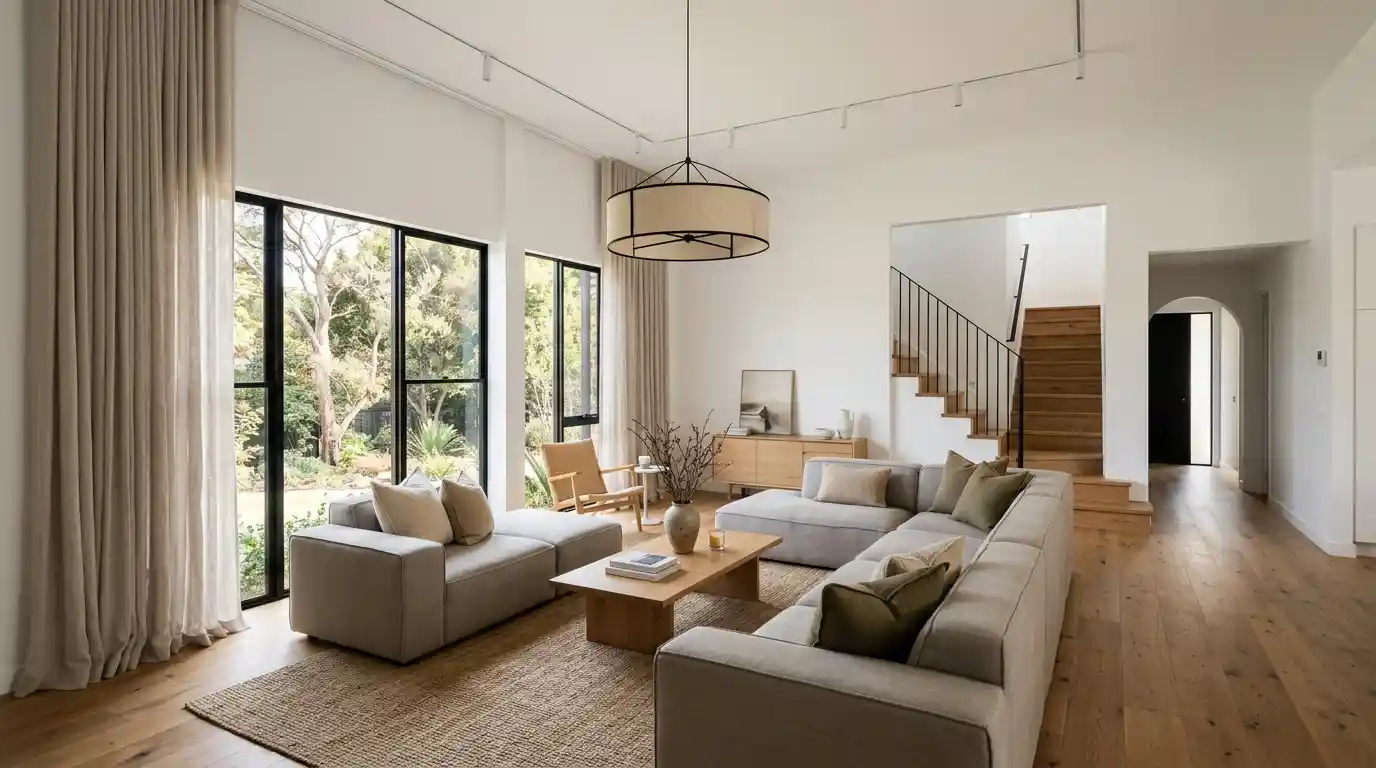
Walk into any room that feels immediately right genuinely comfortable rather than just adequately furnished and ceiling height is almost certainly doing quiet work in the background. Not the paint colour, not the furniture arrangement, not the lighting scheme. The vertical space above your head is setting the emotional register of the entire room before your conscious mind has processed anything else.
I’ve stood in enough Victorian terraces, Australian new builds, Canadian custom homes, and post-war UK semis to know that ceiling height is the dimension people measure last and feel first. A room with 2.7m ceilings and modest furnishings reads as considered and spacious. The same floor plan at 2.1m reads as functional at best, claustrophobic at worst and no amount of floor-to-ceiling curtains or vertical stripes fully corrects it. That’s not an opinion. Joan Meyers-Levy’s research at the University of Minnesota found measurable cognitive differences in how people think inside high-ceiling versus low-ceiling rooms: abstract, expansive thinking in tall spaces; concrete, detail-focused processing in lower ones. The ceiling plane is not a neutral surface.
What the Building Codes Are Actually Telling You About Livable Space
Every major residential building code converges on the same basic position: there is a floor below which a space stops being livable in any meaningful sense. In the US, IRC Section R305.1 sets the minimum habitable room height at 7 feet 2,134mm measured from finished floor to the lowest projection from the ceiling. Bathrooms get a different threshold: 6 feet 8 inches at the centre of the front clearance area for fixtures, dropping to 6 feet 4 inches for basement alterations under existing building rules. Non-habitable spaces like storage rooms and mechanical rooms operate under looser rules, but the habitable space definition is consistently enforced.
In the UK, the national minimum under DLUHC space standards sits at 2.3 metres over at least 75% of the floor area. London operates under a stricter rule: the Mayor of London set a minimum ceiling height of 2.5 metres for all new housing in the capital from 2025, reflecting the density pressures and liveability concerns specific to London’s new build market. Nationally, the Future Homes Standard brought significant changes to UK residential construction not specifically targeting ceiling height measurement, but tightening Part L Building Regulations on insulation, heat loss, and energy consumption in ways that intersect directly with ceiling height decisions.
Australia’s National Construction Code sets the habitable room minimum at 2.4 metres a room ceiling below that threshold cannot legally be classified as habitable space, which affects both planning classification and property marketing. In Queensland, ceiling heights are further adapted for tropical climate conditions. In New South Wales, urban density pressures have produced their own local variations. The standard in contemporary Australian homes has moved to 2.7m as the comfortable baseline, with high-end builds reaching 3 metres or beyond.
The practical implication of all this for homeowners and renovators is direct: any ceiling height alteration, loft conversion, basement ceiling height increase, or attic conversion project that touches habitable space classification needs a structural engineer and local planning authority sign-off before the first ceiling joist gets cut.
The Standard Measurements and Why They Landed Where They Did
The 8-foot ceiling became the dominant US standard for a reason that has nothing to do with design intent and everything to do with material logistics. Standard drywall panels come in 4×8-foot sheets. An 8ft ceiling wall takes a 4×8 sheet with no cutting. When 4×10 and 4×12 panels became widely available, builders started pushing ceiling heights upward, and the residential ceiling height standard began its gradual climb. Modern US new builds now commonly feature 9ft ceilings on the main floor the National Building Code 96-inch standard is the floor, not the target. Custom builds regularly reach 10 feet, and luxury residential projects push higher still, particularly in great rooms and double-height entryways.
The UK average ceiling height landed at 2.4 metres through similar material logic plasterboard sheets come in 2.4m lengths, aligning construction efficiency with the standard floor to ceiling height. Victorian ceiling height and Georgian ceiling height in period properties routinely run to 3 metres and beyond, reflecting both the architectural expression of prosperity and the practical need for natural ventilation before mechanical HVAC systems existed. Post-war housing dropped to 2.1 to 2.3m ceilings, reflecting affordable, efficient housing priorities. By the 1930s, many suburban developments returned to 2.4m. Contemporary new build ceiling height in the UK targets 2.4 to 2.7m as a comfortable, efficient standard.
In Australia, the NCC minimum of 2.4m for habitable rooms sits below what the market now considers desirable. Most homeowners find 2.4m the minimum acceptable ceiling height for comfortable living; 2.7m has become the contemporary Australian standard, with homes below 2.4m unable to legally present lower rooms as habitable space on any property listing.
Room-by-Room: Where Ceiling Height Decisions Actually Get Made
Standard ceiling height guidance treats the house as a uniform volume. The reality is that ceiling height decisions play out room by room, and the right answer differs by function, proportion, and the relationship between room width and vertical space.
Living room ceiling height benefits most from the transition upward. A 2.7m or 9ft ceiling in a living room with a large floor plan reads as proportional and comfortable. Vaulted ceiling living rooms and double-height open-plan spaces create the sense of openness and grandeur that drives the 5 to 25% property value increase that high ceilings consistently produce in real estate appraisal the National Association of Property Builders put the average value uplift at $4,000 per foot of ceiling height increase, a figure that holds across US markets and broadly applies to UK and Australian premium markets.
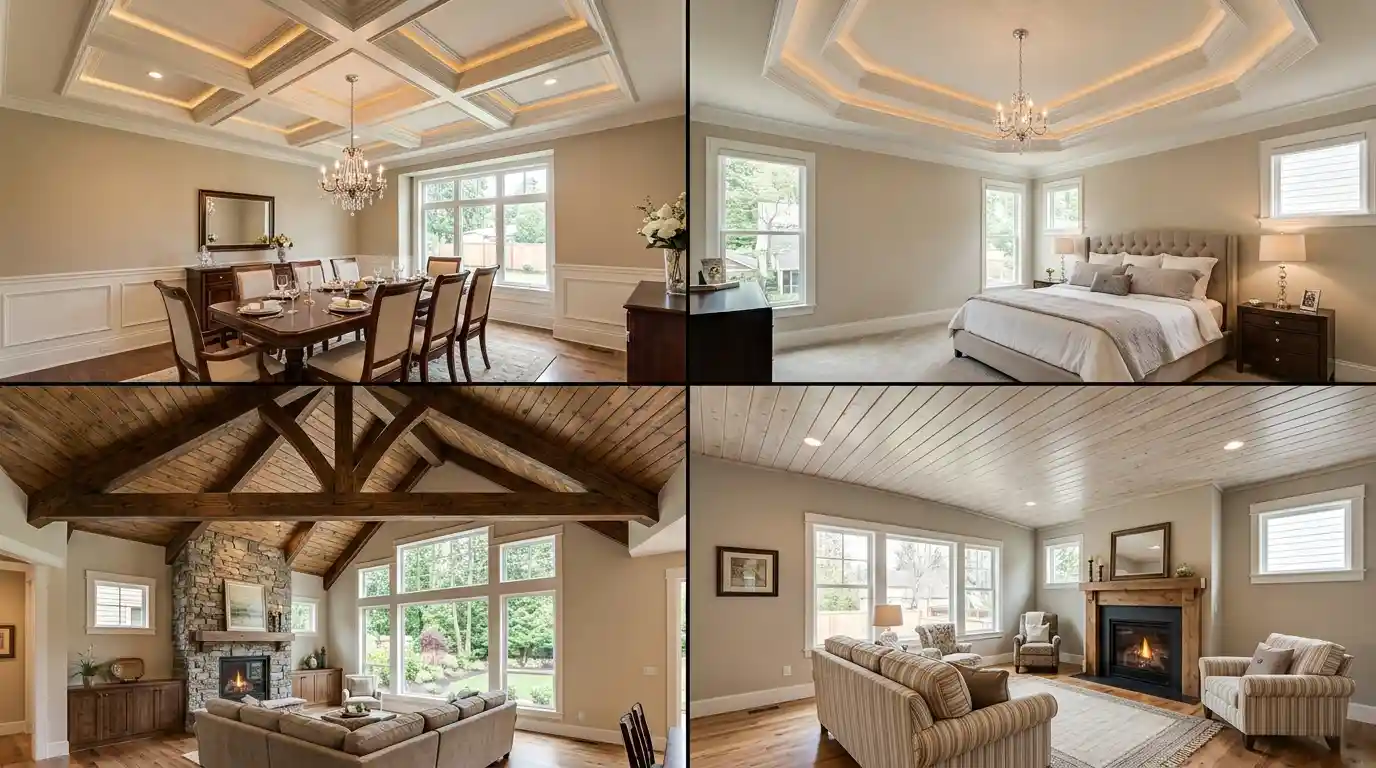
Bedroom ceiling height is where the intimate ambiance of a lower ceiling can actually be an asset rather than a compromise the cozy, warm atmosphere of a 2.4m bedroom often works better than the same room at 3m, which can read as grand but loses the sense of enclosure that good sleep environments depend on. Tray ceiling bedrooms represent a particular sweet spot: the raised central section adds architectural interest and the illusion of height without committing to the full thermal and acoustic implications of a genuinely tall space.
Kitchen ceiling height affects practical decisions as much as aesthetic ones. Cabinet height, range hood clearance, pendant lighting drop, and ventilation extraction all depend on knowing the floor to ceiling measurement precisely before specifying any of them. A kitchen at 2.4m that gets a pendant light sized for a 3m room will feel crowded from the first meal cooked under it.
Bathroom minimum ceiling height under IRC rules is 6 feet 8 inches at fixture clearance the shower ceiling height must clear 6 feet 8 inches above a minimum 30×30 inch area at the showerhead. In practice, any bathroom below 2.3m reads as compressed, and the standard shower ceiling height recommendation sits at 2.4m minimum for comfortable use.
Basement ceiling height carries its own specific constraints. Suspended ceiling systems the drop ceiling that took its origins in office buildings and now appears in residential basements with considerably more design sophistication require the basement ceiling height to accommodate the metal grid framework below the structural ceiling. Per IRC, suspended ceilings in habitable basement spaces require a minimum of 90 inches, or 7.5 feet, with the finished floor measurement taken from the grid surface downward.
The Ceiling Types That Change What Height Means in Practice
Ceiling height interacts with ceiling type in ways that matter more than either variable alone. The minimum recommendation for a coffered ceiling is 8 feet below that, the recessed panels compress the room rather than adding the architectural depth and old-world elegance a coffered ceiling is supposed to deliver. Coffered ceilings belong to traditional, Mediterranean, and French-style homes architecturally, and the room proportion has to support the visual weight of the grid before the treatment earns its place.
Tray ceilings need 9 feet minimum to work correctly. The multi-level design the raised central section surrounded by a flat border that creates the tray-like effect requires enough total height that the drop between the outer flat border and the raised centre reads as intentional design rather than a dropped soffit. Tray ceilings work particularly well in master bedrooms and dining rooms where a subtle ceiling focal point adds depth without the structural implications of a full vaulted ceiling.
Vaulted ceiling and cathedral ceiling designs require 10 feet or more and ideally a structural engineer involved from the planning stage. The inverted V of a cathedral ceiling, the continuous barrel vault arch, the dome ceiling in a formal entryway these are commitment decisions that involve roofline, structural integrity, HVAC redesign, and the ceiling height renovation budget to match. The cost to vault a ceiling averages $19,900 in the US, with the typical range running from $4,800 to over $40,000 depending on room size, structural complexity, and whether existing roof framing can be modified or needs full replacement.
Stretch ceilings in PVC and the tongue and groove pine plank ceiling sit at the aesthetic end of the ceiling treatment spectrum without changing the structural ceiling height. Both influence how ceiling height is perceived a dark stretch ceiling visually lowers the room; a pale tongue and groove plank ceiling with exposed beam detail draws the eye upward and makes a 2.4m space read closer to 2.7m.
Energy, Acoustics, and the Trade-Offs Nobody Discusses Until the Heating Bill Arrives
Every 10cm increase in ceiling height produces approximately a 1% rise in energy consumption a figure from Australian building research that holds broadly across temperate and cold climate zones. A one-foot increase in ceiling height increases energy needs by 11.3% in cold climate regions, because heat rises and the larger air volume requires proportionally more energy to maintain comfortable temperature. This is the trade-off that ceiling height enthusiasm consistently underweights: a 3m ceiling in a poorly insulated room in a cold climate is a beautiful, expensive problem.
The ceiling height energy efficiency calculation changes with the right HVAC system matched to the room volume. Heat pump ceiling height considerations are becoming central to UK building design under the Future Homes Standard low carbon heating systems behave differently in tall spaces than gas boilers, and the system specification needs to account for the actual room volume rather than floor area alone. Ceiling height ventilation and airflow are the counterargument: taller spaces with higher thermal mass and better natural light penetration through larger windows can reduce cooling loads in warm climates, where the energy calculation runs in the opposite direction to cold-climate reasoning.
Acoustic ceiling height is the dimension that gets almost no attention in residential design guides. Low ceilings reduce echo and create sound containment that is genuinely useful in bedrooms and home offices. High ceilings in open-plan spaces amplify sound propagation, creating the acoustic harshness that makes some architecturally beautiful living rooms genuinely uncomfortable for sustained conversation. The ceiling height room feel that draws buyers and the acoustic ceiling height reality that occupants live with are sometimes the same thing — and sometimes very much not.
Conclusion
Ceiling height is the dimension that shapes how every other decision in a room performs. Get it right and the furniture, lighting, colour, and proportion all fall into place with less effort than most homeowners expect. Get it wrong or inherit it wrong in an older property and no amount of decorating corrects the fundamental spatial quality of the room.
The measurement itself is straightforward. The implications are not. Building codes set the floor on what is legally habitable. Material logistics explain why the standards landed where they did historically. Energy efficiency, acoustics, room function, and ceiling type all pull the ideal ceiling height in different directions depending on climate, budget, and how the space actually gets used day to day.
What the research, the building codes, and the real estate data all point toward consistently is this: ceiling height is not a passive feature of a home. It is an active design decision — one that affects property value, running costs, psychological comfort, and the long-term livability of the space in ways that a fresh coat of paint simply cannot reach. Whether you are building new, renovating an existing property, or trying to understand why a room that should work somehow doesn’t, ceiling height is almost always worth measuring twice before deciding anything else.
FAQs
The ideal ceiling height depends on the room type, location, and design goals, but many modern homes consider around 2.7 metres or 9 feet a comfortable standard for living spaces. Minimum building codes set the legal limit, while higher ceilings often improve the feeling of openness and space.
Ceiling height influences how spacious, comfortable, and balanced a room feels. Higher ceilings can create a more open atmosphere, while lower ceilings may provide a warmer and more enclosed feeling, especially in bedrooms.
Standard ceiling heights are based on building requirements and construction practicality, while high ceilings are usually chosen for design impact, larger rooms, and improved visual openness. Modern homes commonly use higher ceilings such as 2.7m or 9ft, while luxury properties may go beyond 3m.

1 thought on “Ceiling Height: Standards, Codes and What It Really Does to a Room”