My neighbor spent $4,000 on marble countertops and then grabbed the cheapest cabinet line the big box store had in stock. It looked exactly like what you’d expect. Flat, thin doors next to stone that cost more than her car payment. That’s the thing about kitchen cabinets nobody tells you upfront. They’re not a line item, they’re the whole visual anchor of the room. All the rest, from the back splash to the hardware and lighting, is measured by these. So let’s get to the heart of the matter, rather than all the superficialities every other guide talks about.
The Color Question Everyone Gets Wrong:
People obsess over paint chips for weeks and then pick based on whatever’s trending on Instagram that month. Bad idea. Trends move fast. Your kitchen cabinets need to survive at least a decade.
Warm Neutrals Are Winning, But Not All of Them:
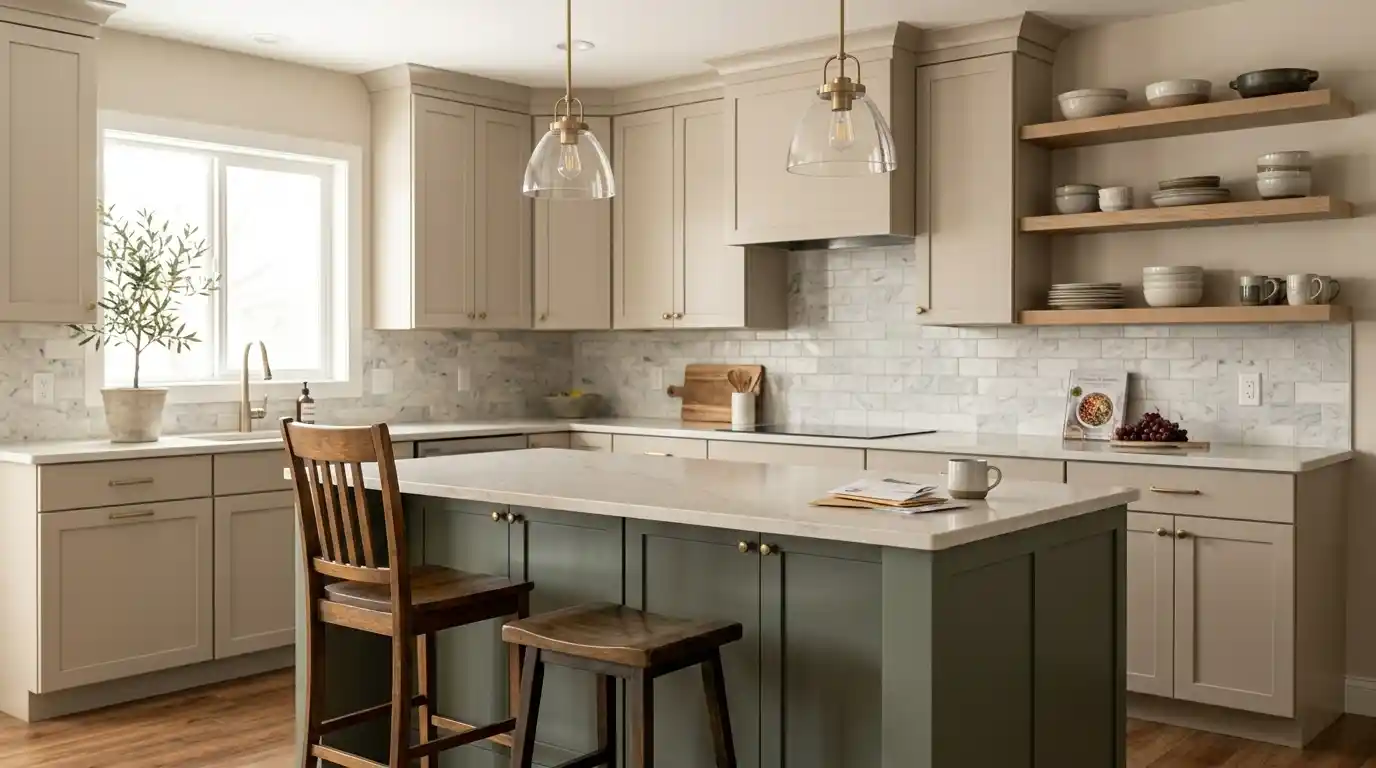
Stark white is fading. Not gone, fading. There’s a difference. Warm neutrals like mushroom tone, greige, and taupe are what designers keep pushing, and honestly they’re right this time. Warm white and creamy white still show up constantly, just less clinical than the icy versions from five years back. Off-white and warm stone create a backdrop that lets your hardware do the talking instead of competing with it. Farrow and Ball’s Shaded White gets name dropped in almost every design blog for a reason. It has depth that flat white paint just doesn’t.
I switched mine from bright white to a muddy greige two winters ago on a whim, mostly because I was tired of it looking like a hospital. Didn’t regret it once. Match these moods with wood, stone, brushed metal, anything, and it all just works. Take note of what Pantone or Benjamin Moore says about their color of the year for an easy way out, but do not take it for gospel. White is not going anywhere, but it is warming up and losing its sterility.
Bold Greens and Blues Aren’t Going Anywhere Either:
Sage green, olive green, forest green, emerald. Pick one, they’re all having a moment in kitchen cabinet colors right now. Smoky jade is the quieter cousin if full green feels like too much commitment. Navy blue, midnight blue, sapphire, inky blue. These work incredibly well on islands specifically, less so on full runs of upper cabinets in small rooms.
I’ve seen it done wrong. Matte black paired with soft black creates that moody two tone look everyone’s chasing, but it eats light in a north facing kitchen. The ruby red and brass really feels luxurious rather than tacky when going all-in with it, instead of just trying to half-measure. The terracotta, rust, caramel, and olive are all wonderful, and photograph well in daylight.
Style: Shaker, Slab, or Something Weirder:
Nobody agrees on this one, and that’s fine because it depends entirely on your house, not some universal rule.
Shaker cabinets are the safe bet. Five piece door, recessed center panel, works in transitional and traditional kitchens without a second thought. They’re basically the khakis of kitchen cabinets. Reliable, a little boring, never wrong. Slab cabinets are the opposite. Flat panel, zero decoration, built for contemporary and minimalist spaces. Handleless versions with a push open mechanism look incredible until you’re elbow deep in dish soap and can’t get the drawer open cleanly. That’s a real complaint I’ve heard from three different friends now.
Frameless construction genuinely does make small kitchens feel bigger, that part isn’t marketing fluff. Two tone setups, shaker lowers with slab uppers, split the difference for people who can’t commit to one lane. Inset cabinets sit at the top of the price ladder and honestly look like furniture more than storage. Mixed materials in one kitchen used to be a mistake designers warned against. Now it’s basically expected.
French country, modern farmhouse, coastal. Regional and lifestyle styles all lean on cabinet choice differently, and Scandinavian kitchens specifically want light wood and handleless everything. If you’re doing a villa kitchen or apartment kitchen overseas, scale changes the math completely. What works in a 400 square foot New York apartment falls apart in a sprawling open plan home.
What They’re Actually Made Of:
Material decides whether your kitchen cabinets look fine in year one and terrible by year five, or the reverse.
Solid wood is still the benchmark, full stop. Walnut and cherry sit at the top, oak and maple and birch are the sensible middle ground most people should actually buy. MDF takes paint better than real wood does, weirdly, and costs a fraction of the price. Particle board works fine hidden inside a cabinet box. It’s a disaster on an exposed door that sees moisture.
Plywood beats particle board in humid environments every time, ask anyone who’s redone a kitchen near the coast. Thermofoil wraps MDF in vinyl and shrugs off moisture and temperature swings better than you’d expect from something so cheap. Laminate does something similar at an even lower price point, though it lacks the warmth of real wood veneer.
Reclaimed wood and bamboo cabinets are having a real moment, not just a marketing moment. Low VOC finishes matter more than people realize for actual air quality, not just a checkbox on a sustainability form. White oak specifically has become the darling material of 2026. Warm, sustainable, ages well. If you’re the type who cares where materials come from, this section actually matters to you more than color ever will.
Hardware and Storage Nobody Notices Until It’s Wrong:
Small stuff, big impact. This is where kitchens either feel finished or feel like they’re missing something you can’t quite name.
Brass, brushed brass, aged bronze. Warm metals soften both shaker and slab cabinets equally well. Matte black hardware and polished nickel go cooler and more contemporary. Mixing metals is fine now. That old rule about matching every fixture died a while back. Cabinet pulls versus knobs versus bar pulls really just comes down to hand feel, so touch them in a showroom before ordering online. Finger pulls and recessed grip channels keep handleless designs looking clean, no visible hardware breaking up the surface.
Storage is where the real daily life impact lives, more than color ever will. Pull out drawers, vertical pantry systems, appliance garages.These conceal clutter and maintain countertop cleanliness. Glass cabinets and open shelving serve to interrupt lengthy door runs; this is especially significant in larger kitchens compared to smaller ones. Cabinets that reach all the way up to the ceiling contribute additional storage space and ensure that a high ceiling looks appropriately scaled rather than just being bare overhead. The butler’s pantry is truly a luxury feature if you have the space for one.
The Real Cost Breakdown:
Nobody wants to talk actual numbers, so here they are.
RTA cabinets are the cheapest entry point, followed by stock, then semi custom, then full custom kitchen cabinets at the top of the ladder. Shaker setups typically run $3,000 to $12,000 for a full kitchen. Slab can land similarly or higher depending on finish. Installation labor runs roughly $368 to $520 per unit. That adds up fast in a bigger kitchen. Cabinet refacing cost, $2,000 to $5,000, is the move if your boxes are solid but the doors look dated.
Quartz costs more than laminate for countertops, obviously, but factor it into the total budget before you fall in love with a sample. Mid range materials like maple balance cost and quality better than premium species for most people’s actual budgets. Watch for holiday sales. Memorial Day, Labor Day, Black Friday. Big box stores routinely knock 15 to 30 percent off during those specific windows.
Who You Actually Need on Your Team:
A kitchen designer earns their fee by catching mistakes before they become expensive. Custom cabinet installers offer accuracy that even the most avid do-it-yourselfer cannot attain, despite watching numerous YouTube videos. NKBA trend reports are something one should give a quick glance at, especially to learn about what professionals are actually encountering in their clients’ kitchen spaces and not just trends on social media platforms. Walk into a showroom. Feel the finishes. Photos always exaggerate texture.
Regional differences matter too. American homeowners, UK buyers, and folks doing villa kitchen projects overseas all face different pricing and material availability. Midwest craftsmanship still sets a quality benchmark a lot of the industry measures against, fair or not. Built in appliances, induction cooktops, range hoods. These round out a kitchen but shouldn’t overshadow the cabinet decision that anchors everything else.
Conclusion:
The kitchen cabinets may not be the exciting stuff in your home upgrade project, and I understand that. Yet, they are going to be the ones which you will end up spending all your time with after being tired of your sample slabs. Be it a shaker style or a slab style, If it is the shaker style or the slab style, if it is the neutral tones or the green tones, whether it is the solid wood or the MDF, none of these choices is wrong.
Frequently Asked Questions:
Warm neutrals like greige hold up longest without feeling dated, though bold greens and navys are proving surprisingly durable trend wise too.
Usually yes. At $2,000 to $5,000 versus full replacement costs, refacing solid boxes with new doors is one of the smartest budget moves available.
Solid wood, particularly oak or maple, generally outlasts MDF or laminate, though good care extends any material’s usable life considerably.
Yes. Neutral, well built kitchen cabinets consistently influence buyer impressions more than almost any other single renovation choice you’ll make.