
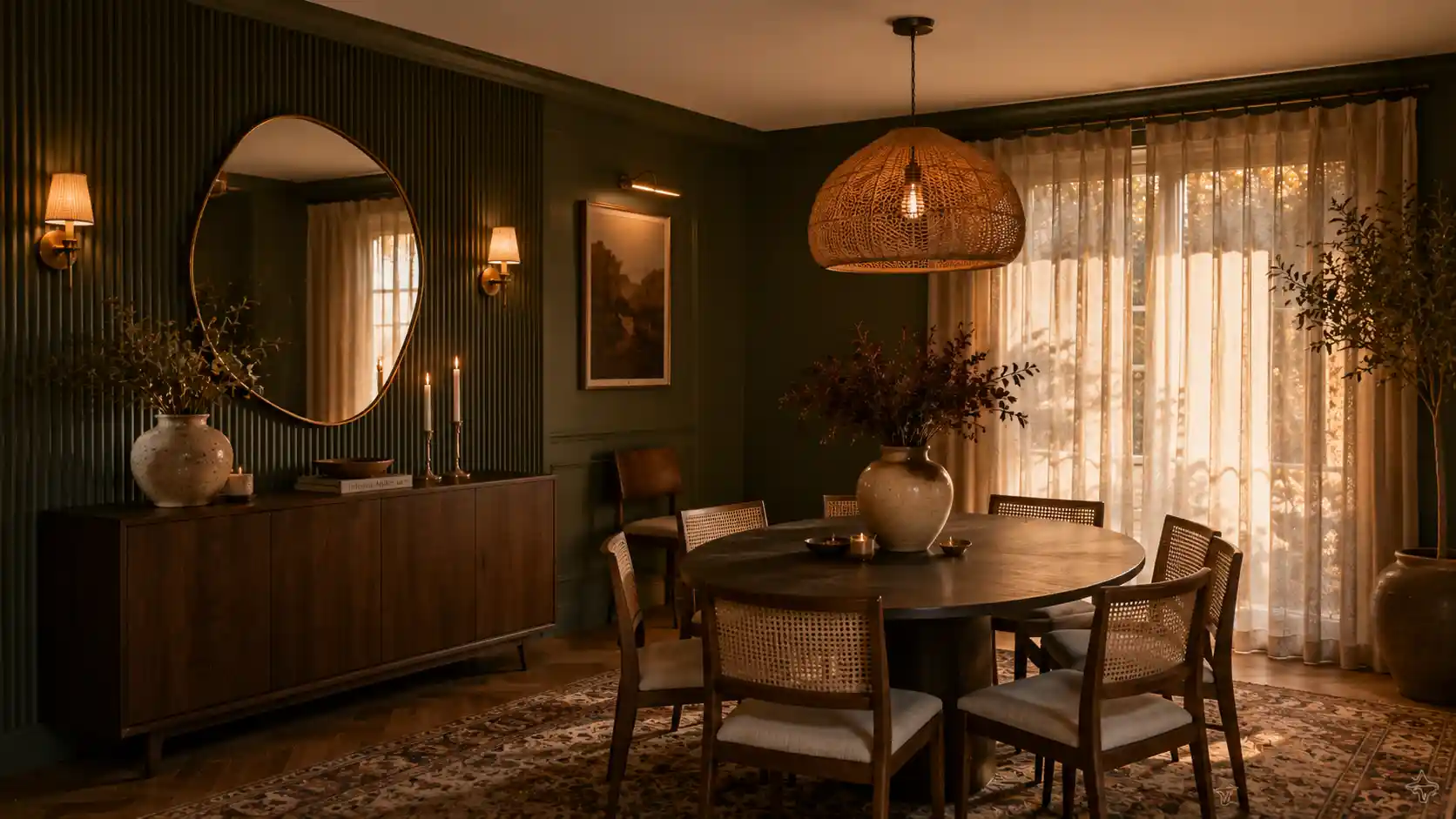
Dining Room Wall Decor
The dining room I’m sitting in right now has one wall I’m still not happy with after four years. Not because I haven’t tried I’ve hung things on it, taken them down, repainted it once, hung different things, taken those down. The problem was never what I was putting on the wall. It was that I was treating the wall as a surface to fill rather than as a design element in its own right. That reframing changed everything. Dining room wall decor, done properly, is not decoration layered over a space that’s already finished. It’s one of the primary decisions that determines whether a dining room feels like somewhere people want to linger after the plates are cleared.
Houzz currently holds 489,796 dining room images submitted by designers and homeowners. Interior designer Rebekah Murphy of Murphy and Moore Design put the 2026 direction plainly: dining rooms are becoming “more architectural environments paneled walls, plaster finishes, walnut tones, statement millwork, warm layered lighting.” Lauren Coburn of NextHaus Alliance added what most wall decor guides skip: the dining room is most often used in the evening, which makes it the single room in a house where darker, moodier, more saturated wall treatments work without the penalty of feeling dark all day. That’s the real permission slip dining room wall decor needed.
Why the Dining Room Wall Became the Most Interesting Surface in the House
The 2026 Shift That Gave Dining Room Walls a Real Role Again
For the better part of a decade, the dining room either disappeared into open-plan kitchens or became a box with a chandelier. The walls were white. The art was obligatory. Stark white dining rooms are fading fast in 2026, replaced by surfaces that actually contribute to the atmosphere of the room rather than just providing a background for other decisions. Multiple sources Decorilla’s 17 dining room trend roundup, Hackrea’s 25 unique wall decor ideas, Modern Luxco’s March 2026 analysis, Homes and Gardens all land on the same conclusion: texture over flat color, experience over display, moody over neutral, and architectural depth over surface-level decoration.
Dining room wall decor in 2026 carries real functional weight. A wall that adds nothing makes a dining room feel transitional a place you pass through to eat rather than a place you settle into. A wall with proper depth, proper scale, and a considered relationship to the furniture in front of it turns the whole room into somewhere that genuinely invites lingering. The goal, as Elimar Lobo Saenz of ElephantStock describes it, is “a warm atmosphere harmonious flow, organic materials, and a personal touch.” The wall is where that warm atmosphere either lives or doesn’t.
Wall Paneling and Texture — the Dining Room Wall Decor Foundation That Earns Its Keep
Wainscoting, Board and Batten, and the Architecture That Does the Work Before Anything Hangs
Dining room wall decor built on a textured or paneled foundation always outperforms one built on flat paint alone. Wall paneling is one of the biggest moves in 2026 for exactly this reason: it adds architectural depth without a major renovation, and it makes every piece of art, mirror, or lighting placed against it look more considered by association.
The paneling options stack up clearly by effect. Wainscoting on the classic lower wall protects against chair scuffs while adding a formal elegance that a coat of paint never quite achieves. Board and batten vertical strips create a clean, contemporary farmhouse line that suits the mixed-era furniture direction 2026 dining rooms are moving toward.
Picture-frame molding thin decorative trim applied over flat drywall mimics expensive solid-wood paneling at a fraction of the cost and photographs dramatically well. Modern slat panels and fluted wood slats bring the warm wood tone direction that Decorilla designer James H. identified in April 2026 as the defining material move in dining room wall decor: “vertical planes are active parts of the 2026 dining room’s atmosphere.” Ribbed wall paneling and slatted wood walls read especially well against moody, saturated paint, creating the layered depth that flat panels alone can’t produce.
Height matters. Half-wall paneling reads traditionally. Two-thirds wall creates drama without committing to full coverage. Floor-to-ceiling paneling is the full statement effective, but requiring enough ceiling height and enough room scale to absorb it. Deep green wainscoting against cream walls with walnut frames and warm linen textiles is a combination cited specifically by Mixtiles’ dining room styling guide as creating a “classic clubroom feel” the kind of dining room wall decor result that looks like it was designed rather than accumulated.
Limewash, Plaster, and the Textured Finishes Doing More Than Paint
Limewash paint and plaster finish are the 2026 alternatives to flat paint that offer natural tonal variation, aging beautifully rather than dating. Limewash dining room walls shift in tone with changing light warmer in candlelight, cooler in morning sun which is precisely what a dining room used primarily in the evening needs. Plaster finish adds tactile depth that registers in person even when photos can’t fully capture it. Both sit within the broader texture over flat color direction that is the defining principle of dining room wall decor in 2026.
Color drenching applying the same rich hue to walls, ceiling, trim, and sometimes the paneling itself is the most committed expression of the moody dining room direction. Painting walls ceiling trim a single deep navy, forest green, or warm terracotta creates what Modern Luxco describes as “an immersive, enveloping feel that makes the dining room feel like a true retreat.” It requires confidence, but it consistently produces the kind of dining room wall decor that visitors remember.
Art, Mirrors, and the Decisions That Determine Whether Dining Room Wall Decor Works
Scale, Placement, and the Rules That Actually Hold Up
Most dining room wall decor problems are scale problems. Art that’s too small for the wall it’s on, or too small relative to the dining table it sits above, makes everything in the room feel slightly uncertain. The practical benchmarks: center artwork at 57 to 60 inches from the floor for standard wall placement, with the bottom edge positioned 8 to 12 inches above any sideboard or furniture surface beneath it. Artwork should cover 60 to 75 percent of the available wall width above a dining table. An oversized canvas works best when it spans 60 to 70 percent of the dining table’s width — which typically means going larger than instinct suggests.
The ten-plus-frame gallery wall, dominant for much of the previous decade, is considered visually cluttered by the standards of 2026 dining room wall decor. The direction that’s replaced it: one large single statement artwork, or a tightly curated gallery wall limited to a 3×3 grid arrangement with consistent framing, 2 to 3 inches between frames, and a unifying element shared color tone, similar wood grain, or consistent hardware finish that makes the collection read as intentional.
A linear series arrangement of related prints, a two-row rhythm with asymmetric hanging, a loose cluster arrangement centered on one thematic subject these are all legitimate approaches. What’s no longer working is the “accumulate and fill” approach that treated the gallery wall as a bulletin board.
Mirrors, Plate Walls, and the Dining Room Wall Decor Moves Nobody Regrets
A dining room mirror, positioned correctly, does three things simultaneously: it reflects the pendant light above the table, adds visual depth to the room, and makes a smaller or darker space feel considerably more open. The placement rules are specific: a standalone mirror should be at least 40 inches wide to read at scale, and roughly two-thirds the width of the furniture it hangs above.
A round mirror, oval mirror, or the organic blob mirror and pebble shaped mirror forms trending specifically in 2026 work particularly well against the rigid rectangular geometry of a dining table the contrast creates a softening effect that a rectangular mirror doesn’t. A Crittall style grid frame mirror reads industrial-modern, suits an exposed brick wall or shiplap dining room beautifully, and keeps the reflection’s grid structure visually connected to the architectural detail.
The plate wall has been rehabilitated. The old version matching floral china in a grid reads dated. The 2026 version is graphic, monochromatic, or highly sculptural: matte black plates on a charcoal wall, hand-painted artisan ceramics in warm greens ochres and terracotta arranged in a loose cluster rather than a rigid pattern, decorative plate wall treatments that prioritize ceramic wall art over china display. Houzz’s 2026 dining room data specifically confirms the decorative plate wall as one of the fastest-growing dining room wall decor choices, extending beyond dining rooms specifically into the lounge and hallway as a statement display technique.
Wallpaper, Murals, and the Dining Room Wall Decor That Transforms a Room’s Character
Scenic Murals, Bold Floral Wallpaper, and the Scale That Makes It Work
Wallpaper is working harder in 2026 dining room wall decor than it has in years, and the direction is specifically toward larger, bolder, more immersive treatments. The small repeating pattern that defined wallpaper’s previous comeback has given way to large-scale botanical murals, scenic murals spanning entire walls, dark vintage floral wallpaper with depth and movement, and toile wallpaper used in the manner of its original 18th-century application as a room-defining pattern that tells a story across every surface. Mind the Gap’s Transylvanian Manor collection centaurs, chimeras, sphinxes on non-woven substrate, FSC-grade material was cited by Decorilla in April 2026 as precisely this direction: wallpaper that creates atmosphere rather than pattern alone.
Bold floral wallpaper on a single accent wall in an otherwise neutral dining room allows bold commitment without full-room saturation. Tropical print wallpaper and geometric wallpaper in teal, mustard, and orange work specifically as accent walls against walnut wood paneling in mid-century plus contemporary dining environments. Grasscloth wallcovering sits at the texture over flat color end of the spectrum rather than the pattern end it adds tactile warmth without demanding visual attention, which makes it compatible with statement lighting and oversized art without competing.
For renters, peel-and-stick wallpaper has moved well past its early reputation for poor adhesion and limited patterns. Removable wallpaper in genuine scenic, botanical, and bold floral options is now a legitimate dining room wall decor approach and combined with cordless sconces, Mixtiles adhesive photo tiles, and picture ledge displays, creates a full dining room wall treatment without a single irreversible modification to the rental property.
Lighting, Sideboard Styling, and the Finishing Layer of Dining Room Wall Decor
Wall Sconces, Picture Lights, and the Fixtures That Become the Decor
Dining room wall decor and lighting are inseparable in 2026 because the wall is the surface lighting fixtures live on. Hackrea put it directly: “light fixtures are being treated as wall jewelry.” A swing-arm sconce in sculptural brass, a candle sconce on either side of a large mirror, a cordless sconce positioned to illuminate art or a textured wall surface these are dining room wall decor decisions as much as lighting decisions.
Brass picture light above a single statement artwork elevates a framed print to focal point status in a way that overhead light alone never does. LED wall lighting and LED strip warm behind a wall panel add a layer of depth that photographs dramatically and reads even better in person during evening meals.
Sideboard styling against the dining room wall decor backdrop is the final layer. The triangle rule applies here: arrange objects of varying heights a tall ceramic vase at the back, a medium framed botanical print in the middle, a low decorative bowl at the front and let negative space do the work between them.
Taper candles in a candle grouping, stoneware vases on an open shelf above, woven basket dining display tucked below the sideboard becomes an extension of the dining room wall decor rather than a separate element placed in front of it. Seasonal artwork rotation swapping a large botanical print for an abstract piece quarterly keeps the dining room wall decor evolving without structural change, which is exactly the kind of investment that earns compounding visual returns over time.
Conclusion
Dining room wall decor is the decision that determines whether the room has atmosphere or just furniture in it. The wall paneling and textured surface choices create the foundation. The art scale, placement, and gallery logic create the focal structure. Mirrors and plate walls add depth and personal character. Wallpaper and murals establish mood. Lighting and sideboard styling complete the picture.
None of these decisions need to happen at once, and none require a large budget to execute correctly. My fourth-year wall problem turned out to have a simple answer: I was trying to fill the wall rather than define what role it needed to play. Once I answered that question light, texture, or focal point everything else followed. That’s how dining room wall decor works when it actually works.
FAQs
Dining room wall decor includes the finishes, artwork, mirrors, lighting, paneling, and other elements that shape the walls around your dining space. When planned properly, it adds depth and atmosphere instead of making the room feel like a space with furniture and empty walls.
Wall paneling works well when you want architectural depth, texture, and a more permanent finish, while wallpaper is better for adding pattern, color, or a strong visual theme. The right choice depends on whether you want the wall itself to provide structure or act as a decorative focal point.
For standard placement, keep the center of the artwork around 57 to 60 inches from the floor and leave roughly 8 to 12 inches above a sideboard. The artwork should also be large enough to feel proportionate to the furniture rather than floating on an oversized wall.

1 thought on “Dining Room Wall Decor: 8 Brilliant Decisions That Separate Walls That Work From Walls That Just Exist”