
What brought the change in my perception about tap water did not happen through any piece of news about PFAS contamination or any report on the presence of lead in aged pipelines. The epiphany occurred when I opened my dishwasher one day and saw white scales deposited on the inner walls of my machine and realized that my hair is becoming increasingly dry every time I take a bath even after trying three different types of shampoo in the last year. My neighbor, who worked in water purification plant for over a decade, without a second thought told me that it was hard water and chloramine which is confirmed by my city’s Consumer Confidence Report to be present in municipal water.
In a time when 87% of Americans have expressed concerns about the safety of their drinking water based on a survey conducted by Aquasana in 2025, and the EPA data reveals presence of contaminants in city-supplied water in all 50 states in the U.S., the need for point-of-entry water filters becomes more evident than ever thanks to the scientific evidence available. As reported in a recent study by the United States Geological Survey (USGS), almost half of all tap water systems in the United States have contaminants in them, and another recent study conducted by The Guardian and Consumer Reports revealed that municipal water contains lead, arsenic, and PFAS at very high levels. Also, there are 43 million people living in privately owned wells receiving no government monitoring of the water quality.
What a Whole House Water Filtration System Can and Cannot Do
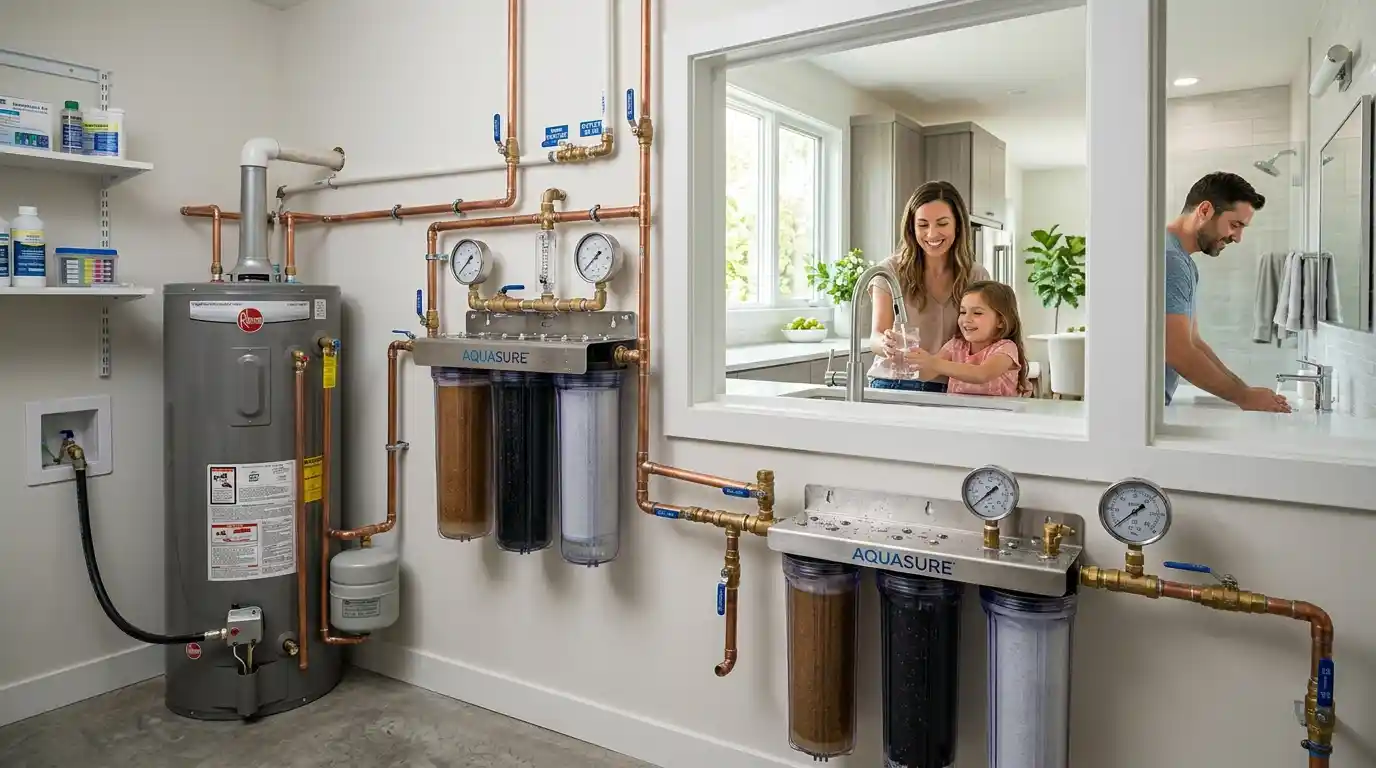
The whole house water filter or point-of-entry/POE filter connects directly to the water supply line behind the shutoff valve. The difference between point-of-entry/POE water filters and point-of-use or POU water filters is that while the latter treats water for consumption at the tap of choice, whole home water filters cover all fixtures in the home kitchen faucets, bath faucets, showers, washing machines, dishwashers, exterior hose bibs, and any appliance connected to the water supply line. This is important because it is not only the taste of drinking water that suffers from the presence of chlorine and chloramines in the municipal water. They off-gas as hot steam during showers and fill the bathroom with chemical fumes. They dry out your skin and damage your hair health no matter how good the shampoo you use is. Hard water deposits accumulate in your water heater decreasing its efficiency and lifespan.
Knowing What Is Filtered By A Whole House Water Filtration System
Knowing what is filtered by a whole house water filtration system and what is not will avoid the most costly mistake when purchasing one of these systems. Most multi-stage systems start with a sediment pre-filter that catches rust, grit, silt, dirt, and debris before water reaches the main filtration stage. From there, activated or catalytic carbon media handles the chemical load removing chlorine, chloramines, VOCs, pesticides, herbicides, PFOA, PFOS, PFAS, MTBE, TTHM, and haloacetic acids through the adsorption process. KDF media utilizes oxidation and reduction processes to reduce heavy metals and water soluble heavy metals including lead. UV purification/UV light eliminates bacteria, viruses, cysts and other microorganisms without using chemicals. UV treatment does not alter the taste and does not emit any chemicals but requires clear water and therefore a 5-micron pre-filter is needed upstream.
Whole House Carbon Filters
Things that standard whole house carbon filters are unable to do: Remove fluoride, nitrates, total dissolved solids (TDS), arsenic, radon, radium, or radio-active particles and you will have to use reverse osmosis, activated alumina, or specific systems for that. The hard water minerals like calcium and magnesium need a special water softener or salt-free water conditioner since the standard filtration system does not take out dissolved minerals. For scale removal the water softener uses the process of ion exchange. And for a salt-free water conditioner one can use a FutureSoft from SpringWell, which does not have salt discharge as it is important for households living in places where there are restrictions on salt softeners.
The best strategy for most homes: whole-house water filtration for bathing, doing laundry, operating home appliances, and other purposes, along with an undersink reverse osmosis unit at the drinking water tap to provide the finishing touches and eliminate fluorides, nitrates, PFAS chemicals, dissolved solids, and anything else not handled by the whole-house filter.
City Water vs Well Water: Why Your Water Source Shapes Every System Decision
The one most crucial factor to consider when choosing a water filter system for an entire house is neither brand nor cost, but rather, the source of water. Filtration systems for municipal and well water are designed differently, and ignoring these differences can lead to a system that does not perform effectively.
Home Water
Home water is already treated and disinfected before arriving at the house, so typical contaminant risks include residual chlorine or chloramines resulting from the disinfection process, disinfection byproducts such as THMs and trihalomethanes, sediment contamination due to aging water supply and delivery systems, lead from aging pipes especially those installed prior to 1986, PFAS chemicals due to upstream industrial pollution, and microplastics 94 percent of tap water tested in the United States contain microplastics, which are 2,125 percent higher than those found in bottled water. Carbon block filters that can capture microplastics require an efficiency of 0.5 microns. NSF/ANSI 42 standard addresses taste and odor of chlorine. NSF/ANSI 53 standard addresses health risks including lead and volatile organic compounds. NSF 401 standard verifies reduction of PFAS chemicals. Reviewing the annual Consumer Confidence Report on EPA.gov shows precisely what contaminants have been detected by your utility and whether there are any distribution system violations.
Underground Aquifer Well Water
Underground aquifer well water is not subject to any federal monitoring and may be contaminated with pesticides, fertilizers, heavy metals, organic compounds, iron, manganese, sulfur, bacteria, viruses, coliforms, nitrates, arsenic, chloride, uranium, and radon based on local geology, agricultural practices, and nearness to industries. At least 23% of private wells contained one or more contaminants at levels of potential health concern according to USGS research. Testing of the water should be conducted yearly by certified test labs or using mail-in test kits ranging in price from $30 to $150 after every year and after major flooding or plumbing installations. Private well water purification usually requires multistep methods including sediment filtration, catalytic carbon filter to remove organic compounds, KDF media filter to remove heavy metals, and UV sterilization to get rid of bacteria and viruses. The SpringWell WS uses an air injection system to remove iron and manganese without chemicals, making it a low-maintenance solution that eliminates the risk of chemical leaks or overdosing.
How to Choose the Right Whole House Water Filtration System: Sizing, Certifications, and Real Brands Tested
System sizing is where most DIY buyers underestimate consequences. Flow rate measured in gallons per minute or GPM determines whether a whole house water filter will meet household demand without causing pressure drop. A properly sized system causes only 1 to 3 PSI pressure drop when clean. An undersized system or clogged filter can drop 10 to 20 PSI, producing weak pressure across every fixture simultaneously. For homes with one to two bathrooms, a system rated at 10 GPM handles peak demand adequately. Homes with three or more bathrooms need 15 to 20 GPM capacity. Use 1-inch ports rather than 3/4-inch for larger homes to minimize flow restriction. Undersizing the tank is the most documented installation mistake oversizing costs more upfront but actually works under simultaneous demand conditions.
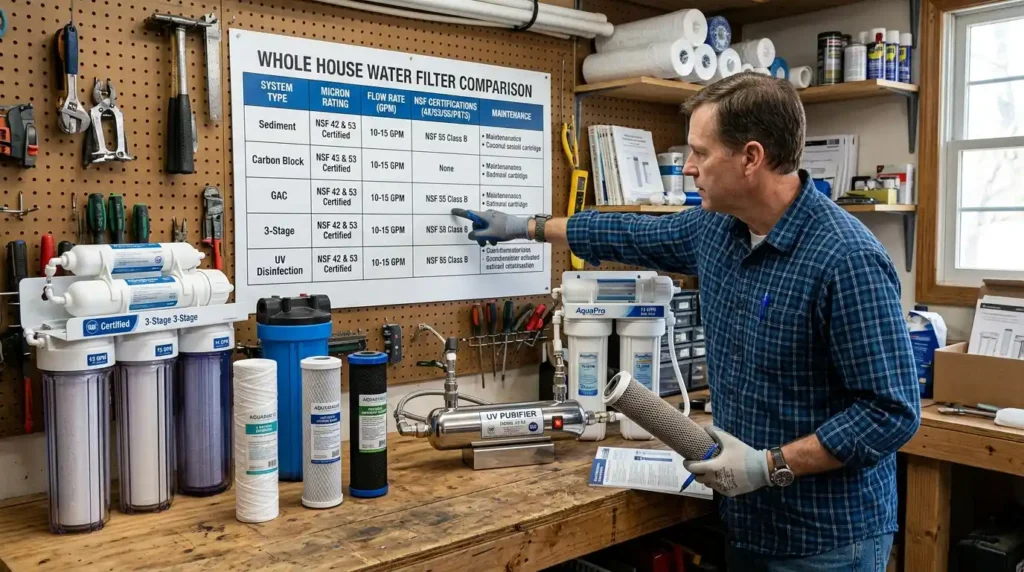
Certifications separate genuine performance from marketing claims. NSF International’s independent testing database lists certified products against specific standards: NSF/ANSI 42 for aesthetic effects including chlorine taste, odor, and particulates. NSF/ANSI 53 for health-related contaminants including lead, cysts, and VOCs. NSF/ANSI 44 for cation-exchange water softeners covering hardness reduction and salt efficiency. NSF/ANSI 55 for UV systems Class A for primary disinfection at 40 mJ/cm², Class B for supplemental treatment only. NSF/ANSI 58 is the standard that evaluates reverse osmosis system performance, including total dissolved solids (TDS) reduction and certification for specific PFAS reduction claims. NSF/ANSI 61 and NSF/ANSI 372 for component safety. WQA Water Quality Association certification runs parallel to NSF and is recognized equally in the water treatment industry. Do not rely on marketing claims without supporting NSF certification documentation ask for the certification file and exact claims.
City Water
For city water where chlorine, chloramine, THMs, VOCs, and disinfection byproducts are the primary concerns, the SpringWell CF1 consistently ranks at the top of independent testing. Quality Water Lab’s Tap Score testing using ETR Labs and Microbac certified labs showed total THMs dropping from 31.83 ppb to non-detect after three-plus years of daily use, with lead reduced to 0.0007 PPM at a bathroom sink. The CF1 combines catalytic carbon coconut shell filter media with KDF media, covers 1 to 3 bath homes at 9 to 20 GPM flow, holds NSF/ANSI 61 and NSF/ANSI 372 component certifications, carries a lifetime warranty, and backs performance with a 6-month money-back guarantee. SpringWell guarantees its carbon reduces chlorine and chloramine levels below minimum detection levels for 6 years or 1 million gallons. The CF4 and CF+ versions handle larger homes with higher flow requirements.
The Aquasana Rhino line Rhino, Rhino Max Flow, Rhino Chloramines, and Rhino Chloramines Max Flow covers city water at 1,000,000 gallons or 10 years, with the Aquasana OptimH2O tested and certified to reduce lead, PFAS, and cysts alongside chlorine and chloramines. The Rhino Well Water with UV system handles private well water and lasts 5 years with UV disinfection for biological contamination protection.
Budget Conscious Homeowners On City Water
For budget-conscious homeowners on city water, the Kind E-1000 from Kind Water Systems formerly Evo Water Systems is a two-cartridge system combining a long-lasting sediment pre-filter with a catalytic carbon block filter, approximately 30 percent cheaper than the SpringWell CF. Cartridges last up to 80,000 gallons or one year significantly better than the 6-month lifespan of smaller POU cartridge systems. The Kind E-3000 adds a water conditioning cartridge. Kind’s AutoShip program ships replacement filters automatically at 15 percent below website pricing, reducing both the maintenance friction and the ongoing operating cost.
For small budgets needing a long-lifetime solution, the SoftPro Whole House Upflow Carbon Filter runs 600,000 to 1,000,000 gallons over approximately five years using a low-maintenance upflow carbon system. The SoftPro Whole House Chlorine+ Filter adds a KDF sponge for heavy metal reduction through oxidation and reduction alongside a 5-micron sediment pre-filter for comprehensive multi-stage performance.
The iSpring WGB32B 3-stage system handles sediment, chlorine, rust, tastes, odors, herbicides, and VOCs with a specific filter stage for iron and manganese reduction a reliable workhorse for city water with mild iron problems. The iSpring WF1054 combines KDF media with coconut shell activated carbon to provide up to five years of effective reduction of PFAS, chloramine, and lead. It delivers a flow rate of 26 GPM without causing a pressure drop and operates without the need for electricity or a drain line. The iSpring WF1024 delivers the same KDF and coconut shell technology at a 3-year filter life and the same 26 GPM flow rate. The iSpring UVF50 LED UV Water Filter adds whole house UV purification with a built-in smart flow sensor, mercury-free LED design, and 13.2 GPM capacity.
DIY Installation
The DIY installation time of most systems that use cartridges ranges from 2 to 4 hours with basic knowledge of plumbing; tools include pipe cutters, wrenches, and Teflon tape, resulting in cost savings of $200-$500. Professional installation is required for systems using multi-stage POE with UV and electrical connections, when pipes 1 inch and larger need modification, and in complicated garage or basement installation. Also, professional installation is necessary when the manufacturer requires such installation in order for the warranty to be valid. The note on carbon media soaking of tanks, including the SpringWell CF: a 48-hour soaking period is required prior to hooking up the system.
Whole house water filtration maintenance costs yearly vary between $80-$500 dollars depending on the type of the system and the quality of the water locally. Pre-filters’ sediment replacement is needed every 3-6 months. Carbon filters change every 6-12 months. The lifetime of KDF media is 5-7 years. Replacement of UV lamp is annual. Filter housing lasts 10+ years if maintained properly. Economically, for every gallon the situation is clear a family which spends $100 monthly on bottled water spends $1,200 every year for water that contains 2,125% more microplastics than the filtered water from the tap. Mid-priced whole house water filtration systems cost $170-$300 yearly for maintenance which is one-quarter of the bottled water expenses.
PFAS, Microplastics, and the Emerging Contaminants Reshaping Whole House Filtration Decisions
The EPA issued maximum contaminant levels for six PFAS chemicals in April 2024: PFOA and PFOS both at 4 ppt, while PFHxS, PFNA, and HFPO-DA otherwise known as GenX were issued 10 ppt each, along with a hazard index of 1 for specific PFAS mixtures. Two main types of treatment technologies recognized by the EPA that have been found to work for PFAS removal are activated carbon and reverse osmosis. NSF 401 certification ensures PFAS reduction capability in any system that makes this claim. In terms of drinking water, POU reverse osmosis installation in the kitchen sink will be the cheaper and safer option for PFAS, fluoride, nitrates, and arsenic removal compared to whole house RO which costs $4,000-$10,000 to install and wastes a lot of water.
The extent of microplastics contamination in tap water became known to many people when researchers discovered that 94 percent of tap water tested had microplastics contamination. The comparison between bottled water and tap water is quite remarkable since bottled water has 2,125 percent more microplastics compared to well-filtered tap water. This makes the case for whole house water filtration and drinking water filtration much stronger because you do not need to buy plastic water bottles anymore. The carbon block filters of 0.5 microns can trap most microplastic particles.
For well owners, the contamination profile needs to be diagnosed in a more detailed manner. A 5-micron sediment pre-filter must always precede any installation of UV purification system; particles in water will block microorganisms from being exposed to the UV light and thereby making disinfection impossible despite whatever UV dose used. Operating the water beyond the rated GPM of a UV system will decrease the UV dose to less than the 40 mJ/cm² safety limit required by Class A regulations, something which water treatment experts on Reddit’s water treatment forums refer to as false security and with good reason. The USGS coliform bacteria website for well owners and DSIRE website for state/local water treatment incentives are the most relevant reference websites after obtaining the lab test results of the contamination profile.
Conclusion
Whole house water filtration is not an extravagance for those who have money to spend, but rather a solution to real problems of water quality that affect the vast majority of American households and millions of well owners who are not subject to any federal oversight whatsoever. The kind of system you need is determined entirely by the type of water, specific contaminants as revealed by a test in a reputable laboratory, household’s needs and requirements in terms of water flow rate, and long term budgeting for regular maintenance. In the case of municipal water, a multi-stage system with catalytic carbon like the SpringWell CF1 paired with a reverse osmosis system under the sink in the kitchen will deal with all health, taste, odor, appliance, and skin/hair-related concerns a whole house carbon filter can’t take care of. For well water, a multi-stage filtration system including sediment filters, catalytic carbon, KDF media, and UV purification correctly sized with NSF components will provide the necessary level of protection for groundwater. The price comparison will settle the matter: $80-$300 annual costs of whole house water filtration versus $1,200 a year spent on bottled water with inferior results in terms of microplastic contamination.
FAQs
A whole house water filtration system treats water as it enters the home, so filtered water reaches showers, faucets, washing machines, and other connected fixtures. Depending on the filter media, it can reduce sediment, chlorine, chloramines, VOCs, some heavy metals, and other contaminants.
They serve different purposes rather than replacing each other. Whole house filtration treats water throughout the property, while under-sink reverse osmosis provides more targeted drinking-water treatment for contaminants such as fluoride, nitrates, dissolved solids, and certain PFAS.
For city water, filtration usually focuses on chlorine, chloramines, sediment, PFAS, and disinfection byproducts. Well water should be tested first because it may require a combination of sediment filtration, carbon, KDF media, and UV treatment depending on bacteria, iron, manganese, or other contaminants present.