
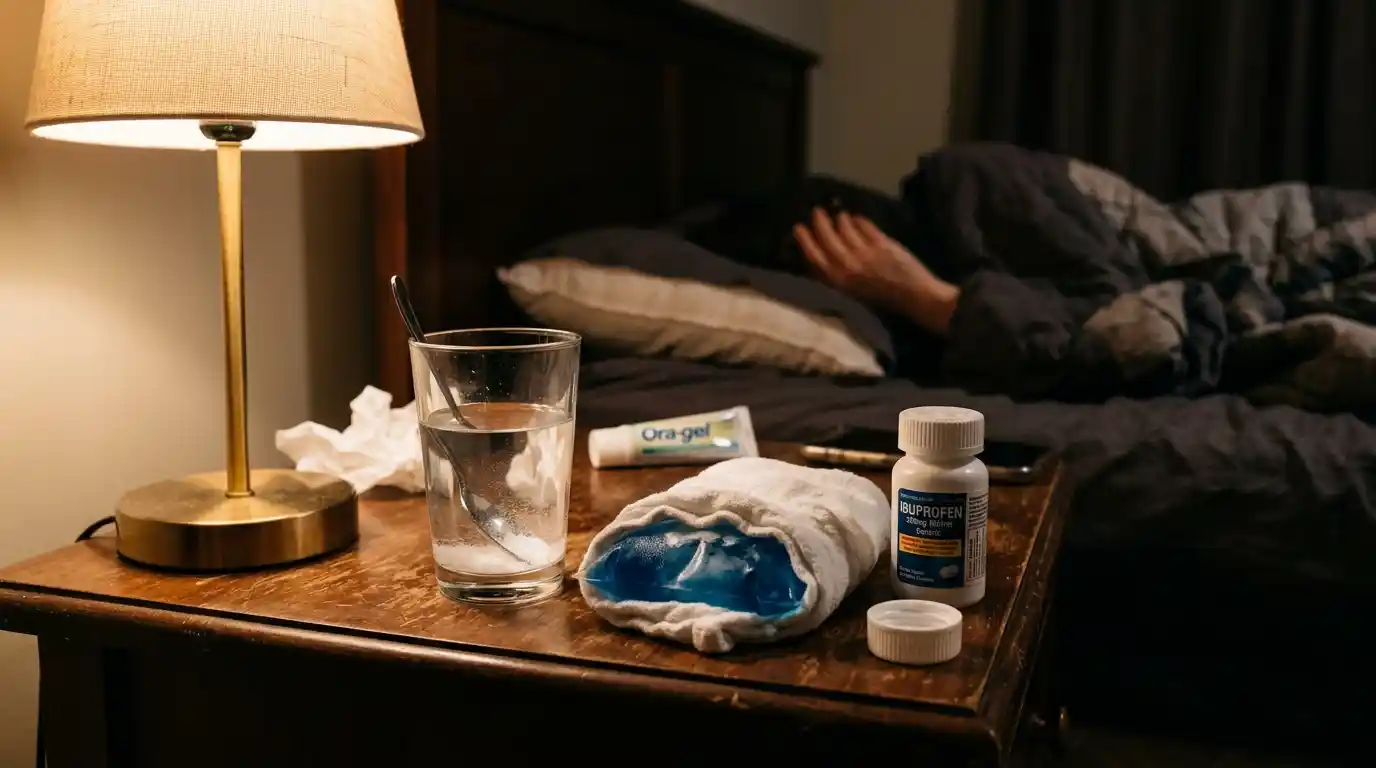
Tooth pain at 11pm on a Sunday is its own special misery. No dentist open, nothing helping, and half the internet telling you to rub garlic on your gum. I want to be straight with you upfront. A home remedy for toothache buys you time and comfort it doesn’t fix the underlying problem. Cavities, cracks, and infections need an actual dentist eventually, full stop.
But there’s a real difference between remedies that genuinely reduce pain safely and ones that are folk wisdom with no backing. Sometimes bordering on risky. This covers both, plus the specific warning signs that mean skip the home remedies entirely and go get seen now.
What Actually Works While You Wait
Cold compresses, saltwater rinses, and standard over-the-counter pain relievers are the three most consistently backed options across dental. And medical guidance not the more exotic stuff you’ll find on some “19 natural remedies” listicle.
Cold Compress How Long Should I Ice It?
Twenty minutes on, then off, repeated several times a day. Using an ice pack or a bag of frozen vegetables wrapped in a towel rather than ice directly against skin. This is especially useful in the first 24 to 36 hours after any trauma-related tooth pain. Since cold reduces swelling and genuinely numbs the area somewhat.
Saltwater Rinse What’s the Actual Ratio?
Half a teaspoon to a full teaspoon of salt dissolved in an 8-ounce glass of warm water. Swished for about 30 seconds to a minute, then spit out don’t swallow it. This is one of the oldest remedies around and it holds up. Since saltwater has genuine mild antiseptic properties and can help dislodge food debris irritating the area. Do this a few times a day, not constantly; over-rinsing can irritate already-inflamed tissue.
Over-the-Counter Pain Relievers Which One Actually Works Best?
For most adults, ibuprofen tends to outperform acetaminophen for dental pain specifically. Since ibuprofen is an anti-inflammatory (an NSAID) and a lot of tooth pain involves inflammation, not just raw nerve signal. Acetaminophen works differently and doesn’t reduce swelling the same way. Always follow the dosing instructions on the package. Or check with a pharmacist if you’re unsure I’m not going to hand out specific milligram numbers here. Since that genuinely depends on your age, weight, and health history, and getting it wrong matters.
One thing worth knowing: some dentists suggest alternating ibuprofen and acetaminophen for particularly stubborn pain. Since they work through different mechanisms. Don’t do this without checking with a pharmacist or dentist first, though especially if you’re on other medications, pregnant. Or have a history of ulcers or kidney issues, all of which change what’s actually safe.
Remedies With Weaker Evidence That Still Might Help
This is the murkier middle ground not proven the way saltwater and ibuprofen are, but not nonsense either, and low-risk enough to try if you’ve got the ingredients.
Clove Oil Does It Actually Numb Pain?
Yes, to a degree clove oil contains eugenol, a compound with real mild numbing and antibacterial properties, which is why dentists have used it historically. One or two drops on a cotton ball pressed against the sore area, not soaked in and left indefinitely, is the typical approach. Don’t apply it directly and undiluted straight onto broken skin or an open wound in the mouth, since it can irritate tissue at full strength.
Peppermint Oil Is There Real Evidence Here?
Weaker evidence than clove oil, but a similar mechanism a mild cooling, slightly numbing sensation from menthol. One or two drops on a cotton pad held against the gum, or steeping peppermint tea and letting it cool before rinsing with it, are the two common approaches. Think of this as a comfort measure, not a genuine fix.
Hydrogen Peroxide Rinse What’s Safe Here?
Diluted only equal parts 3% hydrogen peroxide and warm water, swished and spat out, never swallowed. Undiluted hydrogen peroxide straight from the bottle can genuinely burn oral tissue, so don’t skip the dilution step assuming “more concentrated equals more effective.” It’s not; it’s just more likely to hurt you.
Remedies to Skip Entirely
A few things circulating in home remedy lists are either unproven with real risk attached, or actively bad ideas.
Why You Shouldn’t Put Aspirin Directly on Your Gum
This one’s genuinely common advice and genuinely wrong. Aspirin is acidic, and holding a tablet directly against gum tissue can cause a chemical burn an actual tissue injury, not a minor irritation. Take aspirin orally as directed if you’re using it as a pain reliever; never apply it topically to a tooth or gum.
Garlic Paste Worth Trying?
The evidence here is thin, mostly anecdotal, and garlic paste held against already-inflamed tissue can sometimes irritate it further rather than help. If you want to try it, know you’re working with tradition rather than solid backing, and stop if it makes things feel worse rather than better.
When a Home Remedy for Toothache Isn’t Enough
Here’s the part that actually matters most. Home remedies exist to get you comfortable until you’re seen they’re not a substitute for dental care, and some symptoms mean you shouldn’t be relying on home treatment at all.
What Symptoms Mean I Need Emergency Care, Not a Home Remedy?
Facial or jaw swelling, fever alongside the tooth pain, difficulty breathing or swallowing, or a foul-tasting discharge are all signs of a possible dental abscess a genuine infection that can spread and become dangerous if untreated. These symptoms mean an emergency room or emergency dentist, not another round of clove oil.
Is It Ever Just a Sinus Issue, Not a Tooth Problem?
Sometimes, yes sinus pressure can refer pain to your upper back teeth in a way that feels exactly like a toothache but isn’t dental at all. If the pain comes with other sinus symptoms pressure across the cheeks, congestion and there’s no visible tooth damage, it might be worth checking with a doctor rather than assuming it’s purely dental.
What About Children or Pregnant Women?
This deserves its own mention because dosing and remedy safety genuinely shift here. Most standard OTC pain relievers have different guidance for children under 16 versus adults, and some aspirin specifically shouldn’t be given to children at all due to Reye’s syndrome risk. During pregnancy, several common pain relievers carry different safety profiles depending on trimester. In both cases, skip guessing and call a pharmacist, pediatrician, or OB before medicating this is exactly the kind of situation where a quick phone call beats a home-remedy list.
Conclusion
A home remedy for toothache buys you comfort and time, nothing more. Cold compresses, saltwater rinses, and appropriately dosed OTC pain relievers have real backing behind them; clove oil and diluted hydrogen peroxide sit in a reasonable middle ground; aspirin applied directly to a gum is a genuinely bad idea disguised as folk wisdom. And if you’re dealing with swelling, fever, or trouble breathing or swallowing, skip the remedies altogether and get seen urgently that’s not a toothache anymore, that’s an infection that needs real treatment.
FAQs
Home remedies are meant to get you through a day or two until you can get a dental appointment, not as an ongoing substitute for treatment pain that persists more than a couple of days, or that’s worsening rather than improving, needs professional evaluation.
Some dentists do recommend alternating the two for stronger relief since they work differently in the body, but check with a pharmacist or dentist first, especially if you’re on other medications or have any underlying health conditions.
Generally yes in small amounts a drop or two on a cotton ball pressed against the area but avoid applying it directly and undiluted to broken skin or open sores in the mouth, since it can irritate tissue at full strength.