

After 25 years in her home, a NerdWallet reader began noticing cracks in the plaster, doors not closing properly, and windows getting stuck, as well as problems with gutters that wouldn’t drain water properly. By 2024, an expert evaluation showed that the foundation was sinking, needing many steel piers to be placed underneath, along with a deck and porch removed to get access, with costs exceeding $50,000. The house foundation repair would not be covered by homeowners insurance. She funded them using a HELOC loan, making additional payments to pay off the loan quicker.
The same thing happens all around the nation in every climate and soil condition imaginable. The part that really makes it difficult to read is the nature by which these signs come into existence as gradual warnings disguised as minor annoyances until it is too late. Doors that don’t close properly, small cracks in walls, an uneven floor, and sinking steps –these are no longer simply cosmetic issues. They are structural warnings from beneath the ground, and the sooner you recognize them, the difference is between $750 in crack sealing and $50,000 in pier work.
Reading the Warning Signs Before Foundation Damage Becomes Structural Failure
The symptom profile for active foundation movement is broader than most homeowners realize. The obvious ones cracks in walls, uneven floors, bowing walls get attention. The subtle ones get rationalized away for months or years before the damage forces action.
Horizontal Cracks In Basement Walls
Horizontal cracks in basement walls are the most urgent warning sign in any foundation damage inspection. They indicate lateral soil pressure from expansive clay soil or hydrostatic pressure building against the foundation wall left unaddressed, horizontal cracks progress to bowing basement walls and eventually structural failure. Diagonal cracks running from window corners or door frames at roughly 45 degrees signal differential movement part of the foundation settling or shifting independently of the adjacent section. Staircase cracks in brick or stone mortar lines follow the same differential settlement pattern and should be photographed and dated from first observation. Widening cracks and recurring cracks that reappear after patching are active foundation movement, not cosmetic issues.
Beyond Cracks
Beyond cracks, sloping floors, soft floors, sagging floors, and floors that bounce in pier and beam homes indicate deteriorating support structures below. Sticking doors and sticking windows point directly to foundation shifting door frames and window frames bind when the structural members supporting them move out of square. Gaps between walls and ceilings, separation in concrete slabs at floor level, sinking porch, sinking steps, water in crawl space, wet basement conditions, musty smell and mildew odor, poor indoor air quality from rotten beams or rotten joists, insects around foundation, and visible mold are all early warning signs serious enough to warrant a professional inspection rather than a monitoring approach.
ASHI And Structural Engineers
ASHI and structural engineers consistently note that ASHI calls differential movement from poor drainage one of the leading causes of foundation problems that standard insurance will not cover. Before calling any foundation repair company, hire an independent structural engineer not a contractor offering a free inspection, which is a sales call. An independent engineer costs $500 to $800 and produces an engineering report that documents actual conditions rather than maximum repair scope. A real example from HBG Civil: a homeowner quoted $28,000 for helical pier installation received an independent engineer’s report showing only 3 piers were actually needed, not the 12 proposed. Final cost after the engineer’s recommendation: $9,500.
What Causes Foundation Damage: Soil, Water, Roots, and Construction Failures
Knowing how foundation damage happens is more important than many homeowners realize, since the cause of the problem dictates the repair process, the longevity of the repairs, and whether the problem is covered by homeowner’s insurance.
Soil
Clay soil is the main factor responsible for house foundation repair in residential structures in America, especially in Texas and other southern regions where there is repeated cycle of wet expansion followed by contraction of the soils due to dry seasons year after year. The cracking and sloping of the foundations as a result of the different movements made by wet portions of the soils that are being pushed upwards and dry soils shrinking next to them results in what we refer to as clay soil foundation settling.
Drainage
Drainage problems and grading issues are listed as the two most preventable sources of foundation damage by Allstate, Nationwide, Progressive, Bankrate, and U.S. News. Improper drainage results in the accumulation of water around the foundation, which leads to the formation of hydrostatic pressure on the basement walls, erosion of the soil under the slab, and differential movement according to ASHI. Water accumulation occurs as a result of missing gutters, the proximity of downspouts to the house, and the inclination of the ground surface towards the foundation.
Tree Root
Tree root growth causes foundation problems through two mechanisms: roots physically displacing soil and pushing against the foundation, and roots drawing high volumes of moisture from soil beneath the house creating a drastic moisture level change that shrinks soil and causes settlement. A rule of thumb cited by Bankrate: one foot of safe planting distance for every inch of tree trunk diameter. Plumbing leaks and burst pipes supply line rupture specifically saturate soil under a slab creating heave or cracking that can qualify as a sudden and accidental covered peril under homeowners insurance, unlike gradual causes that fall under maintenance exclusion.
Freeze Thaw Cycles
Freeze-thaw cycles in colder climates, vehicle collision, falling objects, storm damage, and seismic activity are event-based causes that may qualify as covered perils. Termites, rodents, burrowing animals, insects, and pest infestation damage structural members in pier and beam crawl spaces through wood rot and soil displacement. All of these cause and effect connections matter at the insurance claim stage, because the distinction between sudden and accidental damage and gradual deterioration determines whether the adjuster approves or denies the claim.
House Foundation Repair Methods: From Epoxy Injection to Smart Foundation Sensors
The repair method for any house foundation repair project depends on foundation type concrete slab foundation, pier and beam foundation, basement foundation, crawl space foundation, pile foundation, stem wall, or raised foundation combined with the specific nature and severity of the movement. Choosing the wrong method produces a temporary fix that returns within years at higher cost than the correct method would have cost initially.
Epoxy Injection And Crack Injection
Epoxy injection and crack injection handle hairline cracks and non-structural crack sealing at $100 to $400 for a DIY epoxy injection kit, appropriate for cracks less than a quarter-inch thick showing no signs of active movement. Polyurethane foam injection high-density polyurethane foam pushed through penny-sized holes, curing in 15 minutes compared to 24 to 48 hours for mudjacking lifts sunken concrete slabs, fills voids under foundations, and levels driveways and garage floors with a 50-plus-year lifespan. Mudjacking and slabjacking using grout injection pump cement-sand slurry beneath the slab at $500 to $1,300, effective but heavier and requiring replacement within 5 to 10 years compared to polyurethane foam longevity.
Helical Pier Installation
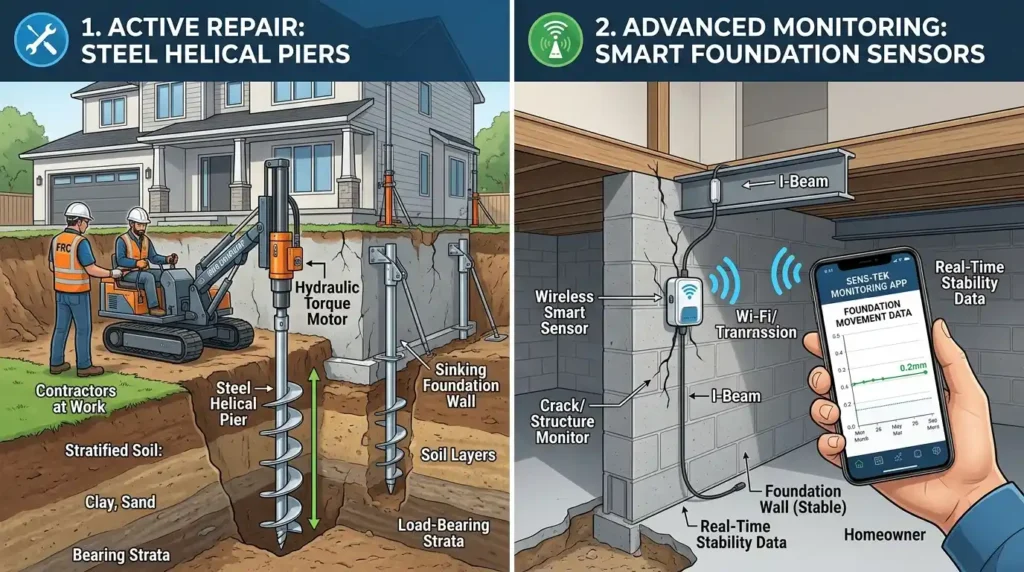
Helical pier installation drives galvanized steel shafts with helical plates deep into stable soil sometimes 30-plus feet down, well past unstable expansive clay layers. Helical pier cost runs $1,000 to $3,000 per pier in underpinning, and most homes need 6 to 12 piers for total project costs of $10,000 to $30,000. Steel push piers and hydraulic piers are driven hydraulically to bedrock or load-bearing soil for severe foundation settling, costing $8,000 to $30,000 for the system.
Pressed pilings combine concrete and steel for load transfer in constrained access situations. These pier systems are engineered as permanent solutions when properly installed by certified professionals, and FEMA’s retrofitting standards apply for homes in high-risk seismic zones, flood-prone areas, and expansive clay soil regions.
Wall Anchors
Wall anchors stabilize bowing basement walls through counter-tension to stable exterior soil a cost-effective solution for bowing walls with moderate lateral movement. Carbon fiber straps and carbon fiber reinforcement bond tensile strength directly to the interior face of bowing walls without adding bulk, requiring no excavation, and maintaining a 25-year lifespan when properly installed. Steel reinforcement strips and steel reinforcement serve the same structural purpose for more severe bowing wall cases where carbon fiber tensile strength is insufficient alone.
The foundation repair 2026 trend generating the most professional interest is Bluetooth-enabled smart foundation sensors providing real-time monitoring of structural shifts via smartphone. These devices attach to critical points in the foundation or structure and track movement continuously, alerting homeowners and engineers before cracks widen to critical stage. Combined with eco-friendly polyurethane foam and modern helical pier engineering, smart foundation sensors represent a genuine shift from reactive repair to proactive foundation management a fundamentally different approach to house foundation repair that the industry is moving toward steadily.
Crawl Space
Crawl space encapsulation, interior drainage systems, sump pump installation with battery backup, perimeter drains, French drain installation, surface drains, swales, and exterior waterproofing address the moisture intrusion and hydrostatic pressure root causes that structural repairs alone cannot permanently resolve. Repairing a bowing wall without eliminating the soil pressure and water accumulation that caused it produces recurrence. Tim Tracy from Groundworks puts this plainly: address the water first, then the wall. Grade the soil with a 6-inch drop over 10 feet, extend downspouts 4 to 6 feet from the foundation, install a sump pump if the basement floor sits at or near grade, and the water problem that caused the structural problem stops recurring.
For a 2 to 4 day minor pier installation project, noise and vibration from pier driving is present but evacuation is unnecessary. Moderate repair timelines of 3 to 5 days cover wall reinforcement and waterproofing systems. Major full leveling and excavation-heavy work takes 5 to 7 days or more. Contractors can work one section at a time to minimize disruption. Always ask about noise, dust, and cleanup before signing. Require a detailed written quote specifying repair method, materials, number of piers if applicable, timeline, and cleanup responsibility. Bundle related services drainage, landscaping removal, tree removal, waterproofing, and structural repairs together to lower labor and equipment costs versus separate contractor mobilizations.
Foundation Repair Costs, Insurance Coverage, and Financing the Right Way
House foundation repair costs in 2026 sit at a national average of approximately $5,100 to $5,179 across multiple sources This Old House, Angi, HomeAdvisor, and Modernize with most homeowners spending $2,200 to $8,100 on a single project. The PowerLift Foundation Repair median sits at $7,500 from 2024 to 2025 contractor pricing data. Today’s Homeowner’s national average lands at $4,500. Minor cosmetic crack sealing runs $250 to $800.
Moderate repair including partial settling and moisture issues runs $3,000 to $7,000. Severe structural shifts, bowing walls, and major leveling projects run $15,000 and up. Full foundation replacement after lifting the house costs $20,000 to $23,000 for lifting alone, with total replacement reaching $20,000 to $100,000 depending on foundation type and home size.
Regional repair cost variation follows labor and soil patterns: Southern states run 15 to 25 percent below the national average, Pacific coast and New England markets run 20 to 35 percent above. RSMeans 2026 Building Construction Cost Data and the HomeAdvisor 2025 True Cost Guide compiled from over 40,000 projects are the two most reliable reference sources for verifying regional quotes before accepting or rejecting bids.
Homeowners Insurance Coverage
Homeowners insurance coverage for house foundation repair is narrower than most homeowners expect at claim time. Standard dwelling coverage Coverage A covers foundation damage only from sudden and accidental covered perils: fire, severe windstorm, storm damage, falling objects, vehicle collision, and certain burst pipe events where supply line rupture saturates soil and causes heave or cracking that links clearly to the event.
Gradual deterioration, settling, soil movement, soil erosion, soil expansion and contraction, maintenance exclusion, wear and tear exclusion, neglect exclusion, faulty construction exclusion, tree root exclusion, termite exclusion, rodent exclusion, and pest infestation damage are all explicitly excluded. Flood damage requires separate NFIP flood insurance. Earthquake damage requires a separate earthquake insurance policy or endorsement. Sinkhole coverage and landslide coverage require state-specific endorsements where available.
In her capacity as the Executive Director of the Private Risk Management Association, Diane Delaney suggests that installing vents in the crawl spaces is a low-cost option to relieve the pressure on foundation walls during storms and could even bring down flood insurance rates. It’s something worth talking about with the contractor and the insurance provider. In cases where claims can be made, remember to have all documentation in place photographs and videos of the damage done, identify what caused the damage, notify the claims adjuster, and ask for a structural damage report. Valid claims will be paid up to the policy limits less the deductible amount.
House Foundation Repair Financing
House foundation repair financing when not covered by insurance: HELOCs are at about 8% to 9% as of Q1 2026, and they are tax deductible if used for a qualified home improvement purpose. The FHA 203k rehab loan package covers the cost of foundation repair by including it in the cost of purchasing the house where such repairs are needed. The contractor financing from GreenSky and EnerBank is popular; however, read the promotion terms closely since some promotions will convert into 26.99% APR if they are not paid off during the promotion period.
Personal loans are for small repair under $10,000 at 8% to 18% interest rate without any requirement for collateral. USDA Section 504 loan for up to $40,000 and USDA Section 504 grant for up to $10,000 for very low-income rural homeowners needing structural repairs can be checked via the NCEES website for membership of engineering licensees on state boards.
Conclusion
The field of house foundation repair is where early intervention means low cost and late intervention means high cost more than in any other category of home improvements. The difference in cost between a $400 epoxy injection system on a hairline crack and a $50,000 structural multi-pier repair is almost always defined by the amount of time the warning signs were ignored prior to taking any action.
Obtaining a second opinion from an independent structural engineer, learning what types of damages homeowners insurance covers and doesn’t cover, and resolving the water drainage issues that are responsible for the structure damage prior to doing anything about the damage itself, these are the decisions that determine if the house foundation repair will be an affordable home improvement task or a personal financial catastrophe.
FAQs
House foundation repair involves correcting cracks, settlement, bowing walls, or other structural movement affecting a home’s foundation. Warning signs such as widening cracks, uneven floors, sticking doors, or sinking steps should be professionally evaluated before the damage becomes more severe.
Epoxy injection is generally suited to small, non-structural cracks that show no active movement. Helical piers are designed for more serious settlement problems and transfer the home’s weight to deeper, more stable soil.
Keep water moving away from the house by maintaining gutters, extending downspouts, correcting poor grading, and addressing basement or crawl-space moisture. Fixing drainage problems early can reduce hydrostatic pressure and soil movement around the foundation.
The article places the typical national cost at roughly $5,100, although minor crack repairs may cost only a few hundred dollars while major structural work can reach $15,000 or considerably more. The final price depends on the type of damage, repair method, foundation design, location, and number of piers or structural supports required.