
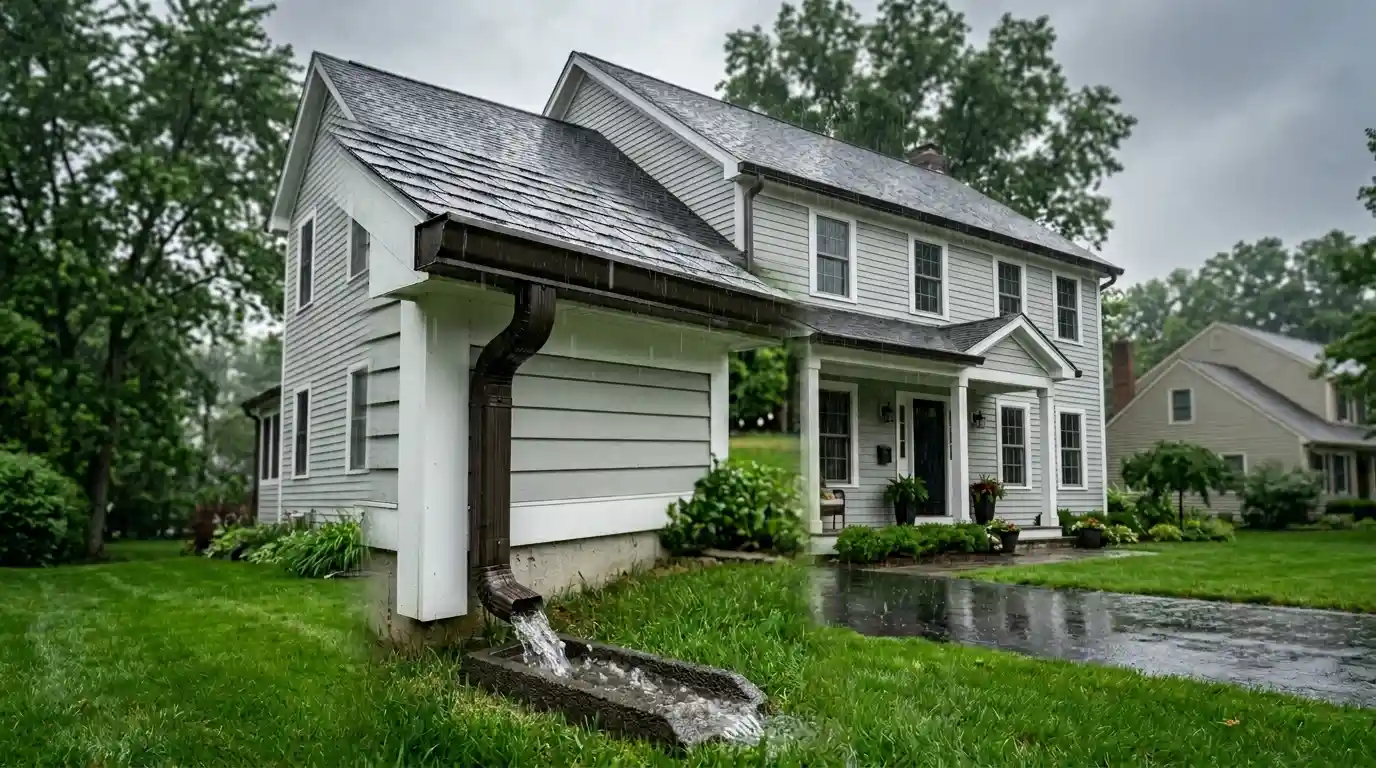
I have watched a foundation crack develop over two seasons because someone kept putting off a $200 gutter repair. The gutters were sagging, the downspouts were clogged, and every time it rained, water was pooling right against the base of the house. The homeowner knew something was off there was tiger striping running down the siding, dark lines left by dirt and pollen washing over the gutter lip but it did not look urgent enough to act on.
If the siding below your gutters has taken water damage, it is worth reading up on vinyl siding cost and what the estimate usually misses before you call anyone. Then came the basement flooding, then the foundation cracks, then the $14,000 structural repair estimate. All of it, traceable back to a rain gutter system ignored for three years. That is the thing about rain gutters. Invisible when they work. You do not think about rainwater channeling or stormwater management until the system fails. This guide covers material, style, sizing, maintenance, and repair before something expensive forces the conversation.
What a Rain Gutter System Is Actually Managing
A drainage solution sounds simple collect roof runoff, direct it away from the foundation. The execution is where it gets complicated. Every time it rains, your roof funnels the full volume of water landing across its square footage down toward the edges. Without a properly pitched and sized system, that water hits directly below the roofline. On clay-rich soil, which drains slowly, it saturates the ground right against the foundation. Soil erosion starts. Foundation cracks follow. Basement waterproofing gets overwhelmed. Fascia boards rot. The soffit goes with them.
Rain chain alternatives and drip path systems exist but overflow in moderate rainfall and genuinely are not a substitute for a properly installed gutter system on most residential homes. Homes with large roof overhangs, proper landscape gradation sloping away from the foundation, and dry climates may manage without gutters most homes do not meet all three conditions.
The Six Gutter Materials — What Each One Is Actually Worth Long-Term
Most homeowners price gutters by the linear foot without factoring in lifespan. That math produces the wrong answer almost every time.
Vinyl gutters run $3 to $6 per linear foot. Lightweight, rust-free, and beginner-friendly for DIY gutter installation. But plasticized PVC degrades under UV exposure and thermal expansion cycles cracking in cold climates, warping in hot ones. Vinyl gutter lifespan sits at 10 to 15 years. In mild climates with light rainfall they are a reasonable budget choice. Anywhere else they are the most expensive option disguised as the cheapest one.
Aluminum gutters at $6 to $12 per linear foot are the standard recommendation for most homes, and deservedly so. Lightweight, rust-resistant, available in a range of colors, compatible with seamless fabrication, and they last 20 to 25 years with reasonable maintenance. The weakness is denting aluminum dents and stays dented, which matters if your site has tree coverage or your installer is careless with the ladder.
Galvanized steel gutters at $9 to $20 per linear foot bring real strength. They handle heavy rainfall and snow loads better than aluminum, with a lifespan of 20 to 30 years. The maintenance requirement is also real galvanized steel rusts when the protective coating wears, and in coastal areas where salinity in the air accelerates corrosion, they need consistent attention. Professional installation is typically required because the weight makes them dangerous for one person to handle at height.
Copper gutters starting at $25 to $40 per linear foot last over 50 years and develop a self-sealing protective patina over time. They add genuine curb appeal and home equity on historic or high-end properties. That kind of material decision sits inside a wider set of exterior design choices that hold up beyond the first impression. Some homeowners maintain the original finish that adds ongoing maintenance cost. Others prefer the greenish-blue patina that develops naturally. A long-term investment that makes financial sense on a house you plan to own for decades.
Zinc gutters at $35 to $45 per linear foot are the premium end. Pre-weathered zinc forms a self-healing patina that obscures surface scratches as it develops, and a zinc gutter system can last 80 years or more with minimal maintenance. Heavy, requiring professional installation, and expensive upfront but no other residential gutter material comes close on lifespan.
Wood gutters in cedar, fir, or redwood are essentially a historic restoration choice today required by some district regulations, expensive, and demanding in maintenance. Worth knowing exist; rarely the right answer for a new installation.
K-Style vs Half-Round vs Seamless — Getting the Gutter Style Right
K-style gutters are the most common residential choice. The K-style silhouette — flat back, flat bottom, decorative front resembling crown molding — nails directly to the fascia board without brackets. They carry more water volume than half-round gutters of the same width, which makes them the right call for rainy climates and steep roofs with high runoff velocity. The downside: debris collects in the inner angles, sits, and rots. K-style gutters need more frequent cleaning and are harder to clean thoroughly than half-round.
Half-round gutters have a smooth, curved interior that cleans more easily and clogs less often, even without gutter guards. The curved sides cannot sit flush against the fascia board, so they require brackets and hangers, which adds installation complexity. They hold less water volume than K-style for the same width a real consideration in heavy rainfall areas. Many historic neighborhoods require half-round by HOA covenants or historic district regulations.
Seamless gutters are a construction method, not a shape custom-cut on-site from a single piece of material using a rolling machine. Eliminating joints and seams reduces leak points, slows debris accumulation, and cuts long-term maintenance. They require professional installation and cost $8 to $28 per linear foot installed versus $3 to $20 for sectional systems. For most homeowners the reduced leak risk and lower repair frequency justify the difference.
Sizing, Pitch, and Downspouts — The Measurements DIY Installs Get Wrong
The most common gutter installation mistake is undersizing. A 5-inch K-style gutter handles most standard residential roofs. Homes in heavy rainfall areas, homes with large roof square footage, or steep-pitched roofs with fast runoff velocity need 6-inch gutters. The upcharge is $1 to $2 per linear foot trivial against the cost of gutters that overflow during every significant rain event.
Downspout sizing matters equally. Too few downspouts, or downspouts undersized for local rainfall intensity, causes gutters to back up, spill over, rust, and leak. One downspout per 20 to 30 linear feet of gutter is the general rule, adjusted upward for heavy rainfall climates. Gutter pitch the slope from the closed end toward each downspout needs roughly one quarter inch of drop per 10 feet of gutter run. Too little and water pools, accelerating rust in steel systems. Too much and water overshoots the downspout opening at the end.
Downspout extensions and splash blocks direct water at least three feet from the foundation. Downspout hinges, which run $10 to $25, let the extension fold up out of the way during mowing a small detail that removes a genuine weekly frustration.
Gutter Guards — What Type Works and What Does Not
Gutter guards reduce cleaning frequency. That is the entire value proposition. They do not eliminate maintenance but extend intervals and reduce full blockage risk.
Mesh screen guards at $2 to $4 per linear foot cover the gutter opening with mesh that blocks leaves while letting water through the standard recommendation for most homes with tree coverage. Micro-mesh guards use finer mesh that catches pine needles, which matters enormously for homes near pine trees where standard cleaning every three months is otherwise required.
Foam filter guards and brush gutter guards drop directly into the gutter channel and install easily, but both tend to accumulate fine debris in their material over time, eventually becoming a planting medium for moss and weeds inside the gutter itself. Surface tension topper guards at $5 to $15 per linear foot are the most effective and lowest maintenance option water follows the curved surface into the gutter while debris falls clear but the cost is significantly higher.
Maintenance Schedule and Repair vs Replace Decision
Clean rain gutters at minimum twice per year early spring before the heavy rain season and early fall after leaf drop. Pine needle areas need cleaning every three months. Start near the downspout and work toward the closed end, removing dry debris with a gutter scoop before flushing with a garden hose. Flush the downspouts separately disconnect the elbows and clear them independently, because a clear gutter with a blocked downspout still does not drain.
Annual inspection covers: sagging sections and loose hangers, cracks at seams and gutter joints, fascia board condition behind the gutter, soffit staining, rust on steel systems, downspout elbow connections, and the soil line along the foundation for erosion patterns.
Repair makes sense for isolated damage a leaking seam sealed with gutter sealant, a hole patched with roofing cement and metal flashing, a loose hanger replaced with a new gutter screw. Gutter repairs average $100 to $450. Silicone caulk handles gaps at thermal expansion points.
Replace when: gutters are over 20 years old with multiple simultaneous issues, rust has spread across large sections of a galvanized steel system, sagging traces back to rotted fascia board underneath rather than loose hangers, or the system is undersized and repairs would leave the fundamental drainage capacity problem unsolved. Full replacement on an average home runs $2,800 to $5,200 in 2026. If you are already thinking at that budget level, it is worth understanding which home additions that pay back and the mistakes that don’t before committing to where the money goes. New installation on a home without existing gutters runs $2,000 to $5,500.
Fascia board replacement adds $5 to $12 per linear foot. Replacing both fascia and soffit together adds $9 to $34 per linear foot. Get three quotes. Ask about sizing upgrades, downspout count, and gutter guard options specific to your system. Check licensing, insurance, and warranty before signing a one-year labor warranty is standard on professional installation, and some installers extend that on seamless aluminum systems.
Conclusion
Rain gutters are one of those systems that earns zero attention when they are working and all of it when they are not. The material you choose, the style you install, and how consistently you clean and inspect it those three decisions determine whether your gutters protect your home for the next 25 years or quietly cause damage that costs ten times what the gutters themselves were worth. Get the fiber type wrong on a rug and you damage a rug. Get the gutter system wrong and you are looking at foundation repairs, rotted fascia, and basement water damage on the same invoice. The time to think about it is before the problem, not after.
FAQs
A rain gutter system collects runoff from the roof and directs it away from the foundation through properly pitched gutters and downspouts. This helps reduce soil erosion, basement water problems, and moisture damage around the fascia and soffit.
K-style gutters carry more water for their size, making them practical for steep roofs and areas with heavier rainfall. Half-round gutters are easier to clean and less prone to trapping debris, but they hold less water and usually require brackets for installation.
A 5-inch K-style gutter works for many standard residential roofs, while larger roofs, steep roof pitches, and heavy-rainfall areas may need 6-inch gutters. Downspout capacity also matters, so the system should be sized according to both roof runoff and local rainfall conditions.