
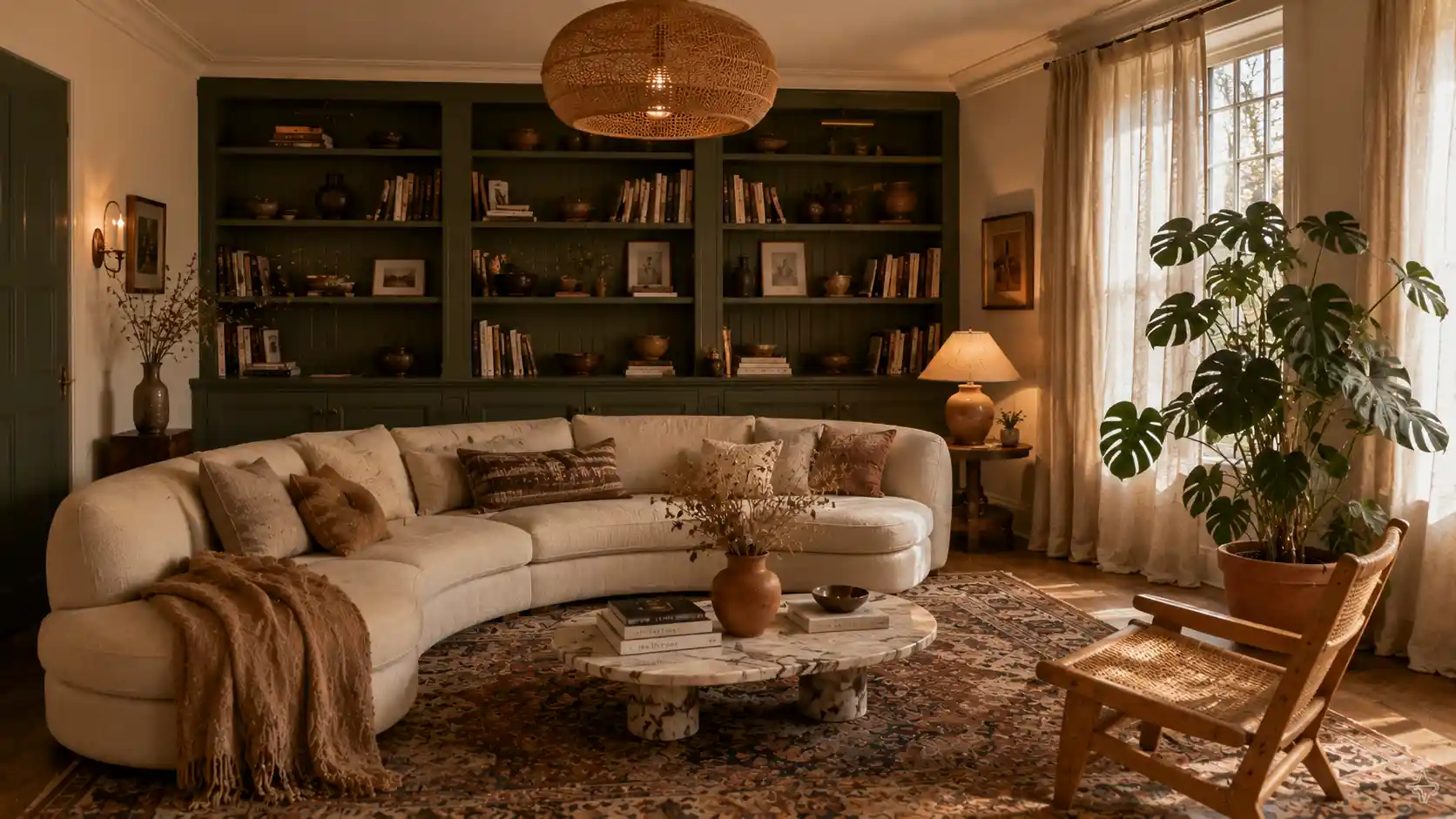
Ideas for Designing a Living Room
Here’s something nobody tells you about living room budgets: the room absorbs roughly 38% of interior design spending in most American homes, and yet it’s still the one people feel least satisfied with after spending the money. I’ve watched clients drop $20,000 the median US renovation spend in 2025, per the Houzz and Home Study of 10,176 homeowners and still end up with a room that didn’t feel finished. What went wrong wasn’t the furniture they chose.
It was the order they chose it in. Color picked before anyone checked how the light actually moves through the room at 4pm. A sofa bought before the layout was resolved. Accessories layered onto a foundation that was still being figured out. Ideas for designing a living room stop going sideways the moment you flip that sequence layout first, everything else after.
I’ve been at this long enough to know the mistake that shows up most often. It’s not the color. It’s not the sofa style. Over and over, it’s the furniture pushed flat against every wall, which makes a room feel like a doctor’s waiting area no matter what’s hanging on those walls. The 2025 Apartment Therapy real-home tour analysis confirmed what designers have been saying for years: the floating arrangement outperforms wall-hugging layouts across every room size they looked at. Ideas for designing a living room that genuinely work start by pulling furniture away from the walls and seeing what happens. Almost always, what happens is the room suddenly makes sense.
Layout First — the Foundation Every Other Ideas for Designing a Living Room Decision Rests On
Layout isn’t decoration. It’s infrastructure the decision that everything else either supports or fights against. Getting it settled before spending on anything else is the one principle that ideas for designing a living room consistently prove out.
The Floating Arrangement and Why It Changes Everything
When you push a sofa against a wall, your instinct is that you’re freeing up floor space. What you’re actually doing is creating a room where everyone sits around the edge staring at the center which starts to feel oddly formal, even in a casual space. Pulling furniture 12 to 24 inches off the walls and anchoring the whole arrangement with a central rug does something counterintuitive: it makes the room feel bigger, not smaller. Traffic runs around the outside of the seating rather than threading through it, which is both more comfortable and considerably less chaotic on a busy evening.
There are some numbers worth knowing here. The front legs of every piece should sit on the rug, not just touch it. The sofa back ideally lands no more than 8 feet from the coffee table further than that and the conversation zone starts to dissolve. Leave 18 inches of clearance around furniture so people can actually move without squeezing. None of this is arbitrary design preference. These are the clearances that make a living room feel generous to be in rather than just look generous in photographs.
Zoning, Focal Points, and Multi-Functional Layout Logic
Living rooms in 2026 are being asked to do more than they used to. The hybrid work living room, the living dining combo, the space that needs to handle a film night on Tuesday and a work call on Wednesday these are real scenarios that layout planning has to account for. Zoning solves it: distinct gathering zones for different uses, defined by rug placement, lighting, and furniture orientation rather than by walls. A TV zone separated from a reading zone.
A relaxing zone tucked away from the work area. A conversation area that actually faces the fireplace focal point rather than a screen. Symmetrical layouts around a fireplace read settled and formal; asymmetrical ones with a curved sectional and an accent chair at an angle read more casual and collected. Neither is wrong but picking one intentionally produces something specific, and that specificity is what makes the room feel designed.
Color, Palette, and the Ideas for Designing a Living Room That Most Guides Get Wrong
Color doesn’t fail rooms because of wrong choices. It fails because of wrong relationships between the choices which is a different problem that the 60-30-10 rule fixes cleanly. 60% dominant color across walls and large surfaces. 30% secondary in upholstery and bigger textiles. 10% accent through cushions, throws, accessories. That ratio is the color scheme relationships framework, and it works.
The Palette Combinations Worth Actually Committing To
Warm white plus natural wood is the one that never stops working walls in warm white, floor or furniture in wood tone, indoor plants as the third element. It adapts to modern, to cottagecore, to transitional, to almost anything. Navy plus warm brass is the second reliable move: deep navy on a sofa or accent wall, brass in the hardware and the lamp bases, and you get sophisticated without cold. Sage plus cream handles changing light better than almost any other combination, which is probably why it appeared in more 2025 and 2026 design coverage than any other palette.
The undertones stay warm through the day even as the room itself shifts. For those after something bolder a deep green sofa plus blush accents, electric blue walls with acid green accessories, color drenching painting walls and ceiling and trim in one continuous saturated hue the ideas for designing a living room point to doing it with full commitment rather than half measures. Partial boldness reads unresolved. Full commitment reads intentional.
Starting With Walls Rather Than the Sofa
Designers say this constantly and homeowners almost never do it: start with the walls, not the sofa. A warm white or greige wall gives you maximum flexibility nearly any sofa works against it. A bold wall locks you into a neutral sofa response, which actually simplifies the furniture decision rather than complicating it.
The long-term sofa choice that ages best is still a textured neutral in linen, bouclé, or velvet because it layers with seasonal throw pillows without dating. Don’t match the sofa color to the rug exactly the color scheme relationships between large pieces should involve contrast, not coordination. And test paint on large samples in your actual space at different times of day. That chip that looked perfect under fluorescent store lighting will surprise you at 6pm with the lamps on.
Furniture, Materials, and the Ideas for Designing a Living Room That Last Beyond Trends
Something shifted in what people actually want from living room furniture. The clean-lined boxy minimalism that ran through the last decade is losing ground to pieces with visible craft detail, personality, material honesty. Call it tailored elegance if you want a label.
Sofa Style, Fabric Choice, and the Longevity Question
Curved sofas and low-slung silhouettes are running the 2026 ideas for designing a living room conversation right now, alongside something that would have surprised anyone five years ago: floral patterned sofas. Emma Sherlock put the practical case for them plainly a patterned sofa breaks up a room more easily than a plain one, and any marks are considerably less visible. Tufted sofas, skirted furniture, fringe accents things that were considered dated are back because the design climate is actively rewarding craftsmanship and personality over restraint.
For longevity though, fabric matters more than silhouette. Performance fabric resists staining while still looking elevated. Linen breathes and layers well with seasonal textiles. Bouclé ages gracefully but needs more care in households with kids or pets. Velvet photographs beautifully and needs brushing to maintain its look daily. Nubby fabric and sherpa work well as accent chair choices enough texture to be interesting without locking the primary sofa into a trend cycle it might outlive.
Natural Materials, Artisanal Quality, and the 2026 Texture Direction
At Milan Design Week 2025, Architectural Digest editors flagged the defining material shift of 2026 as something you can feel rather than just see: the maker’s hand, visible in the object. Wide-plank oak flooring where the knots and grain aren’t hidden. Reclaimed wood with tool marks and hand-shaped edges left intact. Ceramics with uneven glaze on open shelving, because the irregularity is the point.
That’s the artisanal quality direction it runs through woven leather, rattan, bamboo, wicker, natural stone, terracotta, and the biophilic materials movement broadly. Colorful glass has also arrived in force amber, cobalt, and emerald pendant glass that shifts in intensity between daylight and artificial light, animating a room’s palette through the day rather than just sitting in it. Embroidered wood surfaces, fused glass tabletops, hand-tooled furniture joints left deliberately exposed these are the details that give a living room the layered character that flat, smooth, uniform surfaces simply don’t accumulate.
Lighting, Wall Decor, and the Finishing Ideas for Designing a Living Room That Seal the Atmosphere
Get the layout right, the color right, and the furniture right and then light the room badly. That’s where ideas for designing a living room still fall apart most often at the final stage.
Layered Lighting and the End of the Overhead-Only Approach
A single ceiling fixture, even a genuinely beautiful chandelier, doesn’t light a living room. It illuminates it, which is a different thing entirely. Layered lighting means ambient lighting from the ceiling for general brightness, accent lighting from a picture light or concealed LED strip to define specific surfaces, and task lighting through a floor lamp or table lamp where someone’s actually reading or working.
Warm dimmable output at 2700K makes earth tones and warm neutrals glow at night in a way that cooler light never manages. Mirrors placed opposite windows do something no light fixture can — they double the natural light already in the room without any wiring. Circadian lighting, which shifts warmer in evenings and cooler during daytime hours, changes not just how the room looks but how the body responds to being in it through a long day.
Wall Decor, Built-Ins, and the Library Wrap Trend
The library wrap floor-to-ceiling built-in bookcase coverage across one or more walls is having its moment in 2026 living rooms for good reason. It solves the media wall problem, adds architectural depth, and makes a room feel like it was designed from the inside out rather than furnished from a showroom. Meg McSherry’s blue built-in bookcase, painted to drench the shelving and the wall in the same tone, shows what a single architectural decision can do to a room’s entire character.
Wall paneling, ribbed surfaces, and limewash walls all do a version of the same thing they add texture and depth to the background before any art or accessories come near it. Checkerboard flooring searches jumped 38% on Houzz in 2025, which is a floor-level detail that changes the entire visual foundation of a room for less money than most people assume. Curtains hung at ceiling height rather than at window frame level draw the eye upward and add ceiling height without a single structural change.
Accessories, Plants, and the Collected Feel That Finishes Everything
When people ask me what makes the difference between a designed room and a furnished one, I usually point at the accessories specifically at the ones that clearly weren’t chosen at the same time from the same shop. The pre-loved patinated quality of antique furniture alongside a contemporary sofa. Secondhand pieces that carry some evidence of a previous life. A vintage rug that’s slightly the wrong colour in a way that somehow pulls the whole room together anyway. Houzz’s 2026 trend data is specific about this: vintage and curated pieces mixed with modern frames and contemporary materials is the exact counterweight to showroom-ready uniformity that ideas for designing a living room are moving toward.
Indoor plants deserve their own mention a fiddle-leaf fig, an olive tree, a monstera because the organic scale and natural texture they bring in is genuinely not replicable with any purchased object. One large area rug instead of several smaller ones unifies the floor. Decorative vases, sculptural objects, coffee table books in odd number groupings with staggered heights read as collected rather than placed. Meaningful objects and sentimental decor give a room the quality of belonging to someone specifically, which is the thing that matters most.
Conclusion
Ideas for designing a living room work best when they follow a sequence rather than when they chase individual decisions. Layout before anything else. Color informed by the actual light in the room, not just by what worked in a photo. Furniture chosen for longevity and material quality alongside style. Lighting built in deliberate layers rather than assigned to one ceiling fixture. Accessories chosen over time rather than all at once. That sequence protects the budget, produces results that hold up past the first year, and creates rooms that feel like they belong to the person living in them which, in the end, is the only outcome that actually counts.
Frequently Asked Questions
Pushing furniture against all four walls. It’s in more than half of American living rooms and it makes even beautiful furniture feel like it’s waiting for something to happen. Pulling sofas and chairs 12 to 24 inches off the walls and anchoring the arrangement with a central rug is the fastest single improvement most living rooms can make.
It’s a ratio, not a prescription. 60% of the visual surface goes to the dominant color walls, large furniture, flooring. 30% goes to the secondary color upholstery, curtains, a large rug. The remaining 10% carries the accent through cushions, throws, accessories, and small objects. The relationships between those three tiers matter more than any individual color chosen.
One large rug instead of multiple smaller ones. Curtains hung at ceiling height rather than at window frame level. A mirror positioned opposite the main window. Furniture floated away from walls with a low sofa back rather than a high one. These four changes, costing almost nothing compared to renovation, consistently change how large a room reads.
Curated maximalism, biophilic design, quiet luxury, wellness-oriented interiors, and the broader collected-over-time aesthetic are the directions with staying power. The shared thread is personality-led design rooms that carry evidence of who lives in them rather than rooms that look like they arrived fully formed from a catalogue.