
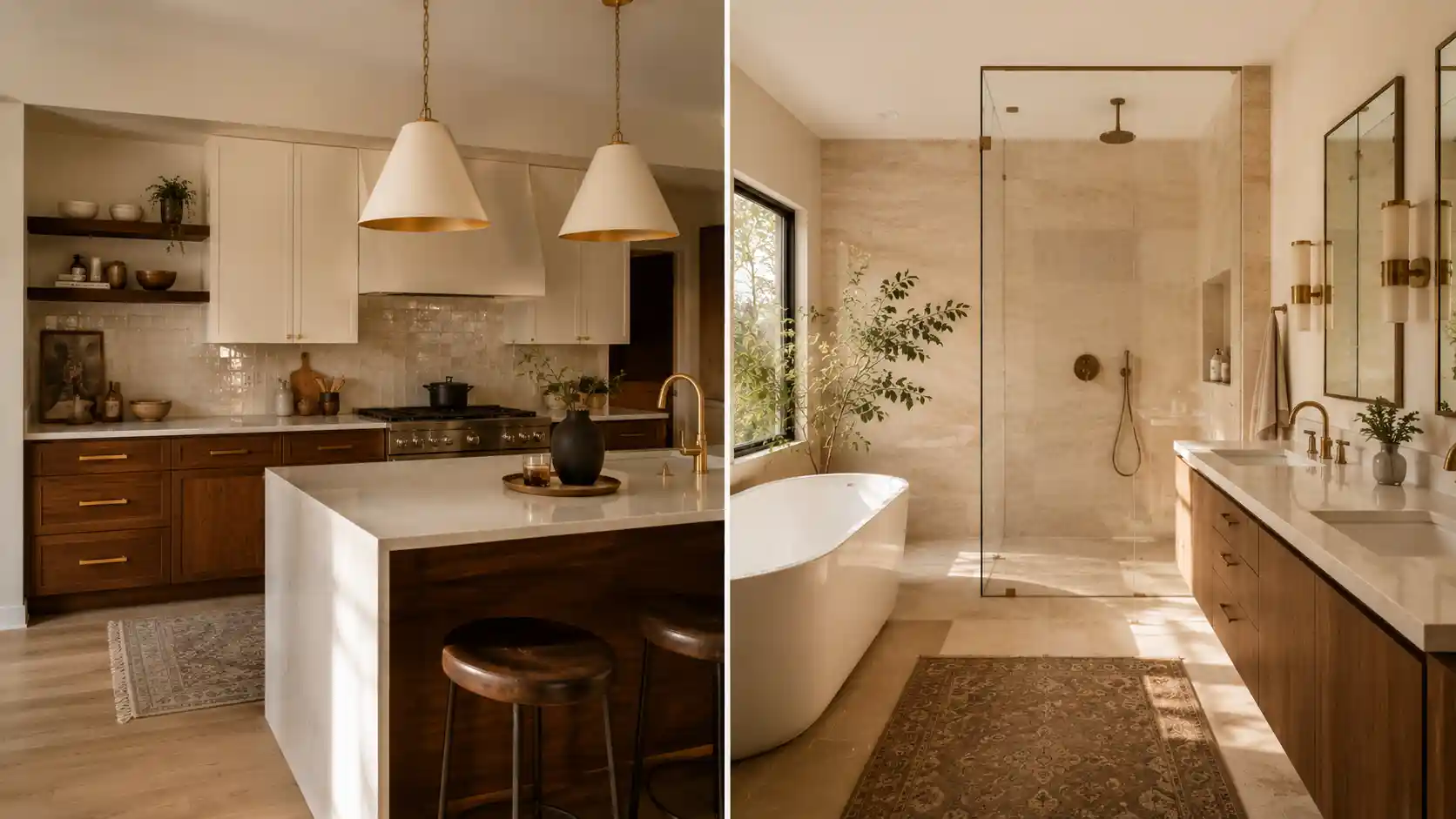
There’s a kitchen I still think about. Galley layout, about nine feet wide, in a terraced house that had been chopped up and put back together badly over the decades. The owner had been working around it for six years moving diagonally to get from the fridge to the hob, storing pans in the living room because the upper cabinet arrangement left no accessible space below the countertop, and dealing with a circulation path that required two people to execute a three-point turn just to pass each other. The kitchen wasn’t small. It was badly planned. Two weeks later, no structural work, no moving of walls, no new appliances just a rethought kitchen layout, a cabinet selection that used the actual vertical height of the room, and pull-out organizers that gave back what the deep drawer storage had been swallowing and it worked. Properly worked. That’s what kitchen and bath design actually does when it’s done from the floor plan outward instead of from the showroom inward.
Kitchen & Bath Design by DrHomey starts there. With the plan, not the finish. With how the room functions before how it photographs.
The global kitchen and bath industry reached $228 billion in 2026. The NKBA 2026 Bath Trends Report compiled from surveys of nearly 700 industry experts across designers, architects, manufacturers, and remodelers confirms that personalized design and lifestyle-driven spaces have replaced trend-chasing as the primary driver. The kitchen remodel services market sits at $22.66 billion in 2026, projected to nearly double to $47.76 billion by 2035 at a 9% CAGR. Seventy-six percent of designers expect the kitchen footprint to increase over the next three years, even as overall home sizes trend smaller. The kitchen and bath are no longer renovation afterthoughts. They are the rooms that anchor how a house functions and feels, and they’re the two rooms homeowners consistently cite as the most personal, most used, and most resistant to compromise.
Kitchen Layout — the Decision That Determines Everything Downstream
Most kitchen renovation projects start with cabinets or countertops. They should start with the kitchen work triangle or in 2026, with the zones that have begun to replace it.
The work triangle is a vintage rule from the 1920s: connect the refrigerator, the sink, and the stove in a triangle, maintain 4 to 8 foot spacing on each side, and the kitchen workflow will follow naturally. It still holds for straightforward single-cook kitchens, particularly in L-shaped kitchen, galley kitchen, and one-wall kitchen configurations where the logic maps directly onto the layout. What’s changed is that modern kitchens now routinely need multiple prep zones, refrigerator drawers at a second location, a dedicated wet zone around a second sink, and appliance grouping that accounts for integrated appliances that didn’t exist when the triangle was codified.
The U-shaped kitchen gives the most working perimeter and the most natural circulation path but it closes down quickly in anything under twelve feet between faces. The G-shaped kitchen and peninsula kitchen add a partial fourth wall that solves the U’s closing problem while creating a natural division between the kitchen entertainment zone and the dining area. For open plan kitchen layouts, the peninsula or kitchen island does the spatial work of a wall without blocking sight lines. A waterfall island with kitchen island seating creates a social layer in the kitchen that no amount of dining room renovation can replicate the kitchen becomes the social hub, which is precisely where 2026 household behaviour has landed. The kitchen and bath design consultation process at DrHomey maps all of this before cabinet selection, tile selection, or fixture selection happens, because every one of those decisions flows from the kitchen floor plan, not toward it.
Traffic flow matters at every scale. A kitchen island that adds beauty but reduces the circulation path to less than 42 inches creates daily frustration. An appliance garage that closes off countertop space while solving clutter introduces a new constraint every time something needs plugging in. The kitchen design brief DrHomey builds with every client specifically interrogates these tradeoffs before the 3D kitchen rendering is built, because a rendering of a plan that doesn’t work is just an expensive illustration of a problem.
Kitchen Materials and Finishes — What 2026 Actually Looks Like
The material shift happening in residential kitchen design right now is significant. Only 29% of designers now prefer all-white kitchens, down from what was near-universal a decade ago. Light wood stain has become the top cabinet finish preference for 2026. Two-tone designs have increased 15% over two years. Shaker cabinets are losing ground to flat-front cabinets and frameless cabinetry with cleaner lines, while inset cabinetry is pulling in the opposite direction more traditional, more handcrafted kitchen in feel, slower to execute, but considerably more durable.
The color picture: forest green cabinets, deep blue cabinets, mushroom taupe cabinets, cabernet red cabinets, and warm cream cabinets are all active in client projects DrHomey handles, usually deployed as bold lower cabinetry against a lighter upper cabinet the two-tone cabinetry approach that gives a kitchen both grounding and height. Warm neutrals kitchen palettes with warm wood tones on open shelving kitchen sections are sitting alongside nature-inspired palette choices in a way that reads organic and intentional rather than trend-led.
Kitchen countertops have diversified. Quartz countertop remains the volume leader for durability and consistency. Granite countertop retains its position in traditional and English country kitchen aesthetics. Marble countertop Carrara marble specifically is back in earnest in the softened traditional style kitchens that dominated KBIS 2026 in Orlando. Sintered stone and porcelain countertop are gaining ground for their heat and scratch resistance. Butcher block remains the tactile choice for prep zones where warmth and replaceability matter more than pristine maintenance.
Kitchen backsplash decisions are where personality enters. Zellige tile and handmade tile have moved well past niche status their imperfect surfaces and tonal variation read exactly as the organic shapes and natural materials trend the market is responding to. Subway tile remains functional and reliable. Mosaic tile works where a pattern anchor is needed. Grout selection and how little attention most people give it determines whether the backsplash reads as one surface or as tile interrupted by lines.
Hardware tells the rest of the story: brass hardware, brushed gold hardware, and antique brass finish are the warm-metal choices; matte black hardware against light wood stain creates contrast that photographs strongly; chrome hardware and brushed finish sit within the transitional style kitchens that don’t want to commit fully to warm or cool.
Bathroom Design — When the Most Personal Room Finally Gets Treated That Way
The NKBA 2026 Bath Trends Report is direct about where bathroom design is heading: bath design is becoming deeply personal, driven by personal rituals, self-care routines, bath layout personalization, and the kind of sensory comfort and emotional resonance that the bathroom used to be the last room to receive. Larger showers have been outpacing tubs for several years the curbless shower, the oversized shower with integrated shower seating, a shower niche or two, frameless glass door, and a rain showerhead or multi-function showerhead combination have become the primary bathroom upgrade most clients prioritise above everything else.
The soaking tub is not gone. A freestanding bathtub clawfoot tub, drop-in tub, or a clean-lined contemporary soaking tub positioned as the focal point of a primary bathroom or ensuite bathroom is one of the most photographed elements in residential design for a reason. It works. The question is whether the bathroom floor plan supports it without making the shower zone feel like it was added as an afterthought. That’s the bathroom layout conversation DrHomey has at the start of every bathroom remodel service engagement.
Floating vanity, double vanity with a marble vanity top or quartz vanity top, wall-mounted faucet or deck-mounted faucet — the vanity zone carries a disproportionate amount of visual weight in a bathroom. Vessel sink above a floating vanity reads contemporary; undermount sink in a double vanity reads transitional to traditional; pedestal sink in a powder room or half bath reads architectural. None of these is correct by default. They’re correct in context. Context is the bathroom design brief.
Finish choices have shifted considerably. Matte black finish bathroom has been dominant long enough to be considered established rather than trendy. Brushed gold finish and champagne bronze finish are the warmer alternatives particularly strong against light neutrals bathroom palettes and warm wood bathroom elements. Unlacquered brass ages in a way that polished nickel finish and chrome finish don’t, developing a patina that actually suits the organic aesthetic bathroom direction of 2026. Antique brass bathroom fixtures pair well with travertine, limestone, and soft stone tile floors that light neutrals bathroom schemes are built on. Large format tile continues expanding fewer grout lines, cleaner visual field, better suited to the spa-inspired bathroom feeling that wellness bathroom design is now consistently delivering.
The smart bathroom layer is moving faster than most homeowners realise: smart mirror with LED integration, chromotherapy lighting in the shower zone, aromatherapy shower heads, steam generator connected to a steam shower, smart thermostat bath integration, touchless faucet and voice-activated faucet in accessible configurations, heated towel rail on a timer these are no longer luxury features. They’re the health-oriented bathroom features and stress-reduction bathroom tools that the NKBA’s survey of nearly 700 experts specifically flagged as becoming mainstream in 2026. Aging-in-place bathroom features universal design bathroom principles, accessibility features bathroom, integrated shower seating, curbless shower are being designed into primary bathrooms from the start rather than retrofitted, because the rooms built correctly now don’t need to be rebuilt in fifteen years.
Smart and Sustainable Kitchen and Bath — the Layer That Pays Back Over Time
Smart kitchen appliances market was valued at $12.4 billion in 2022 and is projected to grow at an 18.5% CAGR through 2030. That rate reflects something real: smart kitchen technology has crossed from novelty to utility, and appliance IQ is now a factor in kitchen design briefs the way traffic flow and countertop space were always factors.
Voice-activated faucet, touchless faucet, water-saving faucet, and aerated faucet technology aerated faucets globally save 1.5 trillion gallons of water yearly are standard considerations in DrHomey kitchen design consultations now, not upgrades. Smart water monitors have demonstrated 22% reductions in bathroom water usage. UV water purifier installations are moving from commercial to residential. Solar thermal water heater systems now represent 12% of EU bath installations. Smart home kitchen integration smart kitchen appliances connecting to smart storage solutions, appliance grouping coordinated with kitchen tech upgrades is changing how kitchen layouts account for power, connectivity, and ventilation simultaneously.
The sustainable materials kitchen layer runs alongside: reclaimed wood cabinets in the premium segment represent an $850 million market, bamboo flooring kitchen and cork kitchen flooring are active in eco-friendly cabinetry projects, low VOC finishes are a baseline specification rather than an upgrade in European markets, and the circular economy kitchen conversation modular kitchen waste reduction is documented at 40% in manufacturing is arriving in residential design consultation in a way that wasn’t visible three years ago. Hemp-based bath textiles, ocean plastic faucet options, zero-waste fixture packaging, and LEED kitchen design certifications are moving from specialist to mainstream at a pace that the $112.4 billion global kitchen bath hardware market’s 5.98% CAGR reflects directly.
FAQs
Kitchen and bath design is the process of planning these spaces around how people use them, including layout, storage, materials, fixtures, and daily routines. A well-designed kitchen or bathroom improves both functionality and the overall feel of a home.
The right kitchen layout depends on your available space, cooking habits, traffic flow, and storage needs. Popular options include L-shaped, galley, U-shaped, peninsula, and island layouts, with the best choice determined by how the space functions rather than just appearance.
The traditional work triangle still works well for simple kitchens, but many modern kitchens use multiple zones for preparation, appliances, and social activities. Kitchen islands and peninsulas now help create flexible work areas while keeping open-plan spaces connected.

2 thoughts on “Kitchen & Bath Design by DrHomey”