
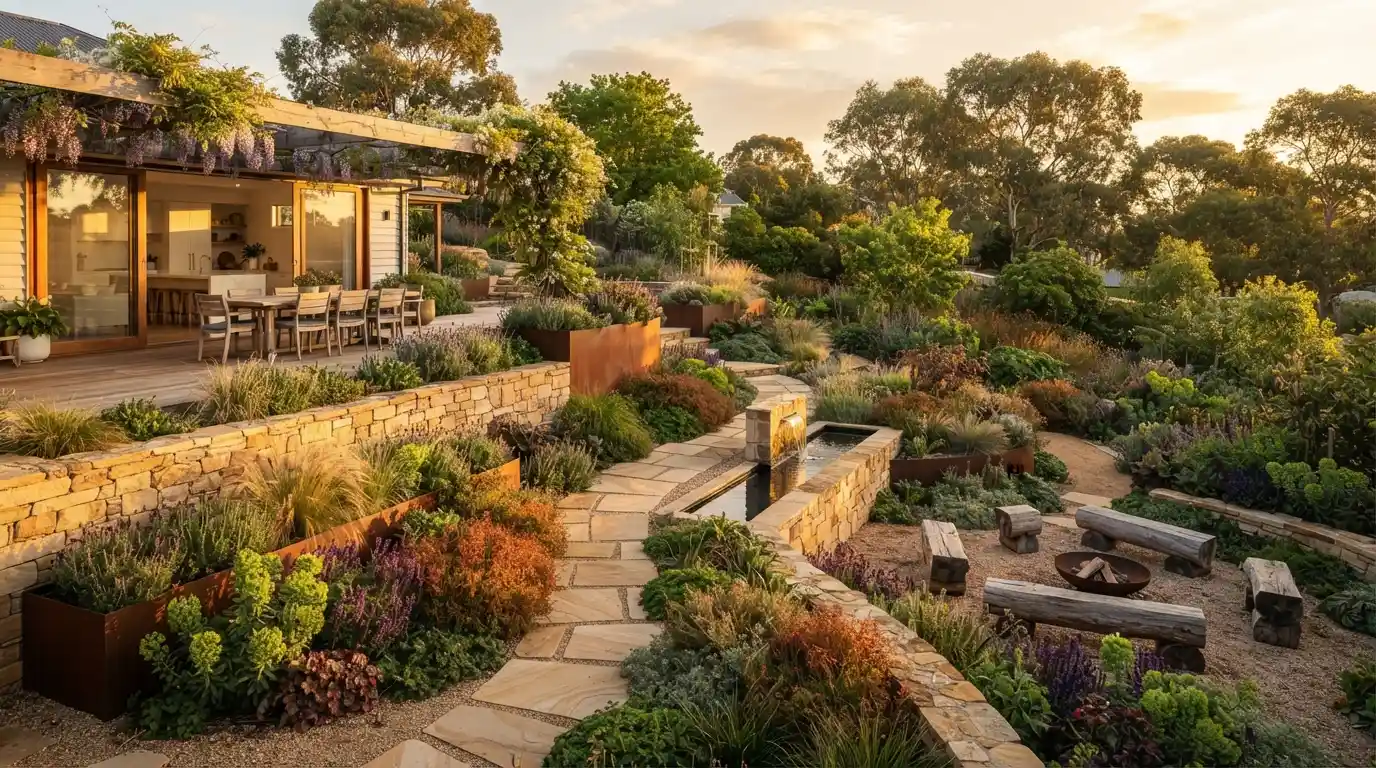
There is a particular kind of outdoor space that stops people mid-conversation. Not because it is dramatic or expensive, but because it feels inevitable as if it grew there rather than got built there. That quality doesn’t happen by accident. It happens when someone looked at the land carefully before touching it, understood what the site was already trying to do, and designed outward from that understanding rather than imposing a plan on top of it.
That’s the core of landscape ideas from morph, the design philosophy developed through KDArchitects that has been reshaping how homeowners think about outdoor space. Roger Morph and the Morph Design Co approach begins not with materials or plant selections, but with observation. What moves through the site? Where does light land in the morning versus the afternoon? Where does water naturally collect? How does the outdoor space relate to the rooms inside the house? These questions sound simple. The answers change everything.
Why Landscape Ideas from Morph Start With the Site, Not the Plan
Most landscape renovations begin with a catalogue. Someone picks a patio material, chooses some shrubs, and arranges them on a plan that could belong to any property on any street. Landscape ideas from morph starts somewhere different.
Observe Before You Plan: The Site-First Design Principle
The foundational move in morphic garden design is the site analysis. This means spending time on the property before committing to a single material or plant. A thorough site analysis covers soil analysis, slope analysis, light movement study, and water flow study. Where does stormwater collect during heavy rain? Where does shade fall at noon in July? These aren’t abstract questions. They are the structural information that determines whether a garden thrives or requires constant intervention to survive.
What I’ve seen on projects informed by this approach is that the site always has an opinion worth listening to before anyone starts drawing. Before a pencil comes out, a designer will walk the ground multiple times at different hours. Sloped ground gets a geotechnical assessment not because it’s procedure but because the soil has to be understood before retaining walls or terraced garden structures can be responsibly specified.
Flatter sites reward the same careful reading in a different way it’s what determines whether permeable paving sits where it should, whether planted swales will actually move water or just hold it, whether a rain garden will perform or become a boggy embarrassment by November. The difference between gardens built from real observation and gardens built from assumptions shows up within the first wet season.
How Structure-First Landscape Design Changes Everything
Landscape ideas from morph operates on a structure-first principle that separates it from conventional garden planning. Hardscaping comes before softscaping, always. The hardscape bones of a site retaining walls, curved pathways, pergolas, stepping stones, stone patio, terraced garden levels, seating walls — define the spatial composition before a single plant goes in. This sequence matters because hardscaping is permanent and expensive to change. Plants are flexible and can be adjusted. Getting the structural elements right first means the planting choices simply need to support and enhance the framework rather than compensate for a framework that doesn’t work.
Seeing a terraced garden with 300 to 600mm level shifts handled well for the first time is one of those moments where something clicks about how outdoor design actually works. Each tier had its own purpose that announced itself without a sign. Upper level pulled people naturally toward outdoor dining. Middle level gathered around a fire pit seating area. The lower level tucked away into a quiet relaxation corner at the garden boundary where nobody needed to be told to slow down. That kind of spatial logic is what the KDArchitects landscape ideas from morph approach builds in from the start, and it’s what separates a yard that works from one that just sits there.
Hardscaping Materials That Define Landscape Ideas from Morph
The material palette used in landscape ideas from morph is deliberately honest and deliberately durable. These are materials that age well rather than materials that look impressive on installation day and begin deteriorating within a season or two.
Raw and Reclaimed: The Material Philosophy Behind Morphic Landscaping
Corten steel planters, dry stone walls, gabion wall structures, raw log seating, and recycled timber pergolas appear consistently across landscape ideas from morph projects. Locally quarried stone and locally sourced materials sit at the heart of that palette for reasons that go beyond environmental responsibility. Sandstone cut from the same geological region as the soil beneath it carries a mineral coherence that imported materials simply cannot reproduce. There’s no design trick that closes that gap. Imported materials produce a low-level visual friction that most people feel without being able to name, and raw honest materials carry an ecological responsibility alongside their visual quality precisely because they sidestep it entirely.
Permeable paving and permeable concrete sit within the landscape ideas from morph material vocabulary because they handle stormwater management without fighting the site’s natural hydrology. Gravel walkways and gravel mulch pathways hold rainfall where it lands, letting it infiltrate rather than run. The maintenance reduction that comes with that is real and compounds across years. Stone paths with irregular geometry do something else: they push back against the rigid grid layouts that conventional garden design defaults to, and that resistance gives the fluid spatial composition in landscape ideas from morph its character across every project.
Corten Steel, Gabion Walls and the Structural Palette
There’s a quality to corten steel landscape applications that no applied finish can replicate, and it has to do with time. The material doesn’t fade. It deepens. By year three it has settled into a rust tone that reads as part of the earth around it rather than something placed against it. That quality of feeling earned rather than coordinated is the difference between a material that strengthens a garden over time and one that dates it.
A gabion wall filled with locally sourced aggregate works from the same logic: its structural retaining function is visible and honest, and the texture it introduces to a level change or boundary ties the built element back into the site’s own material character in a way that a poured concrete wall, however well executed, never quite manages.
Poured concrete fire pit surrounds and built-in grill stations anchor the cooking area and gathering space zones with a permanence that lightweight furniture cannot provide. A weather-resistant countertop integrated into an outdoor kitchen structure treats the cooking zone as a room rather than an accessory, which is consistent with the indoor outdoor flow principle that runs through all landscape ideas from morph work. The glass door connection between interior rooms and outdoor zones is always considered at the structural planning stage, ensuring that the patio extension or deck extension functions as a genuine continuation of the interior rather than a separate and disconnected area.
How Plant Selection Works in Landscape Ideas from Morph
Planting in the morphic approach is layered, structured, and deliberately restrained. The three-layer model — canopy layer, mid-story layer, and ground layer — creates visual depth and ecological complexity within a limited plant palette.
The Limited Plant Palette and Why Restraint Produces Better Results
The three to five species rule sounds like a constraint until you watch it working in the ground. Lavender, rosemary, and native grasses planted across a large bed in proper drifts rather than dotted around individually stop looking like plant choices and start looking like a landscape decision. The visual coherence that restraint produces is what separates a garden that feels designed from one that feels curated in the way that a Saturday morning at the nursery feels curated. Fewer species also behave more predictably season to season, and the limited plant palette delivers that reliability through care routines that don’t require a horticulturalist to manage.
Native plant landscape choices sit at the foundation of the planting philosophy because they earn their place through performance rather than appearance. Once established, native plants, drought-tolerant plants, and ornamental grasses ask for 20 to 30 percent less in maintenance costs than exotic alternatives. Pollinator gardens, bee-friendly gardens, butterfly gardens, and bird-friendly habitat gardens emerge as a consequence of those planting decisions rather than as a separate design ambition. Biodiversity planting through native species increases wildlife garden value while reducing the irrigation demands that drive long-term garden running costs upward. The anchor planting role goes to a sculptural tree or specimen tree, the structural focal point around which the rest of the plant composition organises itself.
Xeriscaping, Water Conservation and the Sustainable Landscape Vision
Landscape ideas from morph integrates xeriscaping as a practical and ecological principle rather than an aesthetic limitation. A properly designed xeriscape reduces water consumption by up to 50 percent compared to a traditional lawn, with a 500 square foot xeriscape costing between $3,500 and $9,165 professionally installed or $4,500 to $5,500 as a DIY project. The ROI payback period runs three to five years through reduced water and maintenance costs. California residents can access Santa Monica rebate programs offering $3.50 per square foot for turf replacement, up to $6,000 in total under California Title 24 provisions.
Rainwater harvesting through rain barrels costing $80 to $120 and underground cisterns, planted swales for stormwater management, drip irrigation, and smart irrigation systems all reduce water use further. Organic mulch and gravel mulch retain soil moisture between irrigation cycles. These are not expensive interventions. They are the water-wise landscape infrastructure that makes the plant choices sustainable in the long term rather than just at the point of installation.
What Landscape Ideas from Morph Delivers in Property Value Terms
The business case for landscape ideas from morph is supported by consistent data. NAR 2026 landscaping value data shows that professional landscape design increases home value by 10 to 20 percent. Hardscaping delivers a 60 percent ROI. Time on market reduces measurably for properties with designed outdoor spaces compared to comparable properties without them.
Design and Build Costs and What the Investment Returns
Professional design-build landscape work using the morphic approach costs between $5 and $45 per square foot depending on scope, material specification, and site complexity. Design-only services sit between $0.05 and $0.75 per square foot. The full-service KDArchitects engagement covers site analysis through to implementation, with parametric modelling and AI-assisted planning applied where the site complexity warrants them, and hardscaping and softscaping sequenced correctly rather than run in parallel.
Here is what I find consistently true about landscape ideas from morph: the results don’t peak on installation day and decline from there. A dry stone wall is more interesting at year five than year one. A corten steel planter stops looking like a purchase and starts looking like it was always there. A native plant mass planting fills in until the original spacing decisions become invisible and the bed reads as a single coherent form.
A gravel and stepping stone pathway gradually settles into the landscape rather than sitting on top of it. The morphic design philosophy is built around that trajectory: outdoor spaces that grow more genuinely themselves over time, more connected to the ecology around them, and more honestly valuable to the people who actually live within them.
Conclusion
Landscape ideas from morph offers a fundamentally different starting point. Site-first, structure-first, materials that age well: those three commitments produce outdoor spaces that feel like they belong to the land rather than sitting on top of it. A small urban courtyard, a xeriscaped front yard, a fully terraced backyard with outdoor dining and a fire pit zone: the morphic approach produces results that compound rather than deteriorate across time. The 10 to 20 percent home value increase, the 60 percent hardscaping ROI, and the long-term reduction in maintenance costs make landscape ideas from morph the most financially rational choice for homeowners who plan to stay, invest, and live seriously in their outdoor spaces.
FAQs
Q: What makes landscape ideas from morph different from standard garden design?
A: The morphic approach starts with a thorough site analysis before any design decisions are made. Structure comes before planting, materials are chosen to age well rather than look impressive on day one, and every design decision traces back to what the specific site actually needs rather than a generic plan applied across it.
Q: How much do landscape ideas from morph projects typically cost?
A: Professional design-build work using the morphic approach runs between $5 and $45 per square foot depending on scope, material specification, and site complexity. Design-only services cost between $0.05 and $0.75 per square foot. A 500 square foot xeriscape element within a larger project costs $3,500 to $9,165 professionally installed.
Q: Is the morphic landscape approach suitable for small yards and urban gardens?
A: Yes. The site-first, structure-first principles that define landscape ideas from morph apply regardless of scale. Compact urban courtyards and small front yards benefit from the limited plant palette, permeable paving, and zoned outdoor room approach just as much as larger suburban properties with room for terraced gardens and outdoor kitchens.
Q: What return on investment can homeowners expect from landscape ideas from morph?
A: NAR 2026 data shows professionally designed landscapes increase home value by 10 to 20 percent. Hardscaping delivers a 60 percent ROI. Xeriscaping reaches its payback period within three to five years through reduced water and maintenance costs, with California homeowners eligible for up to $6,000 in turf replacement rebates under existing programs.