
Home Additions
A neighbor of mine spent eighteen months planning a second story addition. Permits, architect, structural engineer, the whole sequence done correctly. Two weeks before construction started, she found out her HOA had a height restriction that her architect hadn’t checked. The addition she’d designed was six inches too tall. Six inches. The redesign cost four months and about $8,000 she hadn’t budgeted. Home additions are not a casual decision they’re one of the most complex and expensive projects a homeowner will ever undertake, and the gap between the ones that go well and the ones that don’t is almost entirely in the planning.
Overall annual homeowner spending on improvements is expected to reach $518 billion by end of 2026, with Thumbtack pros predicting multigenerational living additions as the single top design trend of the year. The average home addition cost sits at $51,029, though the real range runs from $21,903 for a straightforward room addition to $83,358 and well beyond for larger or more complex builds. Home additions done strategically are among the highest-return investments available in residential property. Done badly, they’re the kind of mistake that shows up in the listing notes when it’s time to sell.
The Types of Home Additions — and Which One Actually Fits Your Situation
Build Out vs Build Up: the First Decision That Determines Everything Else
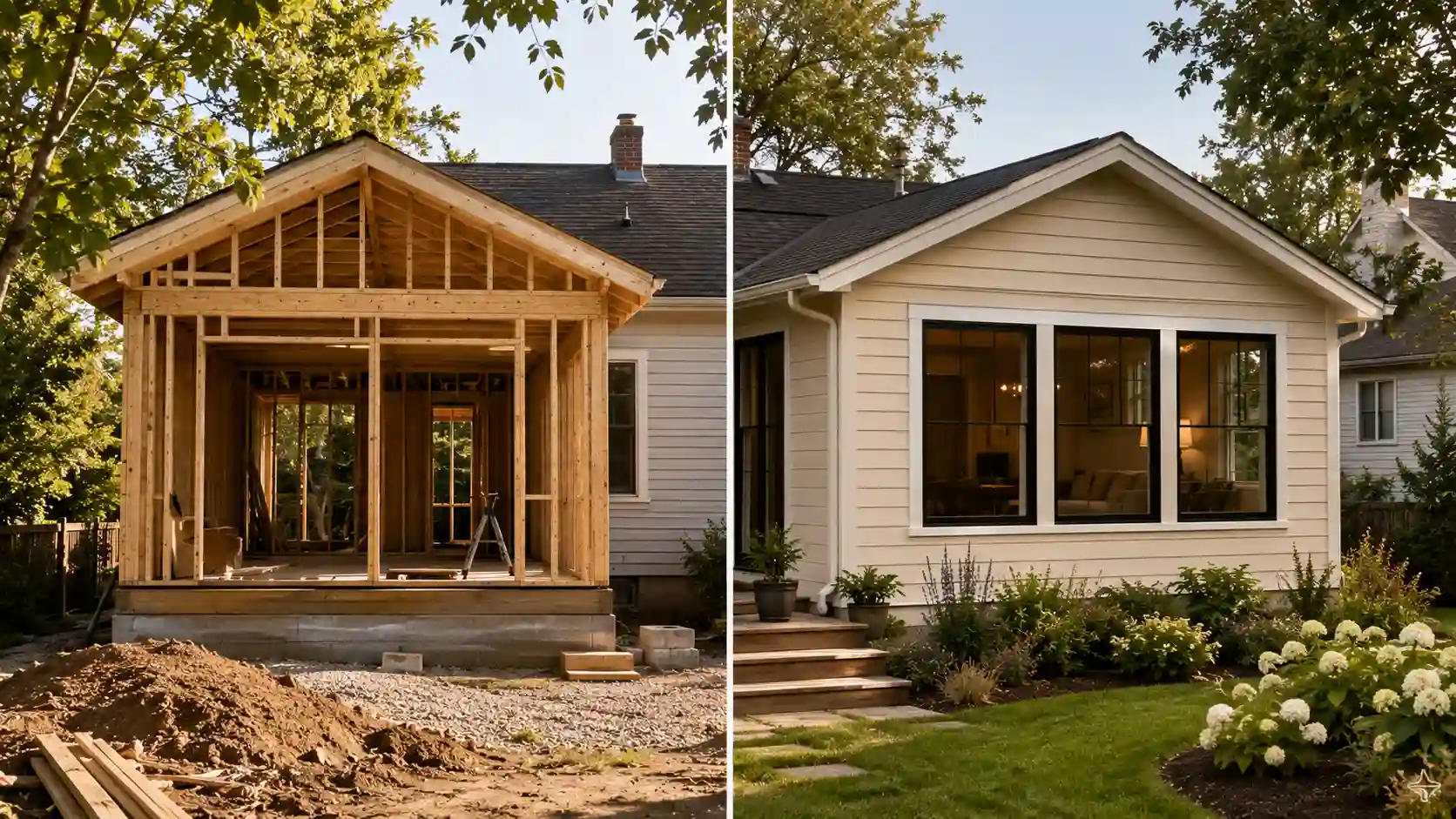
The most fundamental choice in any home addition project is direction: build out or build up. A horizontal addition ground level addition, rear extension, side extension, rear bump-out expands the footprint of the house across the lot. A vertical addition second story addition, full second story adds space without touching the yard. Both have their logic, and neither is automatically right.
Build out home additions cost between $80 and $200 per square foot, making them considerably cheaper than vertical builds, which run $300 to $500 per square foot and beyond. A 10×10 room addition costs around $12,500 built outward and $40,000 built upward. The second story addition cost range runs $100,000 to $250,000 for a standard project, with extensive builds reaching $600,000 or more.
The structural reinforcement required for vertical home additions load-bearing wall removal, second story structural reinforcement, new staircase, foundation engineering assessment before a single frame goes up is what drives that premium. To add a 700 sq ft second story with two bedrooms, a real-world example from a Seattle project came in at $282,000 including reinforced framing, new staircase, and upgraded electrical.
Bump-Outs, Sunrooms, and the Addition That Doesn’t Require Six Figures
Not every home addition needs to be a major structural undertaking. The bump-out addition is exactly what it sounds like an extension of 2 to 5 feet into an existing room, adding just enough space for a breakfast nook, walk-in pantry, or widened kitchen without a full foundation. Bump-out cost runs $4,000 to $30,000. A cantilever addition, which uses support beams rather than a full foundation to extend the upper floor, costs $15,000 to $25,000 and avoids the footprint changes that trigger setback requirements or lot coverage rules in many municipalities.
Sunroom addition sits in a different category. A three-season room enclosed porch that’s not heated costs considerably less than a four-season room that requires HVAC extension, insulation, and full weatherproofing. The four-season room blurs the line between a sunroom and a full room addition, which changes the permitting requirements and the cost in parallel. Balcony addition, porch addition, covered porch, and wraparound porch all sit at the lower end of home additions by cost but contribute meaningfully to lifestyle and market appeal.
ADU, Garage Conversion, and the Home Additions That Generate Income
The ADU accessory dwelling unit has become the most financially sophisticated type of home addition available to most homeowners. A detached ADU garden suite, backyard cottage, granny flat — or an attached ADU gives the option of rental income, multigenerational living addition, or long-term passive income from a property without selling it. Garage conversion is the most cost-efficient entry point: recouping up to 80% of cost according to JLC’s Cost vs Value Report, with a faster timeline than new construction. A garage ADU or carport conversion typically completes in 6 to 8 months, versus 8 to 12 months for most full home additions.
Loft conversion, attic conversion, and basement conversion follow similar logic transforming existing square footage rather than adding new footprint. An in-law suite addition, multigenerational living addition, or junior ADU JADU within existing structure carries lower cost and faster permitting than building new. Pool house conversion and prefab addition or modular addition are the two routes that move fastest when speed matters and the site is ready.
What Home Additions Actually Cost — the Numbers Most Guides Understate
Per Square Foot Reality vs What You See in Headline Averages
The per-square-foot number gets quoted most often because it’s the simplest benchmark. What it hides is significant. A bedroom addition costs $80 to $160 per square foot because it’s a dry addition no plumbing, relatively straightforward electrical, HVAC extension is the main service trade. A bathroom addition costs $150 to $200 per square foot because it’s a wet addition plumbing work, drain trenching, supply lines, tile, vanity, fixtures, and the fact that, as construction manager Mark Poulton notes directly, bathrooms are where homeowners make the most mid-build changes, which raises labor costs, material costs, and permitting costs in sequence.
Kitchen addition is the most expensive wet addition. Gas lines, heavy electrical loads for appliances, cabinetry, countertops the per-square-foot cost of a kitchen addition can double a standard bedroom addition’s cost on the same footprint. The primary suite addition runs at $124,000 for a 320 sq ft build in real-world project data, covering plumbing, finishes, permits, and exterior matching.
Soft Costs, Permits, and the Budget Line Nobody Adds Until It’s Too Late
Soft costs architectural fees, engineering fees, design fees, consultation fees, permit fees, and project management typically account for 20 to 30 percent of total home addition cost. Building permits alone run $150 to $7,500 depending on project type and local jurisdiction. Site prep costs add $1,500 to $5,000 before construction begins. Consultation and design fees run $150 to $1,000 at the early stage. Labor accounts for 40 to 60 percent of total cost $28,000 to $42,000 on an average project covering foundation pouring, framing, roof installation, exterior siding, window installation, door installation, and interior finishing.
A 10 to 20 percent contingency fund is not optional. Home additions of any type uncover surprises drainage complications, site complexity involving underground utilities or root systems, foundation conditions that require additional engineering, or energy efficiency requirements that 2026 building codes apply more stringently than those from five years prior. High performance insulation, triple pane windows, and smart home integration green building standards are now standard compliance items in many jurisdictions, not upgrades.
Planning, Permits, and the Regulatory Layer That Varies by Country
US Permitting — Zoning, HOA, and the Building Code Reality
Every home addition in the US requires a building permit. Zoning regulations, setback requirements, and lot coverage rules determine what’s physically buildable on a given lot before design even begins — which is exactly the lesson my neighbor learned with her height restriction. HOA approval adds another layer for anyone in a managed community, and HOA resale impact from non-compliant work can be severe. A design-build firm that handles permit pulling, architectural drawings, floor plans, elevations, and coordination with structural engineers streamlines this enormously. Hiring a licensed architect and structural engineer separately is standard for larger home additions; a design-build contractor absorbs both functions for projects where the integration matters more than separately managed fees.
UK and European Permitting — Permitted Development and When It Runs Out
In England, many home additions fall under permitted development rights that don’t require a full planning permission application. Single storey rear extensions up to 3 metres deep on terraced or semi-detached houses, or 4 metres on detached homes, fall within standard PD allowances. The Larger Home Extension Scheme extends those limits to 6 or 8 metres via prior approval through the local planning authority. Double storey addition planning requires 7 metre garden clearance to qualify under PD; otherwise, a full householder planning application is required through the Planning Portal UK.
Even when planning permission UK is not required, Building Regulations approval UK always is no exceptions. A Lawful Development Certificate costs £124 to £310 in 2026 and takes 6 to 8 weeks to process; it’s not legally mandatory but is strongly recommended before any construction begins, particularly for resale and remortgaging purposes. Building Control fees run £360 to £1,200 depending on scope. Structural calculations from a structural engineer are required for any load-bearing changes. Conservation area restrictions, listed building consent requirements, Area of Outstanding Natural Beauty restrictions, and Article 4 Direction limitations all sit outside standard permitted development rights and require early consultation with the local planning authority.
ROI, Financing, and the Value Logic Behind Strategic Home Additions
Which Home Additions Pay Back and Which Ones Don’t
Home additions ROI averages 20 to 50 percent across project types, but the variance within that range is significant. Bathroom addition ROI reaches 53%. Extra bedroom ROI and functional addition value for multigenerational living or ADU rental income can return well above the construction cost when the local rental market supports it. Primary suite ROI sits at 32% lower than a bathroom, because primary suites are emotionally valuable but less universally needed than an extra bathroom in a family home. Garage conversion ROI reaches 80% of cost recovered, making it consistently one of the best-performing home additions by financial return.
The renovation versus relocation calculation is real: home additions that keep a family in a neighborhood they love, in a school district that works, without competing in a volatile housing market, carry an emotional equity component that resale ROI doesn’t fully capture but that real estate agents like Allison Harris from Keller Williams and Jerome Leyba in Santa Fe consistently cite as a major driver of addition decisions in 2026.
Home Addition Financing — Matching the Loan to the Project
Home equity loan and HELOC home equity line of credit are the most commonly used routes for home addition financing, since they draw on existing property value and typically carry lower interest rates than personal loans. Cash out refinance works when rates are favorable. FHA 203k loan covers renovation financing for purchases that include immediate improvement needs.
Personal loan options from SoFi with limits up to $100,000 and LightStream, which offers a Rate Beat program and lower starting rates than most competitors, suit projects where equity access isn’t available or the construction loan timeline doesn’t fit. Prequalification, loan term selection, APR comparison, and borrowing limit confirmation all belong in the budget planning stage before the contractor quotes stage, not after.
Conclusion
Home additions are one of the few residential investments that simultaneously improve how you live in a property and protect what it’s worth when you eventually leave it. The range of options from a $4,000 bump-out addition to a $400,000 second story addition, from a garage conversion to a full ADU means there’s a version of home additions that fits almost any budget, lot, and life situation.
What determines whether a home addition goes well is almost entirely the planning: the sequencing of permits before construction, the contingency budget before the first quote, the zoning check before the design, and the honest ROI analysis before the commitment. Get that right and the space you build earns back what you put in. Miss it and you’re redesigning six-inch height restrictions for four months at $8,000 a lesson.
FAQs
Home additions are construction projects that create extra living space by expanding a home’s footprint or adding new levels. Homeowners often choose additions to improve functionality, support changing family needs, increase property value, or avoid moving to a new home.
The cost of home additions depends on the size, type, materials, location, and structural requirements. Average projects can range from around $21,000 for smaller additions to more than $80,000 for larger builds, while complex projects like second-story additions can cost significantly more.
Building out through a ground-level addition is usually more affordable, while building up with a second-story addition saves yard space but requires more structural work. The right choice depends on your lot size, budget, zoning rules, and existing home structure.

3 thoughts on “Home Additions: What They Actually Cost, Which Ones Pay Back, and How to Avoid the 10 Mistakes That Don’t”