
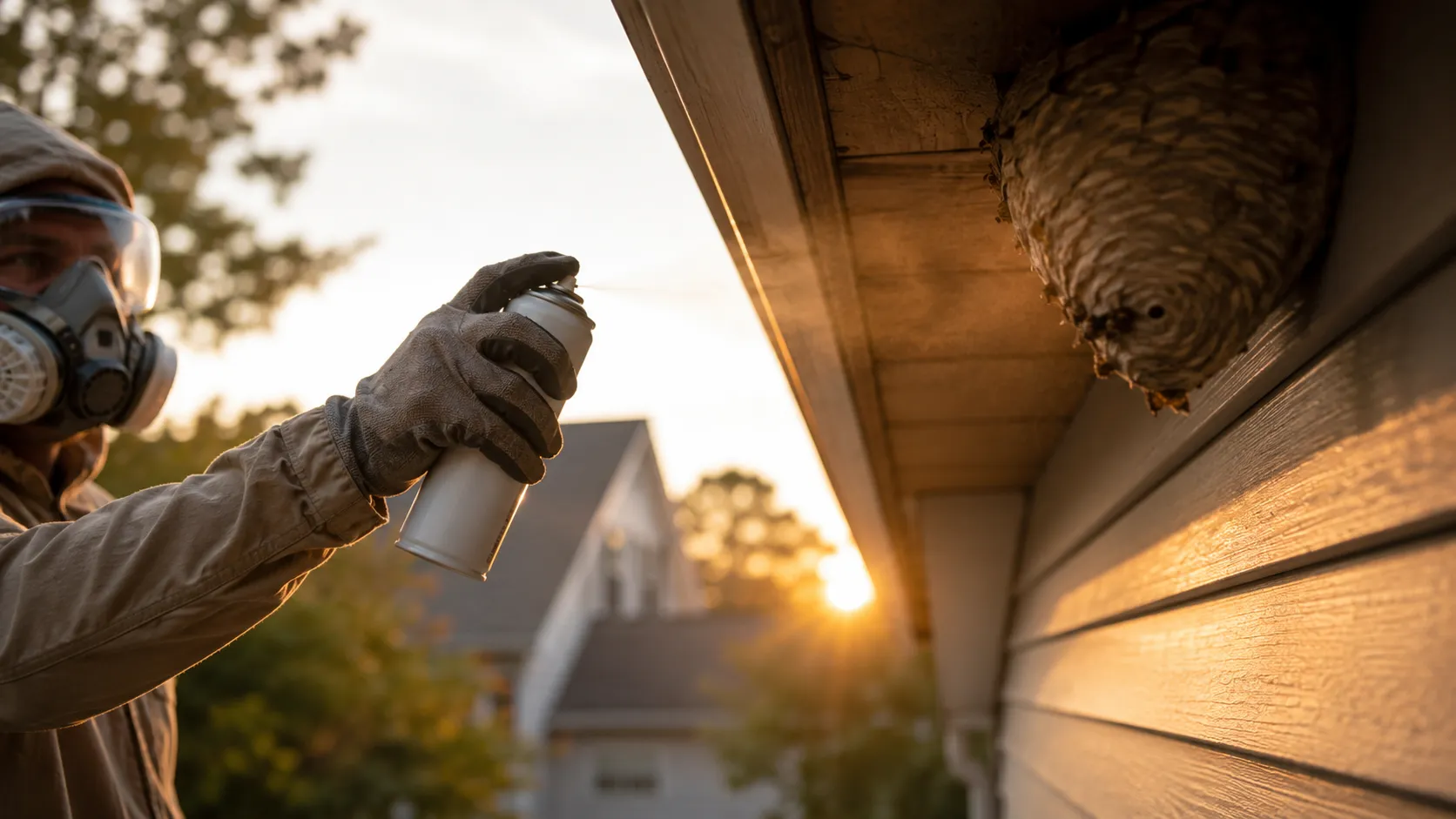
The first time I pulled a can of wasp killer from the hardware shelf without reading the label, I sprayed the wasp nest in broad daylight, watched to see what happened, and got stung three times before making my way back inside.. The nest was still there the next morning. I hadn’t used the wrong product I’d used the right product at the wrong time, from the wrong distance, with zero protective clothing and no escape route planned. That’s how most DIY homeowner failures with wasp spray happen. Not because the insecticide doesn’t work, but because technique gets ignored entirely.
The most common means of home pest control is the wasp spray, and rightly so. An effective aerosol spray should be able to shoot up to 20 to 27 feet, kill on contact within 5 to 15 seconds, and offer residual effectiveness for up to 4 weeks. But none of that matters if you’re standing downwind at midday with no idea where the nest entrance actually sits.
Here’s the complete scenario the kinds of wasp killers there are, the compounds responsible for killing the wasps, the method of application that will make the difference between effectiveness rates of 90 percent versus 50 percent, the safety precautions that deserve consideration, and the instances where it makes sense to bring in the pros.
Why the Type of Wasp Spray You Choose Matters More Than the Brand
Enter any hardware store, and you find yourself facing an array of aerosol spray cans, foam spray products, dust products, and liquid concentrate products. They cannot be interchanged. Each format suits a specific nest type and nest location, and picking the wrong one wastes both money and time.
Aerosol jet spray is what most people reach for first and for exposed nests, it’s the right call. Raid, Spectracide, Hot Shot, and Bonide Wasp and Hornet Aerosol all deliver a directional jet stream reaching between 20 and 27 feet. Spectracide claims 27 feet on the label; real-world use in any breeze puts it closer to 18 to 20 feet. Raid House and Garden adds a non-conductive formula rated to 32,500 volts, which matters when treating nests near an outdoor electric cable box or meter panel. CRC pushes that to a dielectric strength of 47,600 volts a detail nobody thinks about until they’re spraying near live circuits.
Foam spray delivers insecticide in an expanding foam that fills and seals cavities. For nests tucked inside wall voids, enclosed spaces, or gaps around a fascia board, foam stays put rather than dripping away. Wasp X Spray works on this principle the foam traps wasps on contact and blocks the nest entrance simultaneously.
Insecticidal dust and wasp powder suit ground nests and hidden underground nests better than any aerosol. Carbaryl, sold as Sevin, and deltamethrin are common dust active ingredients. The powder sticks to worker wasps as they pass through the nest opening, gets carried inside, and spreads through the entire colony reaching the reproductive core where a jet spray never arrives. Demise Dust goes further: a single treatment can last a year or more, making it the right choice for recurring infestations in the same wall cavity or attic.
Liquid concentrate products like Maxxthor and Prothor gets mixed with water and applied via pump sprayer or hose end sprayer for large-area perimeter treatment and preventive applications. These are economical for covering the full exterior of a property, leave a long residual barrier, and cost far less per square foot than stacking aerosol cans.
Active Ingredients: What’s Actually Killing the Wasps
The Chemistry Behind Fast Knockdown
Any wasp extermination spray that acts swiftly utilizes synthetic pyrethroids, which are artificial versions of the natural pyrethrins found in the flowers of chrysanthemums. The artificial pyrethroids have better chemical stability, greater longevity in an outdoor environment, and increased efficacy against vespid insects compared to their natural counterparts.
The 0.10 percent Cypermethrin has the fastest knockdown. Prallethrin, which is the active ingredient in several Hot Shot formulations, paralyzes the target insect rapidly, and it falls out of the air after seconds of contact. Permethrin is a broad-spectrum pyrethroid with slightly reduced speed but prolonged residual activity, which can be effective for two to four weeks. Tetramethrin is another knockdown insecticide that acts almost immediately after contact with the target wasp. Deltamethrin and Lambda-Cyhalothrin come in both aerosol and dust formulations, although EFSA has identified potential risks in 2026 re-evaluation due to aquatic toxicity and pollinator risk factors.
Mode of action: the chemicals enter the exoskeleton and affect the nervous system of the insect directly. Pyrethroids act on the sodium channel in the membrane of the neurons – proteins through which sodium ions flow and after which they shut down for resetting. By keeping the channels open and allowing too much sodium to flood into the cells, the pyrethroids cause an uncontrollable firing of nerve impulses ending in paralysis and death. Insects’ sodium channels are 100 to 1,000 times more sensitive to pyrethroids than mammalian ones. The same chemical combination which kills a wasp in 5 to 15 seconds causes no damage to the skin of a human.
Piperonyl Butoxide is a useful addition to some insecticides as it is not used to kill the insect directly, but to be a synergist in these formulations. It blocks the enzymes which would decompose the pyrethroid, making the compound ten times more potent.
Those people who don’t want to use synthetic chemicals can choose either the STEM brand products or the EcoSmart brand products that use oils extracted from botanicals as the active ingredient in the natural insecticides.
Where Wasps Build Nests Around Your Home
Identifying Every Hiding Spot Before You Spray
Yellow jackets, bald-faced hornets, paper wasps, and mud daubers don’t pick nesting spots at random. They look for sheltered, protected cavities — and a house offers dozens of them.
Roof eaves and rafters are the most common site for paper wasp nests and bald-faced hornet colonies. The umbrella-shaped nest under an eave is often the first thing homeowners spot. Wall voids, attic spaces, crawl spaces, and gaps around a pipeline or air brick attract yellow jackets — specifically the Vespula genus. Fence posts, deck railings, tree branches, roof overhangs, the soffit between rafters, and even a weep hole in brick mortar all get used depending on the species.
Ground nests are a different situation entirely. Yellow jackets nesting underground don’t dig their own tunnels they take over burrows abandoned by rodents like chipmunks. Vibrations from lawn care equipment agitate them badly. Many people discover a ground nest while mowing, which is one of the less pleasant outcomes of skipping a property inspection before starting yard work.
The nest inside a wall cavity or attic is the hardest case. Wasp spray is rarely effective against these because the colony sits some distance from the entrance and a jet spray never reaches the core. A non-repellent liquid concentrate applied to the nest opening works better wasps don’t detect it, walk through it, and carry it inside. Products like Alpine and Prothor work on this principle. They take 4 to 6 days rather than minutes, but they actually reach the reproductive wasps. For large attic nests with difficult access, a professional pest control company is the realistic call.
How to Use Wasp Spray Correctly
Timing, Technique, and the Exit Plan That Saves You
Timing is the decision that separates a 90 percent single-treatment success rate from the 50 percent rate most homeowners see. Spray at dusk or 30 minutes after sunset. At that point, most worker wasps are back on the nest, the colony sits at full population for a single-hit elimination, and cooler temperatures make flying insects slower and far less likely to pursue. Dawn also works. Midday, when social wasps are most active and aggressive, is the worst window. I’ve compared these timing outcomes over several summers, and the difference is not subtle.
Before anything else: protective clothing. Long sleeves, long pants, closed-toe shoes at minimum. A beekeeper hat and beekeeper veil for large colonies or anything near a bald-faced hornet nest these sting multiple times and defend aggressively. A full beekeeping suit for upper torso coverage when working on a telescoping ladder.
Stand upwind. Plan your escape route before you start clear the path of any lawn tools, furniture, or anything you might trip over. Use amber light instead of a standard flashlight; white light alerts the colony. Position yourself at the maximum standoff distance the spray can reach. Direct a steady jet stream at the nest entrance not the whole surface for 10 to 15 seconds. Then leave the area immediately. Don’t stand watching. Don’t check results until the following evening. If activity continues, repeat the treatment.
For nests under second-story eaves or high roof overhangs, the Gotcha pole adapter clamps to a standard aerosol can and lets you spray from the end of an extension pole no ladder required to get coverage on the nest entrance.
For a ground nest: pour a full can into the nest opening at night. Cover the entrance immediately with a bucket or shovel of dirt. Don’t stand directly over the hole while spraying. Check the next evening and apply a second treatment if wasps are still active.
One thing labels don’t mention: foam and petroleum-based formulas can stain painted wood, vinyl siding, and asphalt shingles if left to dry. Rinse the surface within an hour. And plan for wasp spray reapplication after heavy rain sunlight and moisture both accelerate pyrethroid breakdown outdoors, shortening the residual window below the stated 2 to 4 weeks.
Safety, Pets, Fish, and Disposal
What the Label Tells You and What It Doesn’t
The outdoor use only designation on wasp killer spray is not just a legal disclaimer it reflects a real hazard. The aerosol concentration effective enough to kill flying insects fast is the same concentration that causes respiratory irritation, inhalation risk, and skin contact issues in enclosed spaces. If a single wasp gets inside, use a flyswatter. If you find a colony inside a wall from interior access, call a professional pest removal company.
Keep pets away from the sprayed area until the spray dries off, usually within one to two hours for synthetic pyrethroids aerosols. Wasps spray is highly poisonous for fishes and all other aquatic species. Make sure you avoid spraying around any kind of garden pond, stream, or even a water feature. EFSA’s reassessment of lambda-cyhalothrin and deltamethrin in 2026 clearly states that aquatic toxicity and its effect on honey bees were the main issues that caused the need for reassessment.
In case your eyes or mouth gets contaminated with the spray: immediately call Poison Control at 800-222-1222. Take the spray can along with you. Inhaling permethrin spray causes respiratory distress even though the insect-selective chemistry makes it far less dangerous than it sounds volume and concentration in confined spaces still matter.
For disposal:
Empty cans get rinsed and recycled. Partially full cans are classified as hazardous waste and must go to designated facilities, not regular trash.
Know your limits. Anyone with a known insect sting allergy, a history of allergic reaction or anaphylaxis, or family members at elevated risk should not DIY an active wasp colony removal. The American College of Allergy, Asthma, and Immunology puts average insect sting deaths in the US at 72 per year. Aggressive species bald-faced hornets, Dolichovespula maculata, defensive Vespula colonies don’t offer much warning before a full defensive swarm.
When Wasp Spray Isn’t Enough
Recognizing the Jobs That Need a Professional
Wasp spray handles exposed paper wasp nests, accessible hornet nests within spray range, and ground nests where you can safely reach the nest opening. It does not handle a colony established deep inside structural walls, a nest in an attic that’s been expanding for multiple seasons, or any situation requiring building material removal to reach the colony.
Wasps chew wood. A large colony in a wall void causes wood damage, ceiling damage, and sheetrock damage that starts as a pest infestation and ends as a repair bill. The structural damage that results from a colony left inside a home’s framing isn’t dramatic until it suddenly is. Yellow jackets nesting inside a wall for twenty or more years building up layer upon layer of nest material represent a scale no consumer aerosol can address, and the colony lifecycle simply restarts each spring if the original entry point stays open.
After any successful elimination — DIY or professional — preventive treatment determines whether the problem returns. Sealing entry points, removing food sources, filling rodent burrows that yellow jackets repurpose as ground nests, placing yellowjacket traps and decoy nests near entryways, and scheduling a property inspection each early spring before nest construction begins: these are the steps that break the seasonal cycle. A wasp colony that never establishes doesn’t need a spray to address it.
Conclusion
Wasps will surely die because of wasp spray; however, timing, approach, and appropriate wasp killer will decide if the situation gets better or worse, as the spray may infuriate the wasps even more.
The right time to use spray is after dusk; the right location is upwind from the nest; wear protective gear; direct the spray towards the nest opening, and get away immediately.
For exposed nests, use aerosol jet spray; for enclosed areas, foam spray; and for ground nests and wall voids, insecticidal dust and wasp powder.
Familiarize yourself with the ingredients: cypermethrin, prallethrin, permethrin, and piperonyl butoxide and the ways they kill the wasps. Also, be careful when using the sprays indoors, with pets, fish, and hazardous waste disposal.
FAQs
Wasp spray is an insecticide designed to kill or disable wasps through direct contact or residual treatment. Many products use synthetic pyrethroids that disrupt the insect’s nervous system, causing rapid paralysis and death.
It depends on where the nest is located. Aerosol sprays work best for exposed nests, foam is more suitable for enclosed gaps and cavities, while insecticidal dust is often better for ground nests and harder-to-reach colonies.
Dusk or shortly after sunset is generally the best time because most worker wasps have returned to the nest and are less active in cooler temperatures. Avoid spraying during midday when wasps are more active and more likely to defend the colony.