
There’s a house three streets from where I grew up big lot, decent bones, but the owners repainted the siding every couple of years chasing something they couldn’t name. Cream one year, warm beige the next, then a sandy neutral that lasted about eighteen months before it felt wrong again. The color wasn’t the problem. It was never the color. The facade had no logic underneath it, no architectural harmony holding the choices together, and no amount of paint was going to fix that. I think about that house every time a client asks me where to start with exterior renovation.
The drhomey exterior design approach starts from a different place than most homeowners do. Most renovation advice leads with curb appeal as the target. This approach doesn’t. The exterior gets treated as something that has to hold together as a whole and the warmth people feel when they pull up to a well-designed house isn’t an accident. Someone made specific decisions to create it.
Architectural Style Isn’t a Label, It’s a Decision That Controls Everything Else
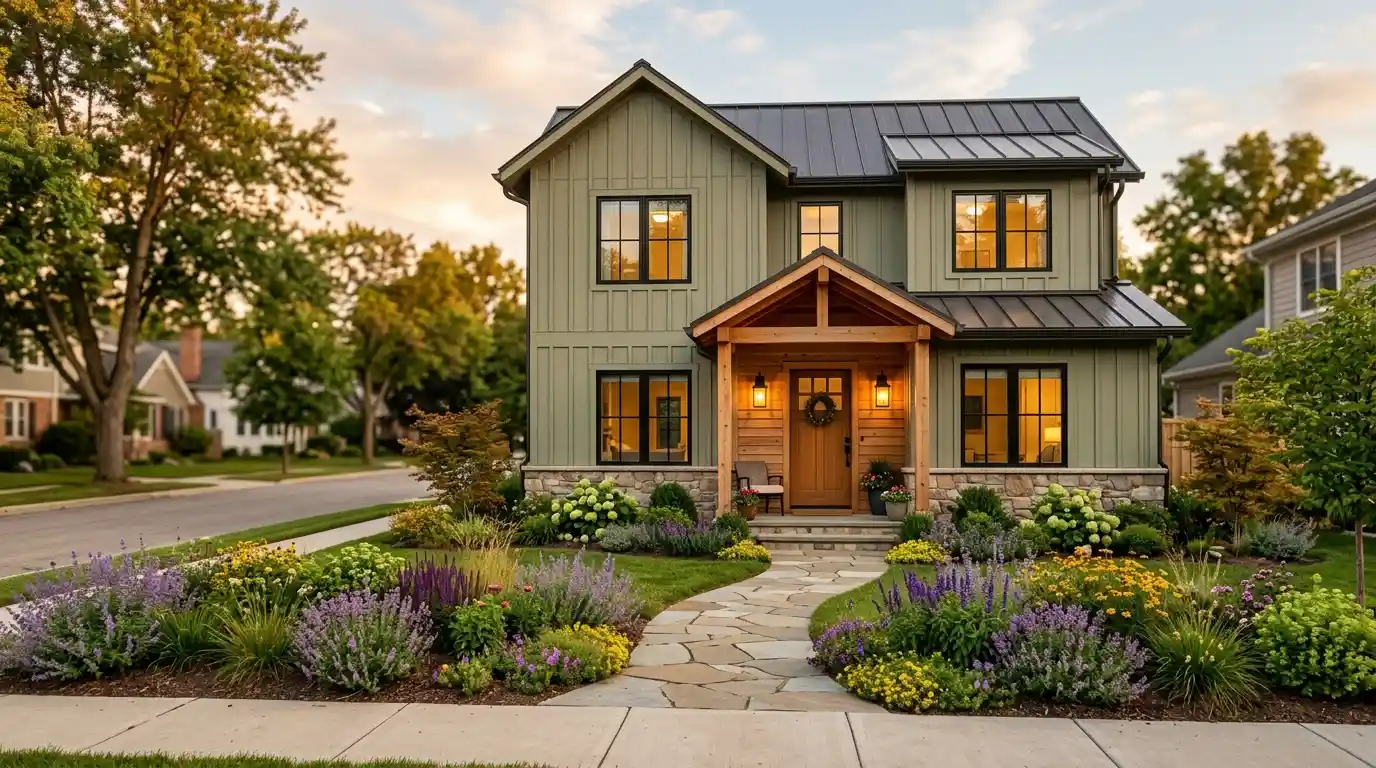
Most people skip this part. They go straight to color swatches or new siding samples and then wonder why nothing feels cohesive. Architectural style is the framework that every other exterior decision either supports or fights against. Take a modern farmhouse. Board-and-batten siding, metal roofing, natural wood accents around the entry those three things share a logic. They belong to the same visual family. Add something that doesn’t belong to that family ornate cornices, projecting volumes that come from a different style entirely and the whole front elevation starts arguing with itself.
This is one of the things drhomey exterior design handles better than generic renovation advice it asks you to understand what your building’s architectural style actually demands before you spend anything. Whether the roofline is gabled, sloped, hip, or flat matters before the color palette conversation. Whether you’re working with a traditional home or a contemporary architecture matters before the material selection conversation. Getting that sequence backwards is expensive.
Materials Are Where Most Exterior Projects Quietly Fall Apart
I’ve watched homeowners pick beautiful individual materials that had no business being on the same house together. Limewashed brick on the lower half, fiber cement boards above, white stucco on the gable end each element fine on its own, collectively incoherent. Mixed materials absolutely work in exterior design.
They just need a logic stone accents grounding the base, board-and-batten siding above, natural wood accents framing the entryway, sleek metal roofing as the cap. Texture contrast and a consistent material palette tie them together. Matching finishes don’t. If siding is part of your material plan, it’s worth understanding the full vinyl siding cost picture before committing the estimate almost always misses at least a few line items that change the total significantly
Sustainable materials and eco-friendly materials have moved into this conversation in a real way. Cork, bamboo, reclaimed materials, permeable paving not just environmental responsibility talking points but genuinely good material choices because they age organically rather than looking tired. Unpainted brick ages well. Natural stone ages well. Fiber cement, tilt-up concrete, limewash all of them earn their place on a facade when the climate and the architectural style support them. Low-maintenance material in a high-weather region beats a beautiful one that needs replacing in six years every single time.
Color Works on Emotion Before It Works on Aesthetics
Here’s something I didn’t fully understand early in my career: exterior color does emotional work before it does visual work. The reason earthy neutrals warm taupe, warm beige, buttery beige, clay, sand have taken over from cool grays isn’t purely aesthetic preference. Cool grays became a default for so long that people stopped noticing they’d stopped feeling anything about them. Sage green does something different. So does olive, forest green, deep navy, umber colors that read as natural rather than chosen-from-a-catalog.
You come around the corner and the house just sits there looking like it belongs. That’s what nature-inspired color actually does at street level and it’s harder to achieve with a neutral gray than people expect. Real estate professionals consistently put curb appeal’s impact on perceived home value at around 7 percent, and a lot of that is color doing its quiet work.
Color drenching as an exterior approach is worth taking seriously. A charcoal gray or matte black body on a contemporary architecture, a rich magenta or blackberry-purple on a Victorian, a bold dark teal or deep blue on a transitional design these aren’t risky. They’re personal expression, which is exactly what drhomey exterior design leans into over safe, neighborhood-neutral two-tone combinations.
One thing worth knowing before going dark on a body color heat absorption on a south or west facing facade is real and darker paints fade faster than the lighter ones they replaced. Low-VOC, exterior-grade paint with UV resistance isn’t optional here, it’s just the right product for the job. Trim is a separate conversation. Semi-gloss or satin on doors and window frames catches light in a way that flat finish can’t, and warm white or creamy white trim against a deep body gives the facade a contrast that reads as considered rather than accidental.
What Exterior Lighting Actually Does That Most People Underestimate
A beautiful facade can completely disappear at night. On one project a house I was genuinely pleased with during the day a neighbor mentioned it looked abandoned after nine at night. She wasn’t wrong. The lighting had been an afterthought, which meant it wasn’t really a plan at all. A few well-placed things fix this completely. LED strips tucked under the roofline or along wall edges don’t shout at you, they just make the architecture visible after dark. Walkway lighting does the same thing at ground level.
The house suddenly has a second version of itself that only exists after sunset, and that version matters more to resale perception than most people account for. Oversized pendant lights or sculptural sconces at the entryway become decorative focal points, not just functional fixtures. Wall sconces beside the front door and around the garage, driveway lighting along the pathway, solar-powered accent lighting near the retaining wall these are layered ambient lighting decisions that compound on each other.
Smart lighting systems with automated controls, motion sensor lighting, and wireless solutions that retrofit to existing structures have made this accessible even on homes that weren’t designed for it originally. Smart home exterior technology automated driveway lighting, smart lock on the front door, weatherproof touchscreens near the outdoor kitchen or pool area, outdoor speakers discreetly integrated into the landscaping is no longer a luxury category. It’s what buyers in most markets now expect.
Landscaping Is Half the Exterior Design, Not the Part You Do After Everything Else
Professional landscaping gets cut from budgets constantly. This is almost always a mistake. The visual relationship between a well-maintained lawn, colorful flower beds, strategically placed trees and shrubs, and the facade behind them is layering and layering is what drhomey exterior design is fundamentally about. Native plants and xeriscaping get dismissed as low-effort options but they genuinely aren’t the visual depth they create is the same as a high-maintenance garden bed, just with a fraction of the water bill.
Ground cover along the pathway does something subtle that people only notice when it’s missing: it softens the edge between hard paving and planted area so the transition feels natural rather than abrupt. Vertical garden panels along a compound wall or boundary wall are worth considering if privacy is the goal they screen without closing the property off entirely, which a solid wall always does.
Sustainable landscape design rainwater harvesting, permeable paving, native plant landscaping works both practically and visually. Mulch beds between colorful flower beds and shrubs keep the ground-level design clean. Small things compound. A retaining wall with the house number built into it instead of screwed to the front door that’s the kind of detail that makes a visitor feel like someone thought carefully about this place. It costs almost nothing and lands differently than everything around it.
Outdoor Living Space Is Table Stakes Now
Working from home really working, not occasionally changed something permanent about how people relate to their property. The outside of the house stopped being the part you tidied up before guests arrived and became the part you actually live in on a Tuesday afternoon. Covered patio, fire pit, pergola, wooden pergola, outdoor kitchen, comfortable seating, alfresco entertaining area these aren’t additions anymore. They’re the extension of how people live, pushed outside. Large glass panels and sliding doors do more than look good they change how the inside of the house functions on days when the weather cooperates, which in most climates is more days than people count. Retractable or pocket walls take that further.
A flat roof that becomes a rooftop lounge or rooftop garden stops being dead structure and starts being square footage you actually use. Glass railings keep the view. A glass balcony wrapping around an upper floor gives the whole elevation a quality that no paint color or cladding choice can replicate it reads as considered architecture, not renovation.
Built-in stone or wood seating near a front yard fire pit is one of those additions that changes how people actually use a space. The entryway stops being a place you walk through and becomes somewhere people end up staying. It doesn’t look designed-for-a-photoshoot the way some outdoor furniture arrangements do it just looks like someone lives there and likes it.
The Part That Actually Ends the Debate
The financial case is the argument that usually ends the “is this worth doing” conversation. Long-term value from a well-executed exterior renovation architectural harmony, mixed textures, strategic lighting, layered landscaping, cohesive color contrast, sustainable materials is documented and measurable. Solar panels on a green roof or standard pitched roof pull double duty: energy efficiency and a forward-looking roofline detail. A smart garage door, a bold front door color on a freshly painted facade, new energy-efficient windows with window frames that match the trim none of these are enormous investments individually.
The sequence is the whole thing, really. Architectural style first, then materials, then color, then lighting, then landscaping each layer either reinforcing what came before it or fighting it. Get the sequence right and the decisions downstream become easier, not harder.
An exterior that photographs well on completion day is one thing. One that still looks like it was meant to be there a decade later is something else entirely, and that difference almost always comes down to whether the logic was built in from the start or invented as things went along. That’s what drhomey exterior design is really about not a style but a way of thinking about the outside of a home that makes every individual decision easier because the framework underneath it is solid.
Style Rules, Siding Choices, and the Detail Layer
Each architectural style has its own logic. Modern exteriors rely on clean lines, geometric forms, and flat or low-pitched roofs. Craftsman homes lean on covered porches, exposed brackets, and tapered columns, while a colonial wants symmetry, a centered front door, multi-pane windows, and a restrained palette rather than competing mixed cladding. The common mistakes are shutters that don’t match window proportions, board-and-batten added to a bungalow, or a flat roof grafted onto a Victorian, none of which stone veneer or trim can recover. As a rule, two to three materials used intentionally outperform five used enthusiastically.
On materials, fiber cement (such as James Hardie) is the volume leader, engineered wood like LP SmartSide lasts roughly 15 to 50 years, and vinyl runs about 20 to 40 years at a lower price but can warp with heat. Brick and stone cost more but need almost no maintenance. Metal standing-seam roofing lasts 40 to 70 years and suits modern and modern-farmhouse styles, while architectural shingles read better than three-tab against traditional designs. Manufactured stone veneer on just the lower third of the facade or around the entry is one of the most cost-effective ways to add visual weight.
Details finish the job. Apply the 60-30-10 rule to color: roughly 60% body color, 30% trim and secondary material, and 10% front door and accents. Avoid tone-on-tone schemes where body and trim are so close that architectural details disappear. Period trim such as dentil molding, corbels, brackets, and gable pediments belongs only on the styles that use it, and door hardware, house numbers, and a good entry light fixture are the details closest to eye level. In northern climates, plan on repainting every 7 to 10 years, stretching that interval with regular cleaning and caulking.
Which Exterior Upgrades Pay Back the Most
Returns vary by source, year, and market, but the pattern is consistent. Garage door replacement and entry door updates rank among the highest-return exterior projects (published figures for garage doors range from roughly 194% to 268%), manufactured stone veneer accents typically return at least 90%, and siding replacement generally recovers about 70% to 85% of its cost. Even basic landscaping, such as mulch, pruned hedges, planted beds, and seasonal flowers, often costs $500 to $3,000 and can add roughly 5% to 12% in buyer-perceived value. A bold front door color against a neutral facade remains the cheapest high-impact move. High-performance windows won’t match those percentages on resale, but they pay back in comfort and energy savings.
Budgeting an Exterior Project in Phases
Put weatherproofing before appearance. Phase the work as inspection first, then emergency repairs, then primary upgrades (roofing, siding, windows), and finally finishing touches like color, lighting, and landscaping. Collect three separate contractor bids and hold a contingency of roughly 10 to 20 percent, since problems like rotted sheathing behind old siding tend to surface only once work is underway. A warm-neutral palette is also forgiving for phased projects, because mistakes stand out less than in high-contrast black-and-white schemes.
Conclusion
Drhomey exterior design isn’t really about following trends it’s about making decisions in the right order and letting each one earn its place. The houses that hold up visually over time aren’t the ones that spent the most. They’re the ones where the architectural style, materials, color, lighting, and landscaping were all pulling in the same direction from the start. Get that sequence right and the exterior takes care of itself. Get it wrong and no amount of repainting fixes it trust me, I’ve seen that house.
Related reading: what exterior designers do, choosing a siding contractor and Tyvek house wrap.
FAQs
DrHomey exterior design focuses on creating a complete and balanced home exterior by connecting architectural style, materials, colors, lighting, and landscaping. Instead of treating curb appeal as a single upgrade, it follows a structured approach where every design choice supports the overall look of the property.
The best starting point is understanding your home’s architectural style before selecting paint, siding, or other materials. Choosing the right sequence of decisions helps create a cohesive exterior instead of making separate upgrades that do not work together.
The best exterior materials depend on the home’s style, climate, and maintenance needs. Options like natural stone, fiber cement, reclaimed materials, brick, and sustainable materials can create durability while adding texture and character when used with a consistent design plan.
Garage door replacement, entry door updates, stone veneer accents, and basic landscaping are consistently among the strongest performers, while siding replacement typically recovers about 70% to 85% of its cost. Exact returns vary by market and year.
Phase the work (inspection, emergency repairs, primary upgrades, finishing touches), put weatherproofing before appearance, get three contractor bids, and keep a 10 to 20 percent contingency.
No. Drhomey.com is a home-improvement content site with written guides, not a downloadable app or photo-upload rendering tool. If you’ve seen an AI visualization product linked to the DrHomey name elsewhere, verify on that product’s own website, since it is a separate offering.

1 thought on “Drhomey Exterior Design: What Actually Makes It Work”