
Most home advice online is either too generic to actually use or written for someone with unlimited time and a fully stocked tool shed. Dr Homey handy tips take a different approach here. Specific routines, real numbers, stuff. You can actually finish this weekend instead of adding to a list you never get to. This piece covers cleaning systems that stick. Organization methods that don’t collapse after two weeks, safety checks every homeowner should run monthly. And a color rule that takes the guesswork out of picking paint. You’ll walk away with steps you can start today. Not just a mood board’s worth of inspiration.
Why Most Home Organization Systems Fail Within A Month:
Most storage systems fail for a boring reason. They’re built around categories instead of actual behavior. “Cups” cabinet may seem organized on paper, but if your coffee cups are stored three feet away from the coffee machine and the filters are stored somewhere else entirely, then you’re creating unnecessary friction in a process that takes place every single day. Effective organization aligns with use not appearance.
Why Does My House Get Cluttered Again Right After I Clean It?
Clutter comes back fast because most cleanups don’t fix the actual storage problem, they just reset the surface. If every item doesn’t have one fixed home, it drifts back to wherever’s convenient in the moment, usually the counter or the floor. The one-in one-out rule helps here too. Bring something new into the house, something else leaves. Otherwise storage capacity just keeps shrinking while your stuff keeps growing.
What’s The Fastest Way To Declutter One Room?
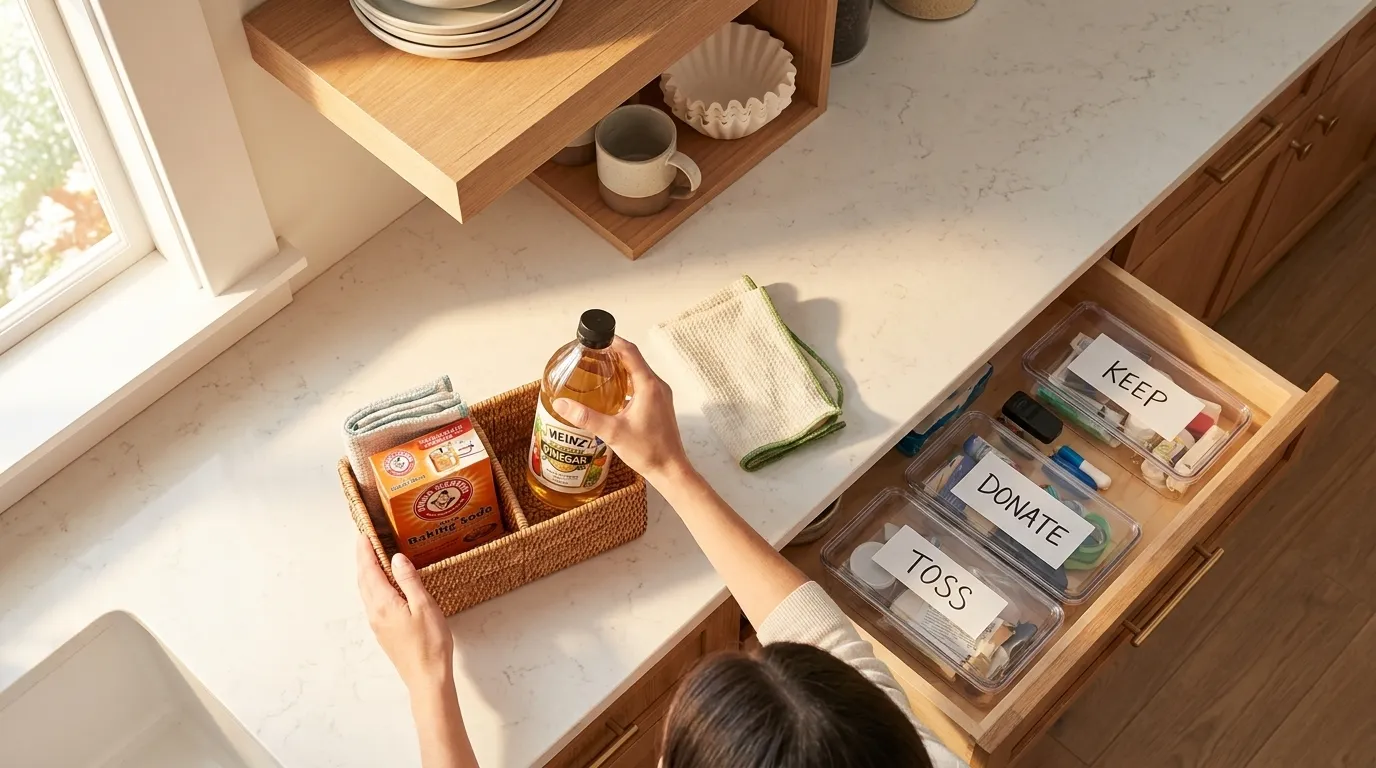
Separate everything into three categories. Keep, give away, and trash. Tackle the task room by room or. If one whole room seems too much. Tackle it drawer by drawer. Fifteen minutes on a timer means this doesn’t stretch out into a daylong task, and in truth it’s the timer that ensures you actually complete the job rather than giving up halfway through. This technique was applied to an entire junk drawer that was hopeless for maybe two years. Eleven minutes.
Cleaning Habits That Actually Save Time:
Cleaning advice usually focuses on products. Products matter less than most people think. Timing and habit matter more. A five-minute daily reset prevents the two-hour deep clean that builds up when nothing gets touched for a week.
Does “Clean As You Go” Actually Work In A Busy Kitchen?
Absolutely, and it is one of the most effective practices to perform from the entire list here. Clean countertops when there is something cooking, put dishes in the dishwasher in-between rather than piling them up in the sink, and the kitchen will stay fully operable even in a hectic evening of the week. We are not talking about cleanliness here we are talking about never getting the situation where cleanup seems like a project.
What Cleaning Products Are Actually Worth Keeping On Hand?
Baking soda, vinegar. And a general all-purpose cleaner will do for almost every kind of household cleaning job you might need. Vinegar will take care of grease and any mineral deposits. Baking soda will get rid of odors and also scrub without damaging any surfaces. Using reusable cloths rather than paper towels is more efficient and actually gets better results when cleaning glass. You don’t need to have 15 different spray cleaners sitting by the sink.
Home Safety Checks Every Homeowner Should Run:
Safety maintenance gets skipped. Because none of it feels urgent until it suddenly is. Two checks matter more than the rest. And both take under five minutes combined.
How Often Should I Test My Smoke Detectors?
Monthly, using the test button, is the realistic minimum for smoke and carbon monoxide detectors. Battery-powered units typically need a battery swap once a year regardless of whether the test passes, since batteries degrade even in units that technically still work. This is one of those Dr Homey handy tips that sounds obvious but gets skipped constantly, mostly because nobody schedules it.
Do I Know Where My Water Shutoff And Breaker Panel Actually Are?
If you can’t answer that in under ten seconds. That’s worth fixing today. A burst pipe or an electrical fault. Doesn’t wait for you to go find the manual. Knowing the exact location of your water shutoff valve and circuit breaker panel before an emergency happens is the. Difference between a five-minute fix and standing water on your kitchen floor. Walk through your home once, physically locate both. And you’re done. Takes less time than reading this paragraph.
Budget-Friendly Home Improvements That Actually Move The Needle
Not every upgrade needs a contractor. Or a weekend of demolition. Some of the highest-impact changes cost nothing. But time and a bit of planning.
What’s The Cheapest Way To Make A Room Look Better Instantly?
Rearranging furniture around your room’s natural light source, at zero cost, often does more than a $200 decor purchase. Most people default to pushing furniture against walls out of habit, but pulling a seating area toward a window changes how the whole room reads without spending a dollar. Combine that with clearing visual clutter off surfaces and a room can look meaningfully different in under an hour.
How Do I Actually Choose Paint Colors Without Overthinking It?
60-30-10 rule of color takes out all the uncertainty. 60% of your dominant color, 30% of your secondary color. 10% of your accent color. This is a ratio that often gets mentioned in interior design tips to make sure. That the room does not get overwhelming and looks balanced instead. Without this ratio your rooms will end up looking either like a single color block or a random combination of five colors.
Repair Versus Replace: Making The Right Call
Not every broken or worn item needs replacing. And not every repair is worth the time it takes. Knowing where that. Line sits saves both money and unnecessary hassle.
When Should I Repair Something Instead Of Replacing It?
It makes sense to repair. If the cost of the repair is less than approximately one-third the cost of replacement and the asset is likely to have remaining useful life in it. Repairing a $15 component in a $200 device is easy decision-making. If a repair estimate is close to a replacement price, then it may not be economical, particularly where the asset is near its useful life expectancy.
When Does A DIY Job Actually Need A Professional?
The moment a task involves gas lines, main electrical panels. Or structural changes to a wall. That’s when a licensed electrician or plumber should take over. Dr Homey handy tips generally favor DIY confidence, but confidence without the right training on high-risk systems isn’t confidence, it’s just risk. Minor household repairs, a stuck drawer, a wobbly shelf, a running toilet, are genuinely fine to handle yourself.
Dr Homey Handy Tips Conclusion:
What ties it all together is small and steady action trumping bigger but sporadic actions. The five minutes each day that you clean the kitchen wins out over the massive cleaning efforts you undertake once a month. Testing the smoke detector each month wins over relying on luck that everything will turn out alright. Dr. Homey tricks succeed because they’re based on real habits that are able to sustain themselves during a hectic week, not some ideal habits that crumble at the first obstacle.
FAQs
Start with locating your water shutoff and breaker panel, testing smoke detectors monthly, and setting up one fixed home for frequently used items. These three habits prevent the most common and costly early homeowner mistakes.
Use existing materials and concentrate more on placing things rather than buying new things. Put stuff nearer to where you use them, for example, putting filters near the coffee maker, and implement the principle of “one in, one out.”
In general, repairs are worthwhile if the cost of repair is less than roughly one-third of the replacement cost. Anything near replacement cost or nearing the end of its normal life is not worth repairing.